
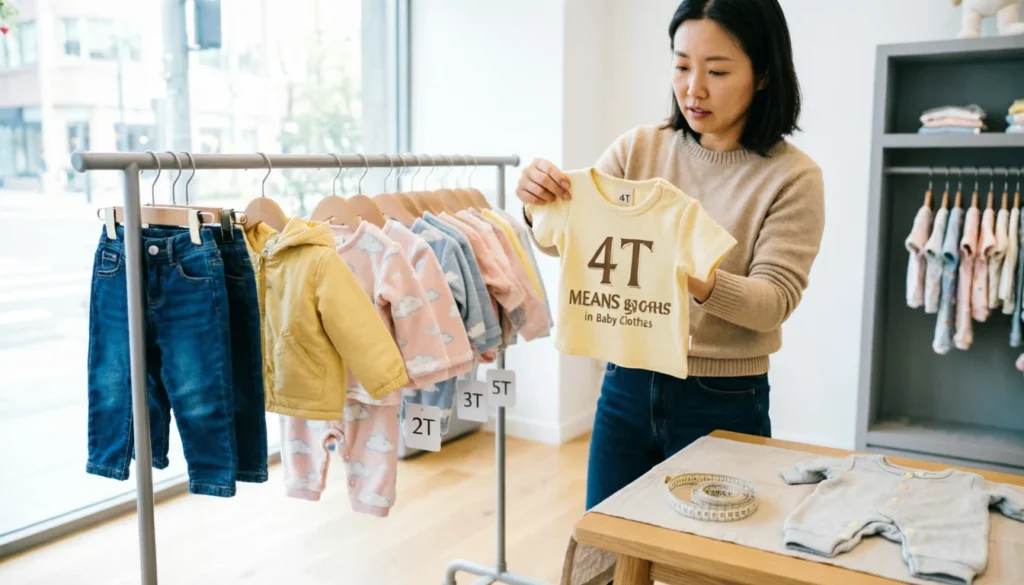
4T in baby clothes means “four toddler,” a clothing size designed for toddlers around four years old. It is typically made for children who are about 38 to 41 inches tall and weigh around 34 to 39 pounds. The “T” stands for toddler, indicating the clothing is specifically designed for toddlers who are still wearing diapers or training pants.
Shopping for baby or toddler clothes can feel confusing, especially when you see labels like 2T, 3T, or 4T. Many parents pause and wonder what these numbers and letters actually mean. Is 4T for a four year old? Is it the same as size 4? And how do you know if it will fit your child comfortably?
Understanding clothing sizes for toddlers is important because kids grow quickly, and choosing the right size makes a big difference in comfort and mobility. If you have ever stood in a store aisle or browsed an online shop trying to figure out toddler sizing, you are not alone.
In this detailed guide, we will explain exactly what 4T means in baby clothes, how it compares with other sizes, when children usually wear it, and how to choose the best fit. By the end of this article, you will feel much more confident shopping for toddler clothing.
Understanding Toddler Clothing Sizes
Children’s clothing sizes often follow age based labels. However, these labels are only general guidelines rather than strict rules.
Toddler sizes are usually written with the letter T after the number. Examples include:
- 2T
- 3T
- 4T
- 5T
The number usually refers to the child’s approximate age, while the T stands for toddler.
These sizes are specially designed for younger children who still have toddler proportions. Toddler clothes often include extra room around the diaper area and slightly different fits compared to standard kids clothing.
What Does the “T” Stand For in 4T?
The letter T stands for toddler.
This means the clothing is designed for toddlers who are typically between two and four years old. Toddler clothing differs slightly from regular kids clothing in several ways.
Key features of toddler clothing include:
- Extra room for diapers or pull ups
- Shorter sleeves and pant legs relative to body size
- Softer fabrics designed for comfort and movement
- Simple fasteners like snaps or elastic waistbands
So when you see 4T on a clothing tag, it means the garment is tailored specifically for toddler body proportions.
Typical Measurements for 4T Clothing
Although exact measurements vary by brand, most clothing companies follow similar guidelines.
Common Size Measurements for 4T
| Measurement | Typical Range |
|---|---|
| Age Range | Around 3 to 4 years |
| Height | 38 to 41 inches |
| Weight | 34 to 39 pounds |
| Chest | 21 to 22 inches |
| Waist | 21 to 22 inches |
These measurements help manufacturers create clothes that fit most toddlers within this range.
However, every child grows differently. Some children may wear 4T earlier or later depending on their size.
Difference Between 4T and Size 4
A common source of confusion for parents is the difference between 4T and size 4.
Even though the numbers look similar, these sizes are not exactly the same.
4T vs Size 4 Comparison
| Feature | 4T | Size 4 |
|---|---|---|
| Target Age | Toddler around 3 to 4 | Young child around 4 to 5 |
| Diaper Room | Extra space for diapers | Less room |
| Fit | Slightly shorter and wider | Taller and slimmer |
| Clothing Style | Toddler focused designs | More child like styles |
In simple terms, 4T is designed for toddlers, while size 4 is designed for kids who have mostly outgrown toddler clothing.
When Do Kids Usually Wear 4T?
Most children begin wearing 4T clothing somewhere between the ages of three and four.
However, growth patterns vary widely. Some children may fit into 4T earlier if they grow quickly, while others may still wear 3T at four years old.
Here are some signs your child might be ready for 4T:
- Their 3T clothing feels tight
- Pants look too short
- Sleeves ride up when arms move
- Shirts feel snug around the chest or belly
Parents often notice these changes during seasonal wardrobe updates.
Real Life Usage of the Term “4T”
Unlike slang terms, the phrase 4T is mainly used in shopping, parenting discussions, and clothing descriptions.
You might see or hear it in everyday situations like these.
Example Situations
| Situation | Example Sentence |
|---|---|
| Shopping in store | “My daughter just moved up to 4T clothes.” |
| Online shopping | “This jacket comes in sizes 2T through 5T.” |
| Parenting discussion | “My son is almost four and still wearing 3T.” |
| Gift shopping | “Should I buy 4T or size 4 for this outfit?” |
These examples show how parents commonly use the term when talking about clothing sizes.
Why Toddler Sizes Exist
You might wonder why toddler sizes like 4T exist instead of simply using regular clothing sizes.
The answer is that toddlers have different body shapes compared to older children.
Toddler body characteristics often include:
- Rounder bellies
- Shorter limbs
- Wider waist relative to height
- Diaper or training pants
Because of these differences, clothing companies design special sizes that fit toddlers better.
How to Choose the Right 4T Clothes
Picking the right toddler clothing size involves more than just looking at age labels.
Here are some helpful tips for choosing the best 4T clothes.
Measure Your Child
Use a measuring tape to check:
- Height
- Chest
- Waist
Compare these numbers with the brand’s size chart.
Check Brand Differences
Not all brands size their clothing exactly the same. Some brands run larger while others run smaller.
Think About Growth
Toddlers grow quickly, so some parents choose slightly larger sizes to extend wear time.
Consider Seasonal Clothing
If you are buying winter coats or thick sweaters, a slightly larger size can allow room for layers.
Example Toddler Size Progression
Most children move through toddler sizes gradually.
Typical Toddler Clothing Progression
| Size | Approximate Age | Notes |
|---|---|---|
| 2T | Around 2 years | First main toddler size |
| 3T | Around 3 years | More room for growth |
| 4T | Around 4 years | Larger toddler fit |
| 5T | Around 5 years | Last toddler size |
After 5T, many children transition into standard kids clothing sizes.
Why Some Children Skip 4T
Not every child follows the typical sizing path.
Some children skip certain sizes completely.
Reasons may include:
- Fast growth spurts
- Brand size differences
- Unique body proportions
- Parents buying larger sizes early
For example, a tall child might move directly from 3T to size 4 or 5.
Alternate Meanings of “4T”
In most situations, 4T refers to toddler clothing. However, the abbreviation may appear in other contexts as well.
Possible alternate meanings include:
| Context | Meaning |
|---|---|
| Clothing | Four toddler size |
| Engine type | Four stroke engine (sometimes written as 4T) |
| Gaming or shorthand | Occasionally used as an abbreviation |
Despite these alternatives, the clothing meaning is by far the most common.
Polite and Professional Alternatives When Describing Size
If you are discussing clothing sizes in a professional setting such as retail or customer service, you might use clearer descriptions.
Examples include:
- Toddler size four
- Size 4 toddler clothing
- Clothing designed for four year olds
These alternatives help avoid confusion, especially when communicating with customers or parents unfamiliar with sizing labels.
Tips for Buying 4T Clothes Online
Shopping online can make sizing a bit tricky. Here are some helpful strategies.
Check the Size Chart
Always review the brand’s size chart rather than relying solely on the label.
Read Customer Reviews
Other parents often mention whether a product runs small, large, or true to size.
Look at Fabric Stretch
Materials with stretch may fit longer as your child grows.
Consider Return Policies
Buying from stores with easy returns can make sizing mistakes less stressful.
FAQs
What age is 4T meant for?
4T clothing is usually designed for toddlers around three to four years old. However, age labels are only guidelines because children grow at different rates.
Is 4T the same as size 4?
No, they are slightly different. 4T is designed for toddlers and often has extra room for diapers, while size 4 is meant for older children who have outgrown toddler clothing.
What does the T stand for in clothing sizes?
The letter T stands for toddler. It indicates that the clothing is designed specifically for toddler body proportions.
Can a two year old wear 4T?
Yes, if the child is taller or larger than average. Some kids grow quickly and move into bigger sizes earlier than expected.
Do all brands follow the same 4T measurements?
No. Each clothing brand may have slightly different size charts, so it is always helpful to check measurements before buying.
What size comes after 4T?
Typically 5T comes next, which is the final toddler size before transitioning into standard kids clothing sizes like size 4 or 5.
Is 4T considered baby clothes?
Technically, 4T is toddler clothing rather than baby clothing. It is designed for older toddlers who are becoming more active and independent.
How do I know if my child should move from 3T to 4T?
If your child’s current clothes feel tight, sleeves look short, or pants no longer reach the ankles, it may be time to move up to 4T.
Conclusion
Understanding what 4T means in baby clothes makes shopping for toddlers much easier. The label simply refers to toddler size four, designed for children around three to four years old.
The “T” indicates that the clothing is tailored for toddler body shapes, often with extra room for diapers and more comfortable fits. While the number suggests age, it is important to remember that every child grows differently.
When choosing 4T clothing, always check measurements, review brand size charts, and consider your child’s growth pattern. Doing so helps ensure a comfortable fit and avoids the frustration of buying clothes that are too small or too large.
With a little knowledge about toddler sizing, parents can shop confidently and keep their children comfortable as they grow.
Read More Related Articles:
- True Meaning of Discrete in Math: How to Recognize and Use It In 2026
- What Does YoY Mean in Business? Year-Over-Year Explained Simply In 2026
- Abstract Mean in a Paper: Essential Guide to Writing It Right In 2026

Megan Foster is a thoughtful and creative content creator at Meanzy.com with a strong curiosity for language and communication. Known for her clarity and attention to detail, she simplifies confusing slang, acronyms, and modern terms into easy, relatable meanings readers can trust.