
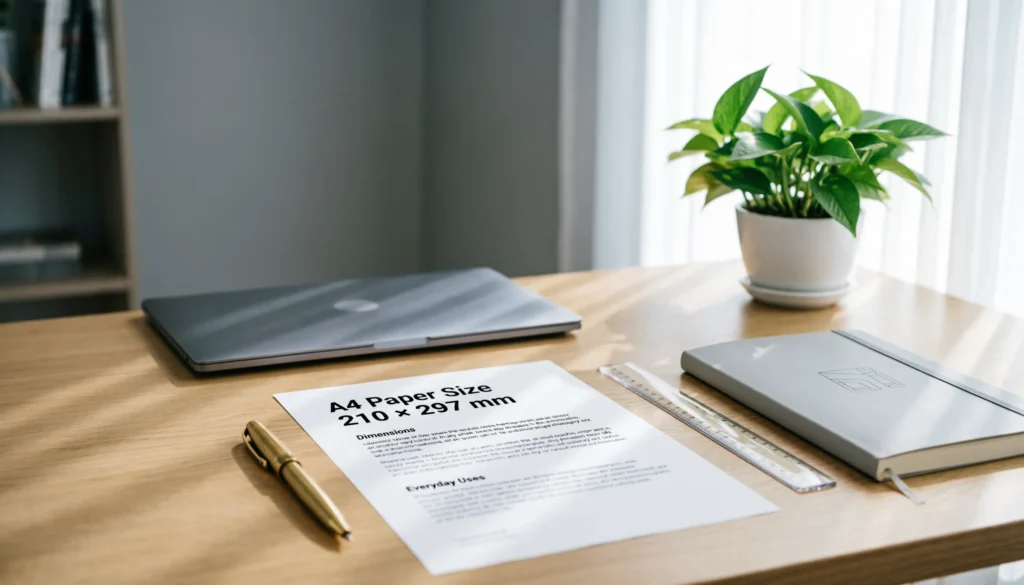
A4 is a standardized paper size that measures 210 millimeters by 297 millimeters, or approximately 8.27 inches by 11.69 inches.
Have you ever opened your printer settings, bought a notebook, or printed a document and noticed the paper size labeled A4? It appears everywhere, from office documents and school assignments to official forms and business reports. Despite how common it is, many people still wonder what A4 actually means, why it has that name, and why it is used so widely around the world.
Paper sizes might seem like a small detail, but they play a huge role in printing, publishing, design, and everyday paperwork. If the size is incorrect, documents can print incorrectly, layouts may shift, and formatting may look unprofessional.
It is part of the ISO 216 international paper size system, which is based on a consistent mathematical ratio that allows paper sizes to scale up or down easily.
A4 is most commonly used for:
School assignments
Office documents
Letters and reports
Printed forms
Magazines and brochures
In many countries across Europe, Asia, Africa, and Australia, A4 is considered the default paper size for printers and documents.
In this guide, you will learn exactly what A4 means in paper size, where it comes from, why it became the global standard, how it compares with other paper sizes, and how it is used in real life. By the end, you will have a clear understanding of why A4 paper is one of the most widely used formats in the world.
The Origin of the A4 Paper Size
The A4 paper size comes from an international standard called ISO 216, which defines a system of paper sizes used in most countries around the world.
The concept was originally developed in Germany in the early twentieth century by a scientist named Walter Porstmann, who designed a paper sizing system based on a mathematical ratio of 1 to the square root of 2. This ratio allows paper to be folded or scaled while maintaining the same proportions.
When the system was later adopted as an international standard, it became known as ISO 216. Within this system, paper sizes are divided into a series labeled A0, A1, A2, A3, A4, and so on.
Each size is created by folding the previous size in half.
For example:
A0 is the largest size in the A series
A1 is half of A0
A2 is half of A1
A3 is half of A2
A4 is half of A3
This design makes it extremely practical for printing and copying documents while maintaining consistent proportions.
A4 Paper Dimensions and Measurements
Understanding the exact dimensions of A4 paper can help when printing documents, designing layouts, or preparing materials for professional use.
| Measurement Type | A4 Size |
|---|---|
| Millimeters | 210 mm × 297 mm |
| Centimeters | 21 cm × 29.7 cm |
| Inches | 8.27 in × 11.69 in |
| Pixels (300 DPI) | 2480 × 3508 pixels |
These measurements remain consistent worldwide, which is why A4 works reliably across different printers and software programs.
For example, if you create a document in A4 format on your computer, it will print correctly on any A4-compatible printer.
How the A Series Paper System Works
The A series paper system follows a simple rule. Each paper size is exactly half the size of the previous one when folded along its longer side.
This makes scaling documents extremely easy.
For example, if you print an A4 document and enlarge it by 141 percent, it will fit perfectly on A3 paper.
Here is how the A series compares.
| Paper Size | Dimensions (mm) | Typical Use |
|---|---|---|
| A0 | 841 × 1189 | Posters, technical drawings |
| A1 | 594 × 841 | Large diagrams, architecture |
| A2 | 420 × 594 | Posters and displays |
| A3 | 297 × 420 | Large documents, design prints |
| A4 | 210 × 297 | Letters, reports, schoolwork |
| A5 | 148 × 210 | Notebooks, flyers |
Because each size maintains the same proportions, designers and printers can scale documents without changing the layout.
Why A4 Became the Global Standard
A4 paper is widely used across the world because it offers a practical balance between size and usability.
First, it is large enough to display clear information but small enough to handle easily. This makes it perfect for everyday documents like reports, letters, and forms.
Second, the mathematical design of the A series allows documents to be resized without distorting their proportions. This is extremely helpful for printing and copying.
Third, international organizations and governments adopted the ISO paper size standard, which encouraged widespread use of A4 across many countries.
Today, A4 is the default paper size in most of the world, including:
United Kingdom
Germany
France
Australia
India
Pakistan
South Africa
In these regions, printers and office software are usually set to A4 by default.
A4 vs Letter Size Paper
Although A4 is the global standard, some countries use a different default paper size called Letter size.
This is especially common in the United States and Canada.
While A4 and Letter size are similar, they are not identical.
| Paper Type | Dimensions (Inches) | Common Regions |
|---|---|---|
| A4 | 8.27 × 11.69 | Europe, Asia, Africa |
| Letter | 8.5 × 11 | United States, Canada |
The difference may seem small, but it can affect printing and formatting.
For example, if a document designed for A4 is printed on Letter paper, margins may shift or content may be cut off slightly.
This is why many international businesses must adjust document formats depending on the region.
Everyday Uses of A4 Paper
A4 paper is used in many areas of daily life. Because it balances readability and convenience, it has become the standard format for countless printed materials.
Office documents
Most office paperwork uses A4 paper. Examples include:
Business reports
Meeting notes
Official letters
Contracts
School assignments
Students often submit essays, homework, and projects on A4 paper.
Government forms
Many official forms, applications, and documents are printed on A4.
Books and magazines
Some magazines, manuals, and workbooks are designed using A4 or similar dimensions.
Printing and copying
Printers in many countries are configured to print on A4 by default, making it the easiest and most convenient choice.
Example Table: Common Documents Printed on A4
| Document Type | Why A4 Works Well |
|---|---|
| School assignments | Easy to read and organize |
| Business reports | Professional layout |
| Letters | Standard formatting |
| Application forms | Clear structure |
| Printed presentations | Balanced page space |
These examples show why A4 has become the preferred format for many types of printed materials.
A4 Paper in Digital Design and Printing
A4 is not only used for physical documents. It is also widely used in digital design.
Graphic designers, marketers, and publishers frequently design documents in A4 format because it works well for both digital and printed content.
Examples include:
PDF reports
Printable planners
Digital worksheets
Marketing brochures
Instruction manuals
When creating A4 designs for print, designers often work with pixel dimensions like 2480 × 3508 pixels at 300 DPI to ensure high-quality printing.
Tips for Printing on A4 Paper
Printing documents correctly on A4 paper requires a few simple steps.
First, make sure the document size in your software is set to A4. Most programs such as Microsoft Word, Google Docs, and Adobe Acrobat allow you to choose the paper size easily.
Second, check your printer settings. Some printers default to Letter size, especially if they were manufactured for markets where Letter is more common.
Third, leave proper margins. Typical A4 documents use margins of around 2 to 2.5 centimeters on each side.
Finally, preview your document before printing to make sure the formatting looks correct.
Other Paper Sizes Related to A4
While A4 is the most widely used size, other paper sizes in the A series are also common.
For example:
A3 is often used for posters, charts, and large diagrams.
A5 is popular for notebooks, small booklets, and flyers.
A6 is commonly used for postcards and small cards.
Because these sizes follow the same proportional system, they are easy to scale and adapt for different printing needs.
FAQs
What does A4 mean in paper size?
A4 refers to a standard paper size measuring 210 by 297 millimeters. It is widely used for office documents, letters, and school assignments.
Why is it called A4?
The name comes from the ISO A series paper system. A4 is the fourth size in the A series, created by folding larger paper sizes in half.
Is A4 the same as Letter size?
No. A4 is slightly taller and narrower than Letter size. A4 measures 8.27 by 11.69 inches, while Letter measures 8.5 by 11 inches.
Which countries use A4 paper?
Most countries around the world use A4 paper, including those in Europe, Asia, Africa, and Australia.
Why does the A series use the square root of two ratio?
This ratio allows paper sizes to maintain the same proportions when folded or enlarged, making scaling documents much easier.
Is A4 the most common paper size in the world?
Yes. A4 is considered the international standard for paper and is used in most countries globally.
What size is A4 in inches?
A4 paper measures approximately 8.27 inches by 11.69 inches.
Can A4 documents be printed on Letter paper?
Yes, but the margins or formatting may shift slightly because the sizes are not exactly the same.
Conclusion
A4 paper may seem like a simple office supply, but it plays a crucial role in printing, communication, and document organization around the world.
In simple terms, A4 is a standardized paper size measuring 210 by 297 millimeters, and it is part of the ISO 216 international paper system. Its carefully designed proportions allow documents to scale easily, making it practical for printing, copying, and designing.
Because it balances readability, convenience, and efficiency, A4 has become the default paper size in most countries. From school assignments and business reports to government forms and digital PDFs, it is one of the most widely used formats for written communication.
Understanding A4 paper size helps ensure your documents print correctly, look professional, and meet international formatting standards.
Read More Related Articles:
- Rasterize Mean in Photoshop: Turning Vectors and Text Into Pixels In 2026
- Hybrid Mean in School: Flexible Future of Learning In 2026
- Undefined Mean in Math: Master This Tricky Math Idea In 2026

Rachel Monroe is a digital content writer at Meanzy.com who focuses on explaining modern words, phrases, and online expressions. Her writing style is simple, practical, and reader-focused, helping users quickly understand the meaning and usage of today’s evolving language.