
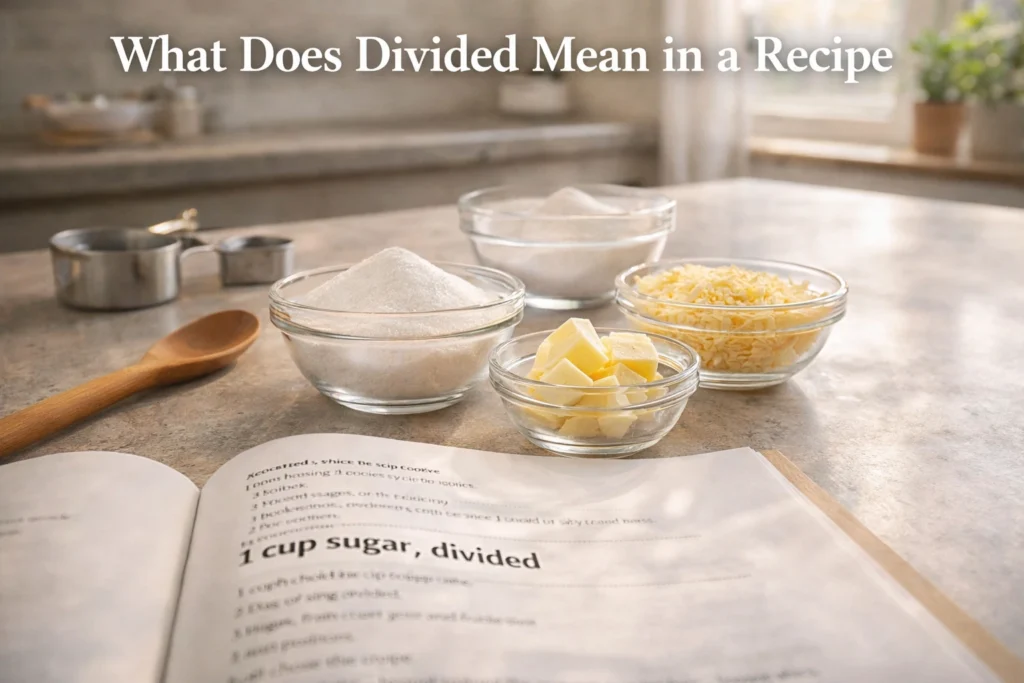
Divided in a recipe means that the listed ingredient will be used in separate portions at different steps in the cooking process rather than all at once.
Example:
If a recipe says “1 cup sugar, divided,” it means the recipe instructions will tell you to use part of the sugar in one step and the remaining sugar in a later step.
If you have ever followed a recipe and noticed an ingredient listed with the word “divided” next to it, you may have paused and wondered what it actually means. Many home cooks encounter this term while baking or preparing complex dishes, and it can be confusing if you have never seen it before.
For example, a recipe might say “1 cup sugar, divided” or “2 tablespoons butter, divided.” At first glance, it may not be obvious how or when you are supposed to divide the ingredient. Does it mean half now and half later? Does it mean separating it into equal portions? Or something else entirely?
Understanding what divided means in a recipe is important because it affects how the dish turns out. Using all of an ingredient at once instead of in stages can change the texture, flavor, or structure of a recipe, especially in baking.
This guide explains what divided means in cooking and baking recipes, why it is used, how to apply it correctly, and how it differs from other recipe instructions. You will also see examples, tables, and practical tips so you can confidently follow recipes that include this instruction.
Understanding the Term Divided in Cooking
When a recipe includes the word divided after an ingredient, it signals that the ingredient will be split into multiple portions and used at different points during the cooking process.
Instead of adding the entire ingredient at one time, the recipe author intends for you to reserve part of it for later steps.
For example, a recipe might require:
- Some butter for cooking ingredients in a pan
- The remaining butter for finishing the sauce
Or it may involve:
- Half the cheese mixed into a casserole
- The other half sprinkled on top before baking
Using ingredients in stages helps achieve the correct texture, flavor balance, and cooking results.
Why Recipes Use the Word Divided
The instruction “divided” appears in recipes for several practical reasons. It helps organize the cooking process and ensures that ingredients are used in the right way.
Here are some common reasons recipe writers use it.
1. To Add Ingredients in Stages
Certain ingredients need to be added at different times to control flavor or cooking results.
For example:
- Oil used for sautéing first
- Additional oil used later for finishing the dish
2. To Build Layers of Flavor
Adding an ingredient in multiple stages can create deeper flavor.
Example:
Garlic added during cooking and again at the end for a stronger aroma.
3. To Improve Texture
In baking especially, ingredients like sugar or eggs may be added in parts to help create the right texture.
4. To Create Toppings or Garnishes
Some ingredients are reserved for the final presentation.
Examples include:
- Cheese
- Herbs
- Sauce
- Crumbs
How Divided Ingredients Typically Appear in Recipes
Most recipes show divided ingredients in the ingredient list, then clarify the amounts in the instructions.
Ingredient list:
- 2 tablespoons butter, divided
- 1 cup shredded cheese, divided
Instructions:
- Melt 1 tablespoon butter in a pan.
- Add vegetables and cook.
- Stir in remaining butter before serving.
Example Table Showing How Divided Works
| Ingredient Listed | First Use | Second Use |
|---|---|---|
| 2 tablespoons butter, divided | 1 tablespoon for cooking | 1 tablespoon for finishing |
| 1 cup shredded cheese, divided | ½ cup mixed into dish | ½ cup sprinkled on top |
| 1 cup sugar, divided | ¾ cup in batter | ¼ cup for topping |
This structure allows the recipe to control flavor and texture step by step.
Real Recipe Examples Using Divided
To make the concept clearer, here are common situations where recipes use divided ingredients.
Example 1: Baking Recipe
Ingredient list:
1 cup sugar, divided
Instructions:
Use ¾ cup sugar in the cake batter.
Sprinkle the remaining ¼ cup over the top before baking.
Example 2: Pasta Dish
Ingredient list:
2 tablespoons olive oil, divided
Instructions:
Use 1 tablespoon olive oil to sauté garlic.
Add the remaining oil before serving.
Example 3: Casserole Recipe
Ingredient list:
2 cups shredded cheese, divided
Instructions:
Mix 1½ cups cheese into the casserole.
Sprinkle the remaining cheese over the top before baking.
Common Ingredients That Are Often Divided
Some ingredients appear with the word divided more often than others. These ingredients are commonly used in stages in recipes.
| Ingredient | Why It Is Divided |
|---|---|
| Butter | Used for cooking and finishing |
| Oil | Used for sautéing and flavor |
| Cheese | Mixed in and used as topping |
| Sugar | Used in batter and toppings |
| Sauce | Used inside and over the dish |
| Herbs | Added during cooking and for garnish |
Understanding this pattern makes recipes easier to follow.
Divided vs Other Cooking Instructions
Recipe instructions can sometimes look similar but mean different things. It helps to know how divided compares to other terms.
| Instruction | Meaning |
|---|---|
| Divided | Use the ingredient in portions at different steps |
| Separated | Split ingredients into parts such as egg whites and yolks |
| Reserve | Save part of the ingredient for later |
| To taste | Add based on personal preference |
For example, egg whites separated means removing them from the yolks.
But sugar divided means splitting the sugar into portions for different steps.
How to Measure Ingredients That Are Divided
When you see an ingredient labeled divided, the best approach is to measure the full amount first, then separate it.
Here is a simple method.
1
Measure the full ingredient amount listed.
2
Read the recipe instructions to determine how much to use at each step.
3
Separate the portions before cooking to avoid confusion.
For example:
Ingredient list says
1 cup milk, divided
Instructions say
Add ¾ cup milk to batter and reserve the remaining ¼ cup.
Measure 1 cup milk first, then separate it.
Mistakes People Make With Divided Ingredients
Many beginner cooks misunderstand the word divided and accidentally use the ingredient incorrectly.
Here are common mistakes.
Adding the Entire Ingredient at Once
This is the most frequent mistake. When the recipe expects staged additions, adding everything at once can change the result.
Forgetting the Reserved Portion
Sometimes cooks use part of the ingredient and forget the rest later.
Guessing the Portions
Some recipes clearly specify how to divide ingredients. Others expect you to estimate based on context.
Reading the instructions carefully helps avoid these issues.
Why Divided Is Especially Common in Baking
Baking often relies on precise ingredient timing. Adding ingredients gradually helps achieve the correct structure in baked goods.
For example:
- Sugar may be added in stages when whipping eggs
- Butter may be divided between dough and topping
- Chocolate may be mixed in and also used as garnish
These steps influence texture, moisture, and flavor balance.
Practical Tips for Handling Divided Ingredients
Following these tips can make cooking with divided ingredients much easier.
First, read the entire recipe before starting. This helps you understand how ingredients will be used later.
Second, measure ingredients in advance when possible. Preparing portions ahead of time prevents mistakes.
Third, place reserved portions in small bowls so you remember to use them.
Finally, follow the recipe instructions closely, especially for baking recipes where timing and order matter.
Key Takeaways About Divided in Recipes
Understanding recipe terminology makes cooking much easier. The word divided simply tells you that the ingredient will be used in multiple steps rather than all at once.
The most important points to remember are:
- Divided means splitting an ingredient into portions for different steps.
- The recipe instructions explain how much to use each time.
- Measuring the full amount first helps avoid mistakes.
- This instruction is common in baking, sauces, and layered dishes.
- Reading the full recipe before cooking ensures you use ingredients correctly.
FAQs
What does divided mean in a recipe?
Divided means the ingredient will be used in separate portions during different steps of the recipe instead of being added all at once.
Do divided ingredients have to be split evenly?
Not necessarily. Recipes often specify exact amounts for each step, and they may not be equal portions.
Why do recipes say butter divided?
Butter is often used in stages, such as cooking ingredients first and then finishing the dish with the remaining butter.
Should I measure the full ingredient first?
Yes. Measure the total amount listed, then separate the portions according to the instructions.
Is divided the same as separated in recipes?
No. Divided means using an ingredient in portions during different steps. Separated usually refers to splitting ingredients like egg whites and yolks.
What happens if I do not divide the ingredient?
The recipe may not turn out correctly. The flavor, texture, or consistency could change.
Why is sugar sometimes divided in baking recipes?
Sugar may be used partly in batter and partly as a topping or to help with whipping eggs.
Is divided used only in baking recipes?
No. It appears in both cooking and baking recipes, especially when ingredients are added in stages.
Conclusion
Seeing the word divided in a recipe may seem confusing at first, but it is actually a helpful instruction that guides how ingredients should be used throughout the cooking process. Instead of adding everything at once, the recipe is telling you to use the ingredient in stages to create the best possible flavor, texture, and presentation.
Once you understand this simple concept, following recipes becomes much easier. The next time you see “butter divided,” “cheese divided,” or “sugar divided,” you will know exactly what it means and how to handle it.
Cooking and baking are much more enjoyable when you understand recipe instructions clearly. Learning small details like this helps build confidence in the kitchen and improves your results every time.
Read More Related Articles:
- BMing Meaning in Clash Royale: Why It Annoys Players So Much In 2026
- Meaning of Salute in Italian: From Health to Cheers In 2026
- Meaning of Basta in Italian: How It’s Used and What It Conveys In 2026

John Miller is a professional meanings writer at Meanzy.com, specializing in word definitions, internet slang, acronyms, and text abbreviations. He focuses on delivering clear, accurate explanations with practical examples, helping readers easily understand modern digital terms and their real-life usage.