
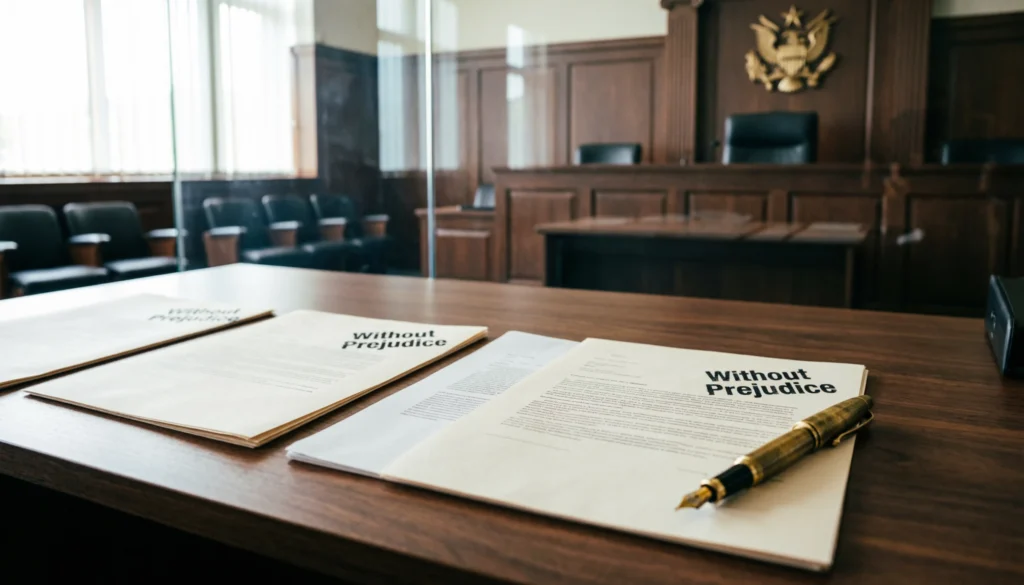
Without prejudice in a court case means that a statement, offer, or communication cannot be used as evidence in court against the person who made it. It is typically used during settlement negotiations to encourage open discussion without risking legal disadvantage.
If you have ever received a legal letter stamped with the words “without prejudice,” you may have paused and wondered what it actually means. Is it good news? A warning? A legal threat?
The phrase sounds formal and serious. And in the context of a court case, it carries real legal weight. Let’s break it down clearly and simply.
In other words, it protects parties who are trying to resolve a dispute outside of court. Now let’s explore this concept in detail so you fully understand how it works, when it applies, and why it matters.
What Does Without Prejudice Mean in Legal Terms?
In legal language, “without prejudice” signals that a communication is part of genuine settlement negotiations. Because of this protection, the court generally cannot see or rely on those communications if the case proceeds to trial.
This rule exists to encourage honest negotiations. Parties should feel safe making settlement offers without worrying that their words will later be used against them.
For example:
If someone writes
“We are willing to pay $10,000 to settle this matter without prejudice”
That offer cannot usually be presented to the judge as an admission of guilt.
This protection is often referred to as the without prejudice rule.
The Origin and Legal Background
The principle behind without prejudice has deep roots in common law systems, particularly in countries like the United Kingdom and other jurisdictions influenced by British legal traditions.
Historically, courts recognized that settlement discussions should be protected to promote dispute resolution. Over time, this became a formal legal doctrine.
Today, the concept is widely used in:
• Civil litigation
• Employment disputes
• Commercial disagreements
• Personal injury claims
• Family law cases
Courts such as the Supreme Court in various jurisdictions have reinforced the importance of protecting genuine settlement discussions.
The idea is simple. Justice systems function more efficiently when disputes settle without trial.
Why Is Without Prejudice Used in a Court Case?
The phrase is used to protect both parties during negotiations.
Here are the key reasons:
- It encourages open communication
- It promotes settlement instead of prolonged litigation
- It prevents admissions from being used unfairly
- It protects negotiation strategies
Imagine trying to settle a case but knowing that every offer could be shown to a judge later. Most people would refuse to negotiate openly. The legal system recognizes this problem.
When Does Without Prejudice Apply?
Not every document labeled “without prejudice” is automatically protected. Courts look at substance, not just wording.
For the rule to apply:
• There must be an existing dispute
• The communication must aim to settle that dispute
• The discussion must be genuine
If someone simply writes “without prejudice” on an unrelated letter, the protection may not apply.
Here is a helpful overview.
Table 1: When Without Prejudice Applies
| Situation | Protected? | Why |
|---|---|---|
| Settlement offer during lawsuit | Yes | Genuine negotiation |
| Email proposing compromise before filing case | Yes | Attempt to resolve dispute |
| Letter threatening legal action | No | Not a settlement offer |
| Regular business communication | No | No dispute negotiation |
| Admission of fraud in settlement letter | Possibly No | Exceptions may apply |
Courts carefully examine the context before applying the protection.
Real World Examples with Tone Explanation
Understanding tone is important. “Without prejudice” does not automatically mean aggressive or hostile.
Friendly Example 😊
“We value our relationship and, without prejudice, we are willing to discuss a payment plan.”
Tone: Cooperative and solution focused
Neutral Example
“This letter is written without prejudice and constitutes a settlement proposal.”
Tone: Professional and standard legal wording
Firm or Strategic Example
“Without prejudice, our client is prepared to settle for $25,000. Failing this, proceedings will continue.”
Tone: Serious and strategic, but still part of negotiation
The phrase itself is neutral. The tone depends on the surrounding language.
What Does Without Prejudice Mean When a Case Is Dismissed?
Sometimes you may see a case dismissed “with prejudice” or “without prejudice.” These are completely different meanings.
Let’s compare them clearly.
Table 2: With Prejudice vs Without Prejudice
| Term | Meaning | Can the Case Be Filed Again? |
|---|---|---|
| Dismissed with prejudice | Case permanently closed | No |
| Dismissed without prejudice | Case temporarily closed | Yes |
When a case is dismissed without prejudice, the claimant can refile the case later.
When dismissed with prejudice, the matter is finished permanently.
This is one of the most searched legal questions online because the difference significantly affects your legal rights.
Without Prejudice vs Without Prejudice Save as to Costs
You may also see a variation:
Without prejudice save as to costs
This means:
The communication cannot be shown to the judge during the trial
But it can be shown after judgment when the court decides who pays legal costs
This version is strategic. It encourages reasonable settlement behavior because a party who refuses a fair offer may later be penalized in costs.
Table 3: Comparison of Legal Phrases
| Phrase | Used During Trial? | Used in Cost Decisions? |
|---|---|---|
| Without prejudice | No | No |
| Without prejudice save as to costs | No | Yes |
| Open offer | Yes | Yes |
Understanding these differences is important in litigation strategy.
Are There Exceptions to the Without Prejudice Rule?
Yes. The protection is strong, but not absolute.
Courts may allow disclosure in situations involving:
• Fraud
• Misrepresentation
• Undue influence
• Perjury
• Unambiguous impropriety
For example, if someone admits criminal conduct during negotiations, the protection may not shield them.
The court’s priority is fairness and justice.
Does Writing Without Prejudice Automatically Protect You?
No.
Simply adding the phrase does not create automatic legal protection. Courts examine:
- Was there a real dispute?
- Was the communication part of settlement negotiations?
- Was the intent genuine?
If not, the label alone will not help.
Think of it as a shield that only works when properly used.
Alternate Meanings Outside Court
Outside legal settings, “without prejudice” may mean:
• Without bias
• Without preconceived opinion
• Without discrimination
For example:
“I reviewed the complaint without prejudice.”
In everyday language, this simply means fairly and objectively.
But in court, the meaning is technical and procedural.
Polite and Professional Alternatives
If you are writing a letter and want to avoid sounding overly aggressive, you could use:
• “For settlement purposes only”
• “Confidential settlement communication”
• “Subject to settlement discussion”
• “This communication is made in the spirit of resolution”
However, in formal legal matters, “without prejudice” remains the standard phrase.
Practical Tips When Using Without Prejudice
If you are involved in a dispute, keep these guidelines in mind:
- Use it only when genuine settlement negotiations are taking place
- Make your intention clear in the body of the letter
- Avoid mixing open accusations with settlement language
- Seek legal advice before relying on it
- Understand that exceptions exist
Misusing the phrase can weaken your legal position.
FAQs
What does without prejudice mean in a court case?
It means that statements or offers made during settlement discussions cannot usually be used as evidence in court against the person who made them.
Does without prejudice mean the case is closed?
No. It usually refers to settlement negotiations. If a case is dismissed without prejudice, it means the case can be filed again later.
Can a without prejudice letter be shown to a judge?
Generally no, if it was part of genuine settlement negotiations. However, exceptions may apply.
Is without prejudice legally binding?
The phrase itself is not binding. It protects communications from being used as evidence, but it does not create a contract unless both parties agree.
What is the difference between with prejudice and without prejudice?
With prejudice means permanently closed. Without prejudice means the matter can be reopened or refiled.
Does without prejudice admit fault?
No. It specifically protects against admissions being used as evidence of fault.
Can I use without prejudice in an email?
Yes, if the email is part of genuine settlement negotiations in an existing dispute.
What does without prejudice save as to costs mean?
It means the communication cannot be used during the trial but may be shown later when the court decides who pays legal costs.
Conclusion
So what does without prejudice mean in a court case?
It is a legal protection used during settlement negotiations that prevents certain communications from being used as evidence in court.
It encourages open discussion, honest negotiation, and faster dispute resolution.
• It protects genuine settlement discussions
• It does not automatically apply just because you write the phrase
• It differs completely from dismissal with prejudice
• There are exceptions in cases of wrongdoing
• It can be strategically important in litigation
Understanding this term can save you from costly mistakes and help you negotiate confidently.
If you are involved in a legal dispute, always consult a qualified lawyer before relying on legal terminology. Knowledge is powerful, but proper guidance is essential.
Read More Related Articles:
- True Meaning of Carne Asada in English: It’s More Than Food For 2026
- What Does Blue Mean in the Bible? Spiritual Significance (2026)
- What Does EMP Stand For in Text? Usage Explained (2026)

Rachel Monroe is a digital content writer at Meanzy.com who focuses on explaining modern words, phrases, and online expressions. Her writing style is simple, practical, and reader-focused, helping users quickly understand the meaning and usage of today’s evolving language.