
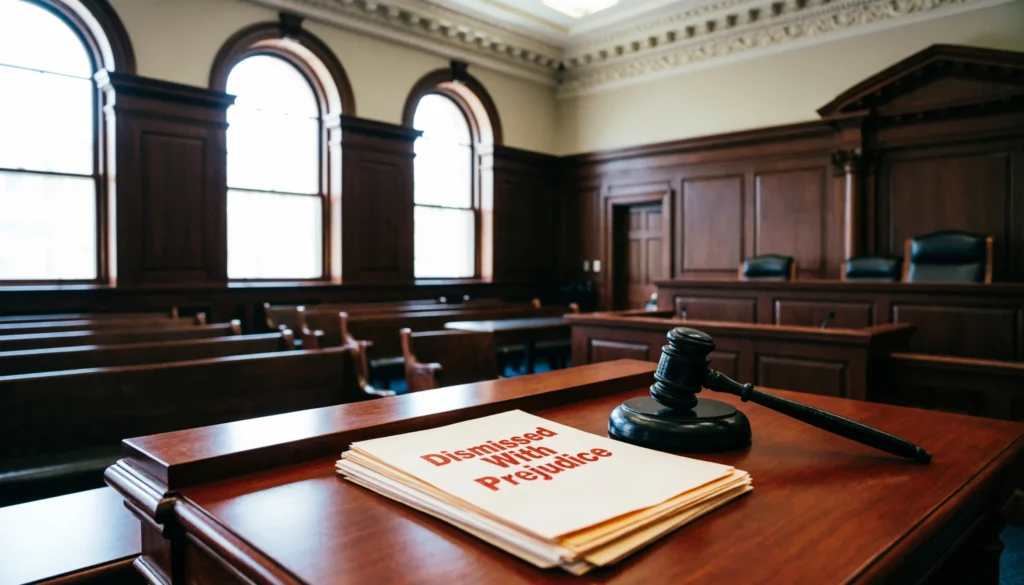
“With prejudice” in court means a case has been permanently dismissed and cannot be filed again in the same court. When a judge dismisses a case with prejudice, the decision is final regarding that claim. The plaintiff is barred from bringing the same lawsuit against the same defendant based on the same facts.
If you have seen the phrase “case dismissed with prejudice” in court documents, you might wonder whether it is good news or bad news. The answer depends entirely on which side you are on.
Let’s break it down clearly and simply.
What Does With Prejudice Mean in Court?
In legal terms, with prejudice refers to a final decision that prevents the same claim from being refiled. It signals closure. The issue has been decided, and the court will not revisit it.
This term usually appears in phrases such as:
- Case dismissed with prejudice
- Complaint dismissed with prejudice
- Claims dismissed with prejudice
When a case is dismissed with prejudice, the door is closed permanently.
If you are the defendant, this is usually good news. If you are the plaintiff, it often means your legal claim is over.
Origin of the Term With Prejudice
The phrase “with prejudice” comes from older legal language influenced by Latin and early English common law traditions. The word “prejudice” in this context does not mean bias or discrimination. Instead, it refers to a loss of rights.
In legal usage, prejudice means harm to a legal right or claim.
So when a case is dismissed with prejudice, it means the plaintiff’s right to pursue that claim again has been harmed or eliminated.
Over time, this phrase became common in court systems across countries influenced by English common law, including the United States, the United Kingdom, Canada, Australia, and many others.
Why Courts Dismiss Cases With Prejudice
Judges dismiss cases with prejudice for several reasons. It is not random. There must usually be a legal basis for such a final decision.
Here are the most common reasons:
1. The Case Lacks Legal Merit
If the court determines that the claim does not have a valid legal foundation, it may dismiss the case permanently.
2. The Plaintiff Failed to Fix Errors
Sometimes a court first dismisses a case without prejudice and allows the plaintiff to correct mistakes. If the plaintiff fails to do so properly, the court may later dismiss with prejudice.
3. Settlement Agreement
In many civil lawsuits, both parties agree to settle. As part of the agreement, the case is dismissed with prejudice to prevent future lawsuits on the same issue.
4. Violation of Court Rules
If a party repeatedly fails to follow court procedures or deadlines, a judge may dismiss the case with prejudice as a sanction.
With Prejudice vs Without Prejudice
This is where many people get confused. The difference between “with prejudice” and “without prejudice” is critical.
Comparison Table
| Term | Meaning | Can the Case Be Refiled? | Final Decision? |
|---|---|---|---|
| With Prejudice | Permanent dismissal | No | Yes |
| Without Prejudice | Temporary dismissal | Yes | No |
When a case is dismissed without prejudice, the plaintiff may fix the issue and file again.
When dismissed with prejudice, the matter is over.
Real World Examples of With Prejudice
Understanding legal terms becomes much easier with context. Here are realistic examples.
Example 1 Friendly Resolution
Two businesses are involved in a contract dispute. They negotiate and settle privately. They ask the court to dismiss the case with prejudice.
Tone: Neutral and professional
Effect: Prevents future litigation on the same contract issue
Example 2 Court Sanction
A plaintiff repeatedly ignores court deadlines. The judge warns them. They continue failing to comply. The judge dismisses the case with prejudice.
Tone: Negative or dismissive
Effect: The plaintiff loses the right to sue again
Example 3 Lack of Legal Grounds
Someone files a lawsuit based on facts that do not legally support a claim. After reviewing the complaint, the judge dismisses it with prejudice.
Tone: Formal and definitive
Effect: The case cannot move forward
Labeled Example Table
| Scenario | Dismissal Type | Result for Plaintiff | Result for Defendant |
|---|---|---|---|
| Settlement reached | With Prejudice | Cannot refile | Protected from future claims |
| Filing error only | Without Prejudice | May refile | Temporary relief |
| No legal basis | With Prejudice | Claim permanently ended | Case permanently closed |
| Missed deadline once | Without Prejudice | May correct and refile | Case paused |
Is With Prejudice Good or Bad?
It depends on your position.
If you are the defendant, dismissal with prejudice is usually positive because it provides finality. You cannot be sued again on the same matter.
If you are the plaintiff, it is often unfavorable because your legal opportunity is gone.
From a legal standpoint, courts use this type of dismissal to protect fairness and prevent repeated litigation of the same issue.
Legal Doctrine Behind With Prejudice
The principle behind dismissal with prejudice is closely related to the legal doctrine known as res judicata, which means “a matter already judged.”
Res judicata prevents parties from relitigating the same dispute once it has been decided.
Legal Impact Table
| Legal Concept | Relation to With Prejudice |
|---|---|
| Res Judicata | Prevents refiling same claim |
| Final Judgment | Required for appeal |
| Claim Preclusion | Bars identical lawsuits |
| Court Sanctions | May result in dismissal |
This ensures efficiency in the court system and protects defendants from repeated lawsuits over the same issue.
Does With Prejudice Apply in Criminal Cases?
Yes, but it is less common than in civil cases.
In criminal law, if charges are dismissed with prejudice, the prosecution cannot refile the same charges.
This can happen due to:
- Violation of constitutional rights
- Prosecutorial misconduct
- Speedy trial violations
When this happens, it is a major legal victory for the defendant.
Can a Dismissal With Prejudice Be Appealed?
In some cases, yes.
Because dismissal with prejudice is a final judgment, it can be appealed to a higher court. However, the appeal must show that the lower court made a legal error.
Appeals are not automatic reversals. The higher court reviews legal reasoning, not simply dissatisfaction.
Related Legal Terms and Comparisons
Understanding similar phrases helps avoid confusion.
Comparison Table of Related Terms
| Term | Meaning | Similar To With Prejudice? |
|---|---|---|
| Dismissed Without Prejudice | Temporary dismissal | No |
| Summary Judgment | Judge decides case without trial | Sometimes final |
| Mistrial | Trial invalidated | Not necessarily final |
| Acquittal | Found not guilty | Final in criminal cases |
Each term has its own legal impact, but dismissal with prejudice specifically focuses on barring future claims.
Alternate Meanings of Prejudice
Outside courtrooms, prejudice usually refers to bias or unfair treatment.
For example:
- Prejudice based on race
- Prejudice in hiring decisions
In legal dismissal context, however, it does not mean bias. It refers to the loss of legal rights.
This distinction is important.
Professional and Polite Alternatives
In formal legal writing, instead of saying “with prejudice,” attorneys may write:
- Permanently dismissed
- Dismissed with finality
- Claim barred from refiling
- Final adjudication
However, in official court orders, the phrase “with prejudice” is the standard terminology.
Common Mistakes People Make
- Assuming it means the judge was biased
- Confusing it with emotional prejudice
- Thinking it automatically means someone was guilty
- Believing it can easily be reopened
Legal terminology can sound intimidating, but once understood, it becomes straightforward.
FAQs
What does case dismissed with prejudice mean?
It means the court has permanently closed the case and the plaintiff cannot bring the same claim again in that court.
Can you reopen a case dismissed with prejudice?
Generally no. It is final. The only option may be an appeal if there was a legal error.
Is dismissal with prejudice a good thing?
For defendants, usually yes. For plaintiffs, usually no because they lose the right to pursue the claim.
What is the difference between with prejudice and without prejudice?
With prejudice means permanent dismissal. Without prejudice allows the case to be refiled.
Does with prejudice mean guilty?
No. It does not automatically imply guilt. It simply means the claim cannot be filed again.
Can criminal charges be dismissed with prejudice?
Yes. If dismissed with prejudice, the prosecution cannot refile the same charges.
Is dismissal with prejudice the same as losing a case?
Not always. It can result from settlement or procedural issues, not necessarily a trial verdict.
Why would a judge dismiss a case with prejudice?
Common reasons include lack of legal merit, repeated procedural violations, or settlement agreements.
Conclusion
Understanding what “with prejudice” means in court is essential if you are involved in any legal matter.
- It means permanent dismissal
- The claim cannot be refiled
- It protects defendants from repeated lawsuits
- It reflects a final court decision
While the phrase may sound harsh, it serves an important function in maintaining fairness and efficiency within the legal system. If you encounter this term in real life, do not panic. Instead, review the full context and seek legal advice. The meaning is procedural, not personal.
Knowing the difference between dismissal with prejudice and dismissal without prejudice can save time, stress, and confusion. Legal terms are powerful. Once you understand them, they become much less intimidating.
Read More Related Articles:
- Nerf Mean in Gaming: Simple Explanation for New Players In 2026
- “Chow” Mean in Italian: Language, Culture and History In 2026
- Kona Mean in Hawaiian: Everything You Need to Know In 2026

Rachel Monroe is a digital content writer at Meanzy.com who focuses on explaining modern words, phrases, and online expressions. Her writing style is simple, practical, and reader-focused, helping users quickly understand the meaning and usage of today’s evolving language.