
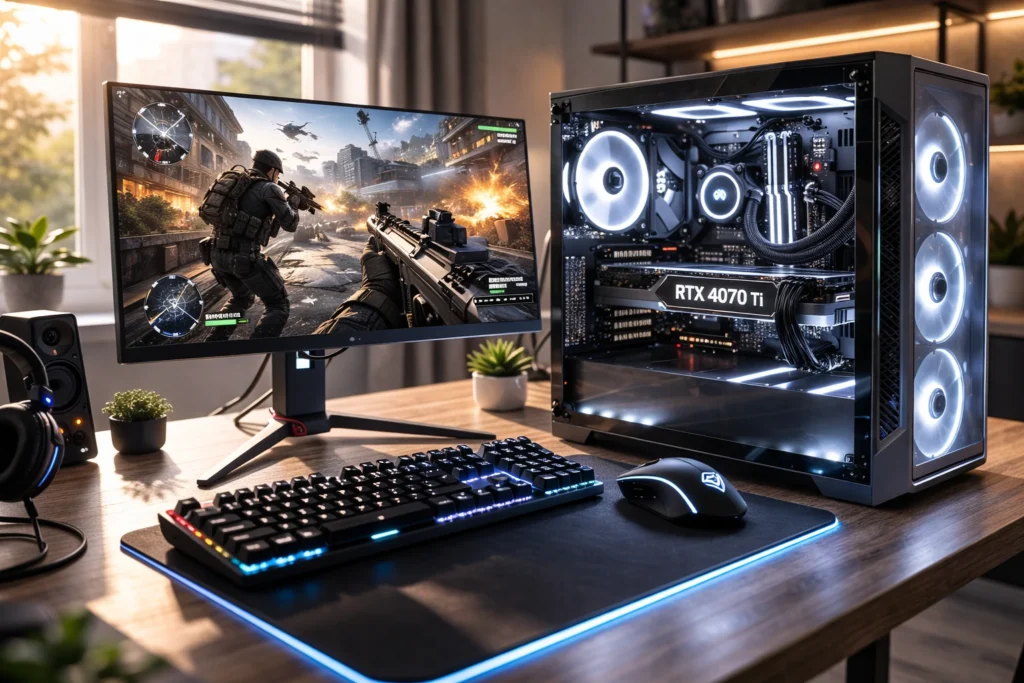
In a GPU model name, Ti stands for a higher performance version of the same base graphics card.
It usually indicates improved specifications such as more CUDA cores, higher clock speeds, or better overall gaming and rendering performance compared to the non Ti version.
If you have ever compared graphics cards and wondered why one says RTX 4060 and another says RTX 4060 Ti, you are not alone. That small two letter addition can mean a noticeable difference in performance, price, and value.
Let’s break it down in a clear and practical way so you can confidently understand what Ti really means when buying or upgrading a graphics card.
Why This Tiny “Ti” Matters So Much
When browsing GPUs for gaming, content creation, or PC building, you will often see models like:
- RTX 3060
- RTX 3060 Ti
- GTX 1080
- GTX 1080 Ti
That simple “Ti” can affect:
- Gaming frame rates
- Video editing speed
- Streaming performance
- Ray tracing capability
- Overall value for money
Understanding what the Ti means in GPU can save you from overspending or underbuying.
The Origin of “Ti” in GPUs
The term Ti is most commonly associated with graphics cards from Nvidia.
Where Did “Ti” Come From?
Ti originally stands for Titanium.
In chemistry, titanium is a strong and lightweight metal. Nvidia adopted the term to suggest that the Ti version is stronger and more powerful than the standard model.
It is not a technical acronym. It is primarily a branding choice that signals enhanced performance.
First Popular Uses
Some of the earliest widely recognized Ti cards included:
- GeForce2 Ti
- GeForce3 Ti
Over time, Ti became a consistent naming convention across multiple generations like:
- GeForce GTX 1080 Ti
- GeForce RTX 3060 Ti
Today, Ti versions are a regular part of Nvidia’s product stack.
What Does the Ti Mean in GPU Performance Terms?
In simple words, a Ti GPU is a stronger version of the same numbered card.
But what actually changes?
Here are the typical upgrades in a Ti version:
- More CUDA cores
- Higher base and boost clock speeds
- Increased memory bandwidth
- Sometimes more VRAM
- Improved thermal design
However, it is not as powerful as the next tier model. For example:
RTX 4060 Ti is stronger than RTX 4060
But weaker than RTX 4070
So it sits in between.
Table 1: Example Comparison of Standard vs Ti GPU
| Feature | RTX 3060 | RTX 3060 Ti |
|---|---|---|
| CUDA Cores | 3584 | 4864 |
| Memory | 12 GB GDDR6 | 8 GB GDDR6 |
| Memory Bus | 192 bit | 256 bit |
| Gaming Performance | Good 1080p | Excellent 1080p and solid 1440p |
| Price | Lower | Higher |
As you can see, the Ti version often has significantly more processing cores and better performance in games.
Real World Usage: When Does Ti Actually Matter?
Let’s make this practical.
For Gamers 🎮
If you play:
- Competitive games like Valorant or CS2
- AAA titles at high settings
- Games at 1440p resolution
A Ti card usually offers:
- Higher FPS
- Better stability
- More future proofing
For example, a 3060 Ti can handle 1440p gaming more comfortably than a 3060.
For Content Creators 🎥
If you use:
- Adobe Premiere Pro
- Blender
- DaVinci Resolve
A Ti GPU can:
- Render faster
- Handle heavier effects
- Improve timeline playback
For Casual Users
If you:
- Browse
- Watch YouTube
- Do office work
You do not need a Ti version. It would be overkill.
Tone and Usage Context
The term Ti itself is neutral and technical. However, the way it is used in conversation can imply different things.
Friendly tone example
“I went with the 4070 Ti because I wanted smoother gameplay.”
Neutral tone example
“The Ti version offers better performance at a higher price point.”
Slightly dismissive tone
“You bought the base model? The Ti would have been a better choice.”
The word itself carries no emotional meaning. It simply signals performance.
Comparison With Related GPU Terms
Understanding Ti becomes easier when you compare it with other common GPU naming terms.
Table 2: Ti vs Super vs XT vs Base Model
| Term | Brand | Meaning | Performance Level |
|---|---|---|---|
| Base Model | Nvidia / AMD | Standard version | Entry tier for that number |
| Ti | Nvidia | Enhanced version | Mid upgrade |
| Super | Nvidia | Refreshed improved version | Between base and next tier |
| XT | AMD | Higher performance model | Similar to Ti concept |
For example:
- AMD uses “XT” instead of Ti.
- Nvidia uses “Super” for refreshed upgrades like GeForce RTX 2060 Super.
So Ti is not universal. It is specific to Nvidia branding.
Is Ti Always Worth It?
Not always.
Here are three situations:
1. Worth It
If the price difference is small and performance jump is noticeable.
2. Maybe
If you game at 1080p and do not need extra power.
3. Not Worth It
If you are on a tight budget and the non Ti version already meets your needs.
Always compare benchmarks before deciding.
Table 3: Quick Decision Guide
| Your Use Case | Should You Choose Ti? |
|---|---|
| 1080p Casual Gaming | Usually no |
| 1440p Gaming | Yes, recommended |
| 4K Gaming | Consider higher tier instead |
| Video Editing | Yes if budget allows |
| Office / School Work | No |
Does Ti Mean More VRAM?
Not necessarily.
Sometimes Ti versions have:
- Same VRAM
- Slightly different VRAM
- Different memory bus width
For example, RTX 3060 had 12 GB while 3060 Ti had 8 GB. That surprises many buyers.
So Ti means more processing power, not always more memory.
Alternate Meanings of Ti
Outside GPUs, Ti can mean:
- Titanium in chemistry
- Texas Instruments in calculators
- Musical note “Ti” in solfege
But in the GPU world, it almost always refers to Nvidia’s higher performance variant.
Why Ti Became So Popular
There are three main reasons:
- Clear performance ladder
- Strong branding from Nvidia
- Positive market reception
Gamers began associating Ti with better value for performance. Over time, it became a trusted upgrade label.
Common Mistakes Buyers Make
- Assuming Ti always has more VRAM
- Thinking Ti equals the next tier model
- Ignoring power supply requirements
- Not checking real world benchmarks
Remember, Ti is better than base, but not equal to the next full model.
FAQs
What does the Ti stand for in Nvidia GPUs?
Ti stands for Titanium. It represents a higher performance version of the base graphics card model.
Is a Ti GPU better than a normal one?
Yes. A Ti GPU usually offers more cores and higher performance compared to the non Ti version of the same number.
Is Ti better than Super?
It depends on the generation. Sometimes Super is a refresh, while Ti may offer stronger raw performance. You must compare specific models.
Is RTX 3060 Ti better than RTX 3060?
Yes. The RTX 3060 Ti generally delivers better gaming performance due to more CUDA cores and higher processing power.
Does Ti mean more VRAM?
Not always. Ti versions focus on processing power. VRAM capacity may stay the same or even be lower in some cases.
Is Ti good for gaming?
Yes. Ti cards are often excellent for higher settings, better frame rates, and more demanding resolutions like 1440p.
Is Ti worth the extra money?
If the price difference is reasonable and you need the extra performance, it is usually worth it.
Does AMD use Ti in their GPUs?
No. AMD uses labels like XT instead of Ti for higher performance models.
Conclusion:
Ti in GPU means a stronger, enhanced version of the same base model. It usually delivers:
- Better gaming performance
- More processing cores
- Improved rendering speed
- Higher price
It does not automatically mean more memory and does not replace the next tier card.While it sits in between. If you are a gamer, creator, or performance enthusiast, Ti models often offer a sweet spot between cost and power. If you are a casual user, the base model is often enough.
Before buying, always:
- Compare benchmarks
- Check power requirements
- Consider your monitor resolution
- Balance price vs performance
That small two letter label can make a big difference in your PC experience.
Read More Related Articles:
- TBD Mean in School: Complete Guide for Students and Parents In 2026
- WDP Meaning in Texting: Slang Breakdown with Examples (2026)
- Equity Means in DEI: How It Levels the Playing Field for All In 2026

Megan Foster is a thoughtful and creative content creator at Meanzy.com with a strong curiosity for language and communication. Known for her clarity and attention to detail, she simplifies confusing slang, acronyms, and modern terms into easy, relatable meanings readers can trust.