
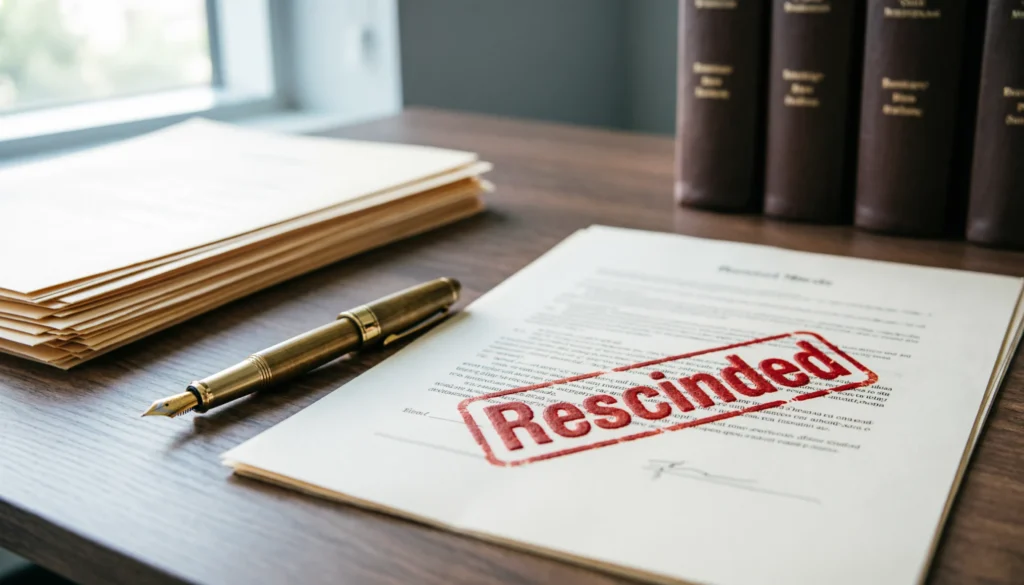
Rescind in law means to officially cancel or void a contract, agreement, or legal decision, treating it as though it never existed. When something is rescinded, the parties are generally restored to their original positions before the agreement was made.
If you have ever seen a contract suddenly canceled or heard that a company “rescinded” a job offer, you might have wondered what that actually means in legal terms. Is it the same as canceling? Revoking? Terminating?
The word “rescind” carries a very specific meaning in law, and understanding it can help you better navigate contracts, court matters, and legal communications.
Now let’s explore this term in depth, including its origin, usage, examples, comparisons, and practical tips.
What Does Rescind Mean in Law?
In legal contexts, to rescind something means to cancel it in a way that effectively erases it. The goal of rescission is not simply to stop future performance but to undo the agreement entirely.
For example:
- A buyer rescinds a contract after discovering fraud.
- An employer rescinds a job offer due to background check issues.
- A government agency rescinds a previously issued rule.
In each case, the action attempts to wipe the agreement off the table, as if it never legally existed.
This is different from merely terminating or breaching a contract. Rescission goes further. It aims to restore both parties to their original state.
Origin and Legal Background of the Word Rescind
The word “rescind” comes from the Latin term rescindere, which means to cut off or tear away. Over time, it entered English legal language to describe undoing a binding agreement.
The concept of rescission is deeply rooted in contract law. Courts often allow rescission when fairness demands it, especially in cases involving:
- Fraud
- Misrepresentation
- Mistake
- Duress
- Undue influence
Legal systems influenced by English common law, including the United States, United Kingdom, Canada, and others, widely use the term.
Because contracts form the backbone of business and personal transactions, rescission has become a frequently searched and commonly used legal term today.
When Can a Contract Be Rescinded?
Not every contract can be rescinded. Courts typically allow rescission only under specific legal grounds.
Here are the most common reasons:
1. Fraud or Misrepresentation
If one party was misled by false information, they may have the right to rescind.
Example
If a seller lies about a car’s accident history, the buyer may rescind the contract.
Tone
Serious and corrective. This is usually a strong legal claim.
2. Mutual Mistake
If both parties entered into the agreement based on a shared mistake, rescission may be allowed.
Example
Both parties believed a piece of land included mineral rights, but it did not.
Tone
Neutral and corrective.
3. Unilateral Mistake
Sometimes one party makes a major error that the other party knew about and took advantage of.
4. Duress or Coercion
If someone was forced into signing a contract under pressure or threats, rescission may be granted.
Tone
Negative and protective of the harmed party.
5. Lack of Capacity
Contracts signed by minors or individuals lacking mental capacity may be rescinded.
Legal Effect of Rescission
When a contract is rescinded:
- The agreement is treated as void.
- Both parties must return what they received.
- Financial compensation may be required to restore balance.
This process is sometimes referred to as “restoring the status quo.”
Table 1: Legal Effect of Rescission
| Aspect | Before Rescission | After Rescission |
|---|---|---|
| Contract Status | Legally binding | Treated as if it never existed |
| Obligations | Parties must perform | Obligations removed |
| Payments | Retained by receiving party | Usually returned |
| Legal Position | Bound by agreement | Restored to original position |
Real World Usage of Rescind
The term rescind appears frequently in legal news, employment situations, and government actions.
1. Employment Law
An employer may rescind a job offer if:
- The candidate fails a background check
- The candidate provides false information
- Company finances change
Example
“We regret to inform you that we must rescind your job offer due to discrepancies in your application.”
Tone
Professional and formal, sometimes disappointing.
2. Government and Policy
Government agencies may rescind regulations or policies.
For example, during administrative changes, a new government might rescind policies introduced by a previous administration.
3. Consumer Contracts
Consumers may rescind certain contracts within a specific time frame, often called a cooling off period.
This is common in:
- Real estate transactions
- Door to door sales
- Certain financial agreements
Rescind vs Other Legal Terms
Many people confuse rescind with similar legal words. Let’s compare them clearly.
Table 2: Rescind vs Similar Legal Terms
| Term | Meaning | Key Difference |
|---|---|---|
| Rescind | Cancel and undo entirely | Erases the contract as if it never existed |
| Revoke | Take back or withdraw | Often applies to offers, licenses, or permissions |
| Terminate | End going forward | Does not erase past existence |
| Void | Never legally valid | Invalid from the beginning |
| Cancel | Stop something | Less formal, not always legal |
Rescind vs Terminate
If a contract is terminated, it ends from that point forward. However, it still existed before termination.
If a contract is rescinded, it is treated as though it never existed.
That is a major legal difference.
Tone and Context Examples of Rescind
The word rescind carries different emotional tones depending on context.
Friendly or Neutral Context
“We have decided to rescind the previous agreement and start fresh.”
Tone
Professional and solution oriented.
Formal Legal Context
“The plaintiff seeks to rescind the contract on grounds of fraudulent misrepresentation.”
Tone
Serious and authoritative.
Negative or Disappointing Context
“Unfortunately, we must rescind your admission offer.”
Tone
Regretful and disappointing.
Table 3: Example Sentences in Context
| Situation | Example Sentence | Tone |
|---|---|---|
| Job Offer | The company rescinded the offer after reviewing references | Professional |
| Contract Dispute | She filed a lawsuit to rescind the agreement | Legal and serious |
| Government Action | The agency rescinded the outdated policy | Administrative |
| Personal Agreement | They mutually agreed to rescind the deal | Neutral |
Is Rescind the Same as Cancel?
Not exactly.
In everyday conversation, people may use “cancel” and “rescind” interchangeably. However, in legal writing, rescind has a more precise meaning.
Cancel is broader and less formal. Rescind is specifically used in legal and contractual contexts.
For example:
- You cancel a dinner reservation.
- You rescind a legally binding contract.
Alternate Meanings of Rescind
Outside legal contexts, rescind still means to revoke or withdraw officially.
It can apply to:
- Policies
- Decisions
- Invitations
- Offers
However, the strongest and most technical meaning appears in contract law.
Polite and Professional Alternatives to Rescind
Depending on the context, you might use alternatives that sound less harsh or more professional.
Here are some options:
- Withdraw
- Revoke
- Nullify
- Invalidate
- Cancel formally
- Set aside
- Annul
Example in professional tone
“We have decided to withdraw the previous offer.”
This may sound softer than saying “rescind.”
How Courts Handle Rescission
Courts may grant rescission as a legal remedy. This means a judge orders the contract undone.
Rescission may be:
- Mutual, when both parties agree
- Unilateral, when one party requests it through court
In some cases, financial restitution is ordered to ensure fairness.
Courts aim to prevent unjust enrichment, meaning one party should not unfairly benefit from a faulty contract.
Practical Tips for Understanding Rescind in Legal Documents
If you see the word rescind in a legal document, consider:
- Is the entire agreement being undone?
- Are both parties returning what they received?
- Is this voluntary or court ordered?
- Does this affect past actions or only future obligations?
Understanding these questions can help you interpret legal communications accurately.
FAQs
What does rescind mean in law?
Rescind means to cancel a contract or agreement in such a way that it is treated as if it never existed. The parties are usually restored to their original positions.
Can a contract be rescinded after it is signed?
Yes, a contract can be rescinded after signing if legal grounds exist, such as fraud, misrepresentation, mistake, or duress. In some cases, both parties may mutually agree to rescind.
What happens after a contract is rescinded?
After rescission, both parties generally return any benefits or payments received. The goal is to restore the situation to what it was before the agreement.
Is rescind the same as revoke?
Not exactly. Revoke usually means to take back an offer, permission, or license. Rescind specifically refers to undoing a contract or legal agreement entirely.
Can an employer rescind a job offer?
Yes, employers can rescind job offers under certain conditions, such as failed background checks or false information provided by the candidate.
Does rescind mean void?
Rescind means to make something void. However, void often describes something that was invalid from the start, while rescission is an action taken to undo a valid contract.
Is rescission automatic in cases of fraud?
No, rescission is not automatic. The affected party typically must request it, either through negotiation or court proceedings.
Can both parties agree to rescind a contract?
Yes, mutual rescission is common. If both parties agree to undo the contract, they can formally rescind it without going to court.
Conclusion:
Understanding what rescind means in law can protect you in contracts, employment situations, and legal disputes.
- Rescind means to cancel and undo a contract entirely.
- It treats the agreement as if it never legally existed.
- Common reasons include fraud, mistake, duress, and misrepresentation.
- It is different from terminate, revoke, or cancel.
- Courts may order rescission to ensure fairness.
If you encounter the term in legal documents, pay close attention. It signals a significant legal action, not just a simple cancellation.
Knowing the precise meaning of rescind can help you respond wisely, protect your rights, and communicate more professionally in legal matters.
Read More Related Articles:
- IGL in Fortnite Explained: The Leader Every Squad Needs In 2026
- Lethargic Mean in Dogs: Signs Every Owner Should Know In 2026
- What Does EMP Stand For in Text? Usage Explained (2026)

Megan Foster is a thoughtful and creative content creator at Meanzy.com with a strong curiosity for language and communication. Known for her clarity and attention to detail, she simplifies confusing slang, acronyms, and modern terms into easy, relatable meanings readers can trust.