
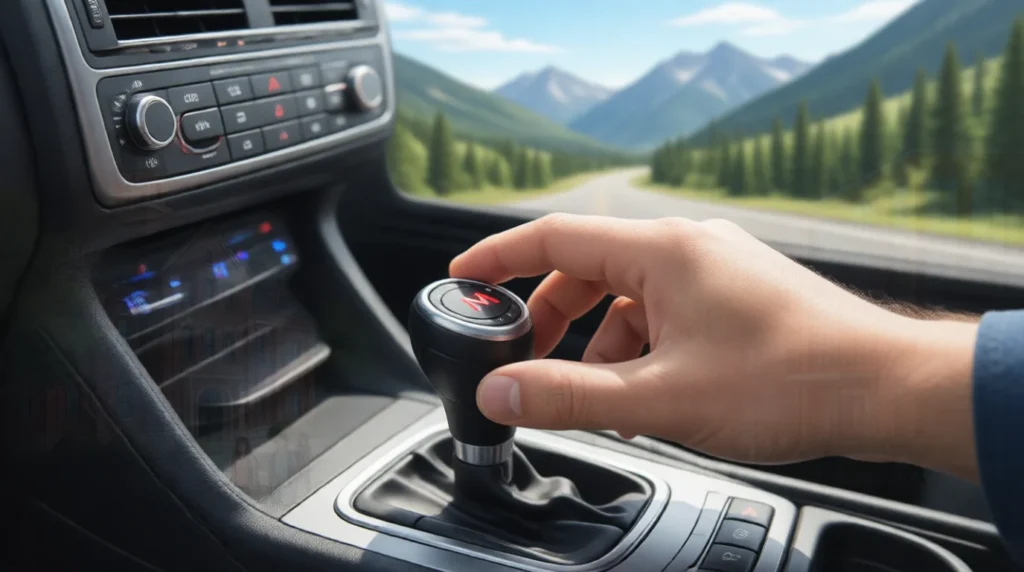
Have you ever glanced at your car’s gear shift and noticed the letter “M” and wondered, “What does ‘M’ mean in a car?” 🤔 You’re not alone! Whether you’re new to driving or just curious about modern automatic transmissions, understanding what M mode is can make your driving smoother, safer, and even more enjoyable.
While automatic transmissions are designed for convenience, M mode bridges the gap between automatic ease and manual control. This feature has grown in popularity as cars become more technologically advanced, giving drivers the ability to take control of gear shifting without a traditional clutch pedal.
In this article, we’ll explore what “M” means, its origin, practical uses, examples, comparisons with other gear modes, alternative meanings, and tips for driving confidently with it.
Definition:
In a car, “M” usually stands for Manual mode, which allows the driver to manually shift gears even in an automatic transmission vehicle. This mode provides more control over acceleration, engine braking, and overall driving experience, particularly in hilly terrains or sporty driving.
Origin of “M” in Cars
The “M” mode didn’t appear overnight—it’s part of the evolution of automatic transmissions toward more driver engagement. Here’s a quick look at its origin:
- Early Automatic Cars: Traditionally, automatic cars offered only “P, R, N, D” (Park, Reverse, Neutral, Drive). Drivers had no control over the gears.
- Rise of Tiptronic & Manual Override: In the 1990s, car manufacturers introduced Tiptronic transmissions, which allowed manual gear control within automatic systems.
- Introduction of “M” Mode: To indicate manual gear selection, carmakers added the “M” on gear shifters, making it clear that drivers could take charge of shifting.
- Popularity Today: Many modern vehicles, from sedans to SUVs and sports cars, include M mode as a standard or optional feature.
Fun Fact: Some cars display “+” and “–” signs next to the M mode, showing drivers how to shift gears up or down manually.
What Does “M” Do? Usage Explained
M mode gives drivers the power to manually select gears while the car is technically still in automatic mode. Here’s how it works:
- Manual Gear Selection: Drivers push the gear lever or paddle shifters to change gears.
- Enhanced Control: Ideal for steep hills, towing, or sporty driving.
- Engine Braking: Helps slow the car without overusing brakes, especially on downhill slopes.
- Prevent Over-shifting: Keeps the engine from unnecessarily downshifting in traffic or hilly terrain.
When to Use “M”:
- Driving on steep hills
- Overtaking on highways
- Navigating snowy or slippery roads
- Enjoying sporty, responsive driving
Tip: Avoid keeping your car in M mode all the time. Let the transmission manage gear shifts during normal city driving to prevent unnecessary wear.
Examples of M Mode in Action
Here are some real-world examples of when M mode is useful:
| Scenario | Gear Mode | Why M Mode Helps |
|---|---|---|
| Climbing a steep hill 🚗 | M mode | Keeps the car in lower gears for better power |
| Descending a mountain road ⛰️ | M mode | Uses engine braking to control speed |
| Overtaking another vehicle 🏎️ | M mode | Allows quick gear shifts for acceleration |
| City traffic stop-and-go 🚦 | D mode | Automatic mode is easier for frequent stops |
| Sporty driving on a track 🏁 | M mode | Provides precise control over gear changes |
Neutral Tone:
“Switching to M mode while going uphill gave me a much smoother drive without constantly riding the brakes.”
Friendly Tone:
“I love using M mode on my weekend drives—it feels like I’m piloting a sports car without needing a clutch!” 😎
Cautionary Tone:
“Keep in mind that using M mode aggressively in heavy traffic can make driving tiring and may increase fuel consumption.”
M Mode vs Other Gear Modes
To better understand M, let’s compare it with other common gear modes:
| Gear | Meaning | Usage |
|---|---|---|
| P | Park | Locks the transmission; always use when parking |
| R | Reverse | Moves the car backward |
| N | Neutral | Disengages engine; used for towing or idling |
| D | Drive | Automatic gear shifting for regular driving |
| M | Manual | Allows driver to manually select gears |
| S | Sport | Optimized for faster acceleration, sometimes auto-shifting |
Key Differences:
- M vs D: D handles everything automatically; M gives you control.
- M vs S: S mode may shift automatically but holds gears longer for performance; M lets you choose each gear.
- M vs Manual Transmission: M mode mimics manual control but without a clutch pedal.
Alternate Meanings of “M” in Cars
While “M” usually refers to Manual mode, there are a few other possibilities depending on the vehicle:
- BMW M Series: In BMW cars, “M” may indicate a high-performance model (e.g., BMW M3, M5).
- Motor Mode (Electric Vehicles): Some EVs use “M” to indicate a mode optimized for manual regenerative braking.
- Maintenance or Malfunction Indicator: Rarely, “M” could appear on the dashboard as a symbol for maintenance required—but context matters.
Tip: Always check your vehicle’s manual to confirm the exact meaning of “M” for your car model.
How to Use M Mode Properly
Here are some pro tips for using M mode safely and efficiently:
- ✅ Use for Control: Switch to M when you need better gear management.
- ✅ Use Downshifting Wisely: Avoid unnecessary downshifts that strain the engine.
- ✅ Avoid Overuse in Traffic: Let the car handle gears in stop-and-go conditions.
- ✅ Combine with Paddle Shifters: Many cars have paddle shifters for faster, safer gear changes.
- ✅ Practice in Safe Areas: Try M mode in open roads before using it in traffic.
Professional Alternatives to Saying “M”
If you’re discussing your car professionally, you might prefer:
- Manual shift mode (formal, accurate)
- Driver-controlled gear mode
- Manual override in automatic transmission
These alternatives are helpful in car reviews, workshops, or technical discussions.
Conclusion
Understanding what “M” means in a car can transform your driving experience. Whether it’s navigating hilly roads, overtaking safely, or enjoying a sporty drive, M mode gives you the best of both worlds: control without a clutch.
- M = Manual mode in automatic cars
- Provides gear control, engine braking, and performance advantages
- Best used in specific scenarios, not daily city driving
- Always refer to your car’s manual for exact instructions
By mastering M mode, you’ll drive more confidently, efficiently, and safely while making the most of your vehicle’s features. 🚗💨
FAQs
1. Is M mode the same as manual transmission?
No. M mode is a manual gear selection within an automatic transmission, so there’s no clutch pedal.
2. Can I drive in M mode all the time?
Technically yes, but it’s best used when you need extra control, like hills or sporty driving.
3. Does M mode save fuel?
Not necessarily. Improper use may increase fuel consumption because manual shifts may keep the engine at higher RPMs.
4. How do I shift gears in M mode?
Use the gear lever or paddle shifters to move up (+) or down (–) gears manually.
5. Is M mode dangerous for beginners?
Not dangerous, but it requires more attention than D mode. Beginners should practice in open areas.
6. What cars have M mode?
Many modern automatics, including sedans, SUVs, and luxury vehicles like BMW, Mercedes, Audi, and Toyota, offer M mode.
7. Can M mode help in snow or slippery roads?
Yes! M mode allows you to start in a higher gear, reducing wheel spin in slippery conditions.
8. Is there a difference between M and S mode?
Yes. S mode is sport-oriented automatic, while M mode lets you manually select every gear.

John Miller is a professional meanings writer at Meanzy.com, specializing in word definitions, internet slang, acronyms, and text abbreviations. He focuses on delivering clear, accurate explanations with practical examples, helping readers easily understand modern digital terms and their real-life usage.

Pingback: LMC Meaning in Text: What It Stands For and How to Use It (2026)