
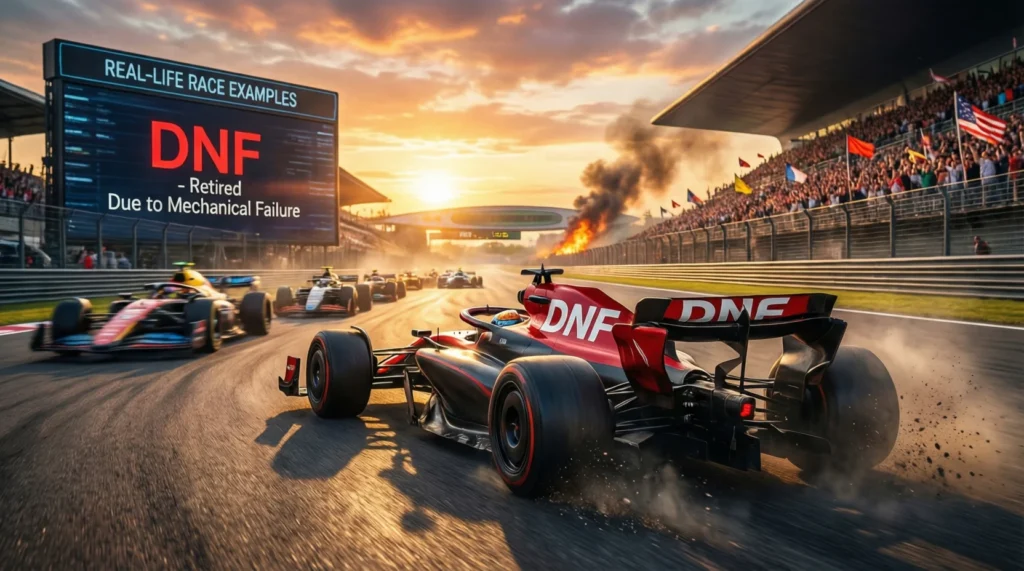
If you’ve ever watched a Formula 1 (F1) race or checked race results online, you might have seen the abbreviation “DNF” in the standings. It’s a common term that can confuse new fans, yet it plays a critical role in understanding race outcomes, statistics, and even championship points.
In this comprehensive guide, we’ll break down what DNF means in F1, explore its origins, usage, examples, related terms, and answer the most common questions fans have. Whether you’re a casual viewer or a racing enthusiast, this article will give you all the clarity you need. 🏎️💨
Definition:
DNF in F1 stands for “Did Not Finish.” It indicates that a driver was unable to complete the race due to technical failure, accidents, crashes, or other issues that forced them to retire before crossing the finish line. DNF does not always reflect poor driving skills it can happen even to top drivers due to mechanical problems or unexpected incidents.
Origin of the Term “DNF”
The abbreviation DNF is widely used in motorsports, not just in Formula 1. Its origin comes from general racing terminology to indicate that a competitor could not finish the course or event.
- Timeline of Popularity:
- 1950s–1960s: Early use in motorsport race scoreboards.
- 1980s–1990s: Standardized in official race results for Formula 1.
- Present: Universally recognized abbreviation in F1, IndyCar, NASCAR, and other racing disciplines.
- 1950s–1960s: Early use in motorsport race scoreboards.
- Why it matters: DNF is crucial for statistical accuracy, championship scoring, and performance analysis. A driver with multiple DNFs may have fewer points in the championship even if they perform well in other races.
Why Do Drivers Get a DNF in F1?
Several reasons can lead a driver to be marked as DNF. It’s not always because of mistakes; sometimes, racing is unpredictable.
Common Causes of DNF:
- Mechanical Failure 🛠️
- Engine breakdown
- Gearbox failure
- Hydraulic issues
- Electrical faults
- Engine breakdown
- Accidents & Collisions 💥
- Multi-car pileups
- Single-car crashes due to track conditions
- Collisions caused by overtaking maneuvers
- Multi-car pileups
- Driver Error 😬
- Spinning off track
- Losing control in wet or tricky conditions
- Missing braking points
- Spinning off track
- Other Factors 🌧️
- Weather-related issues (rain, fog, flooding)
- Debris or obstacles on track
- Health problems or fatigue forcing the driver to retire
- Weather-related issues (rain, fog, flooding)
How DNF Affects Points & Championship
In Formula 1, scoring points depends on finishing positions. If a driver DNFs:
- They typically earn zero points, unless they have completed more than 90% of the race distance (special case).
- It can significantly affect championship standings, especially if top drivers retire unexpectedly.
Example:
| Driver | Race Finish | Points |
| Lewis Hamilton | 1st | 25 |
| Max Verstappen | DNF (engine failure) | 0 |
| Lando Norris | 5th | 10 |
Even if Verstappen was leading, a DNF drops him to zero points, highlighting how crucial reliability is in F1.
Examples of DNF in F1
Let’s look at real-world scenarios where DNF occurs:
- Friendly/Neutral Context
- “Unfortunately, Charles Leclerc got a DNF due to mechanical issues in the Monaco GP.”
- Tone: Informative, neutral.
- “Unfortunately, Charles Leclerc got a DNF due to mechanical issues in the Monaco GP.”
- Negative/Dismissive Tone
- “Another DNF for Bottas he really can’t catch a break this season.”
- Tone: Slightly critical but factual.
- “Another DNF for Bottas he really can’t catch a break this season.”
- Surprise/Emoji Context
- “😱 What a shock! Verstappen ends up with a DNF because of gearbox failure!”
- Tone: Excited, engaging for social media or live commentary.
- “😱 What a shock! Verstappen ends up with a DNF because of gearbox failure!”
DNF vs Other Common Racing Abbreviations
Formula 1 uses several abbreviations that may appear similar to DNF. Here’s a comparison:
| Abbreviation | Full Form | Meaning | Difference from DNF |
| DNF | Did Not Finish | Driver did not complete the race | Main abbreviation for retirements or withdrawals |
| DNS | Did Not Start | Driver failed to start the race | DNF occurs after starting the race; DNS before race start |
| DSQ | Disqualified | Driver removed due to rule violation | Different from mechanical or accident-based DNFs |
| NC | Not Classified | Driver finished less than 90% of race distance | Can be counted as DNF for points purposes |
This table is helpful for understanding official race results in F1 standings.
Alternate Meanings of DNF
While DNF is most commonly associated with racing, it can have other contexts outside F1:
- Gaming: “Do Not Finish” for incomplete game quests.
- Fitness/Running: “Did Not Finish” in marathon or sports event tracking.
- General Usage: Sometimes used metaphorically, e.g., “This plan is a DNF” meaning it failed to complete successfully.
Note: In F1, DNF almost always refers to “Did Not Finish” a race.
Polite or Professional Alternatives to DNF
If you want to phrase DNF in a more formal or professional tone in articles, commentary, or presentations:
- “Retired from the race due to mechanical issues.”
- “Unable to complete the event due to technical failure.”
- “Withdrew from the race after [reason].”
These alternatives maintain clarity while avoiding slang or abrupt abbreviations.
How Fans Talk About DNF
Fans often use DNF casually on social media or forums. Examples include:
- “Wow, Hamilton just got a DNF 😭”
- “DNF again! This season is rough for Bottas.”
- “At least the DNF didn’t affect Verstappen’s championship too much.”
Tips for understanding tone:
- Neutral: Informational, reporting results.
- Critical/Frustrated: When fans are disappointed by repeated DNFs.
- Humorous/Exaggerated: Often used with emojis to react to dramatic race events.
Tips to Avoid DNFs in F1 (From a Driver’s Perspective)
Though fans cannot control outcomes, knowing how drivers minimize DNFs can deepen your appreciation for the sport:
- Vehicle Reliability Check: Regular inspections and upgrades prevent mechanical failures.
- Driver Precision: Staying focused, braking accurately, and avoiding collisions reduces risk.
- Strategy & Pit Stops: Smart tire and fuel management prevent technical issues.
- Weather Adaptation: Adjusting driving style to conditions (rain tires, slower corners).
Example Table: Famous F1 DNFs (2025 Season)
| Race | Driver | Reason for DNF | Notes |
| Monaco GP | Charles Leclerc | Engine failure | Leading the race before retirement |
| British GP | Max Verstappen | Collision | First-lap crash with another driver |
| Italian GP | Lewis Hamilton | Brake failure | Finished 0 points despite being 2nd in standings |
| Singapore GP | Lando Norris | Mechanical | Lost power in last 10 laps |
This table illustrates how DNFs impact top drivers and championship results.
DNF vs Retirements: Are They the Same?
In F1, DNF and “retirement” are often used interchangeably:
- DNF: Abbreviation used in official standings.
- Retirement: Term used in commentary or articles describing why the driver didn’t finish.
Both indicate the same outcome but differ slightly in tone and usage.
DNF in the Context of Modern F1
DNF remains relevant despite technological advancements:
- Modern cars are more reliable, reducing mechanical DNFs.
- However, high-speed crashes and aggressive racing strategies still produce DNFs.
- Understanding DNF helps fans interpret race standings, championship points, and team strategies.
Conclusion:
In conclusion, DNF, or “Did Not Finish,” indicates that a driver was unable to complete a race due to a variety of reasons, including mechanical failures, accidents, driver errors, weather conditions, or other unexpected factors. DNFs typically result in zero points, which can significantly impact championship standings, making reliability and consistency crucial in Formula 1.
It is important to distinguish DNF from similar abbreviations like DNS (Did Not Start) and DSQ (Disqualified), as each represents a different scenario. In professional writing or commentary, alternatives such as “retired from the race” or “unable to complete the race” can be used to maintain a formal tone.
Among fans and on social media, DNF is frequently referenced, often accompanied by emojis to convey surprise, frustration, or excitement. Understanding DNF not only clarifies race results but also enriches your appreciation of F1, highlighting how technical reliability, strategic decisions, and even a bit of luck shape the outcome of every race. 🏁
FAQs:
Here are the most commonly searched questions about DNF:
- What does DNF stand for in F1?
DNF means “Did Not Finish,” indicating a driver was unable to complete the race. - Does a DNF mean the driver performed poorly?
Not always. DNFs can result from accidents, technical failures, or external factors beyond the driver’s control. - Can a driver still get points with a DNF?
Rarely, if they complete more than 90% of the race distance. Otherwise, DNFs usually score zero points. - What’s the difference between DNF and DNS?
DNS means “Did Not Start,” while DNF occurs after a driver starts the race but cannot finish. - How common are DNFs in F1 races?
It varies by season and track. Reliability improvements have reduced DNFs in modern F1, but accidents still happen. - Can DNFs affect the championship?
Yes. Frequent DNFs can severely impact a driver’s overall points and championship position. - Are DNFs used in other sports?
Yes, “Did Not Finish” is used in marathons, running, swimming, and other racing events. - How do commentators announce a DNF?
They often say: “Driver X retires from the race” or “Driver X has a DNF due to [reason].
Read More Related Articles:
- HP Meaning in Games: Everything You Need to Know to Play Better (2026)
- What Does NMS Mean in Texting? Decode the Slang, Real-Life Usage (2026)

John Miller is a professional meanings writer at Meanzy.com, specializing in word definitions, internet slang, acronyms, and text abbreviations. He focuses on delivering clear, accurate explanations with practical examples, helping readers easily understand modern digital terms and their real-life usage.