
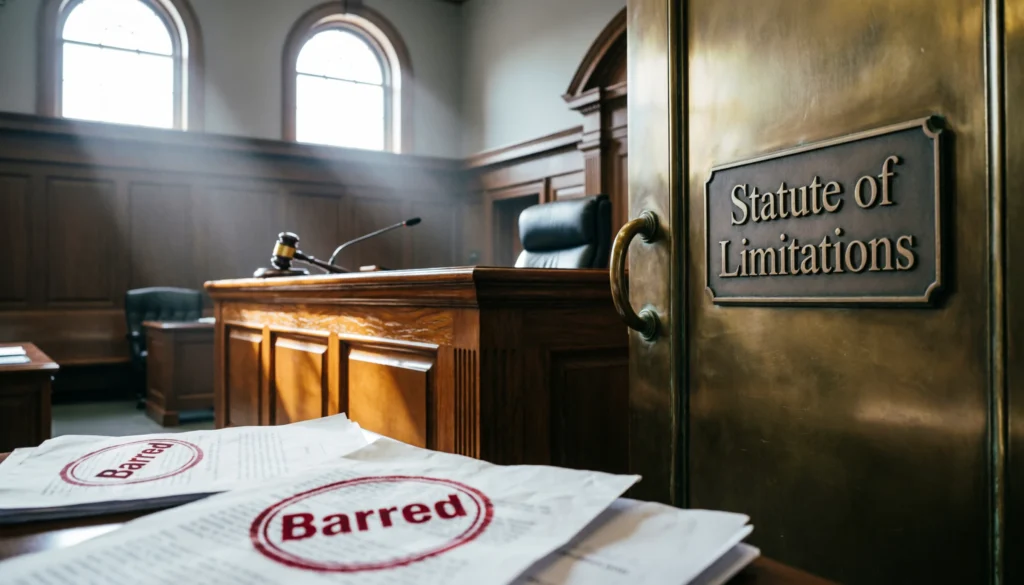
In law, “barred” means that a legal claim, lawsuit, or right is no longer allowed to be pursued, usually because of a legal rule such as the statute of limitations, prior judgment, or procedural failure.
In short, if a case is barred, the court will not hear it.
If you have ever read a court document and seen the phrase “the claim is barred,” you might have wondered what that actually means. Does it mean the case is over? Dismissed? Rejected forever?
In legal language, one word can change everything. And “barred” is one of those words.
Let’s break it down clearly and simply so you understand exactly what barred mean in law, when it applies, and why it matters so much in court cases.
Now let’s go deeper.
Understanding What Barred Means in Law
When a legal action is barred, it does not necessarily mean the claim was false. It simply means the law does not allow it to move forward.
Think of it like a locked door. Even if you believe you have a valid reason to enter, the law says you cannot open that door anymore.
The most common reason a claim is barred is the expiration of the statute of limitations. But there are several other legal reasons too.
Common Legal Contexts Where “Barred” Is Used
- A lawsuit is barred by the statute of limitations
- A claim is barred by prior judgment
- An appeal is barred due to missed deadline
- A claim is barred by waiver
- A case is barred by res judicata
Each situation has a slightly different meaning, which we will explore in detail.
Origin of the Term Barred in Legal Language
The word “bar” comes from Old French and Latin roots meaning obstruction or barrier. In medieval courts, a physical wooden barrier separated the public from legal officials. Only authorized persons could pass beyond the bar.
Over time, the term evolved. In law, to “bar” something means to block it or prevent it from proceeding.
That is why lawyers today still use phrases like:
- Barred from filing
- Barred from recovery
- Barred claim
- Barred action
It carries the idea of being legally blocked.
Most Common Meaning: Barred by the Statute of Limitations
This is the meaning most people encounter.
A statute of limitations is a law that sets a time limit for filing a lawsuit. If you wait too long, your claim becomes barred.
Example
If the law says you must file a personal injury lawsuit within two years of an accident, and you file after three years, your claim is barred.
It does not matter how strong your case is. The court will likely dismiss it.
Why Does the Law Do This?
There are practical reasons:
- Evidence becomes unreliable over time
- Witnesses forget details
- Courts encourage timely disputes
- It promotes fairness and finality
Table 1: Common Situations Where Claims Become Barred
| Situation | Why It Becomes Barred | Example |
|---|---|---|
| Expired statute of limitations | Filed after legal time limit | Filing injury claim after 3 years when limit is 2 |
| Res judicata | Issue already decided by court | Suing again for same dispute |
| Waiver | Party gave up right voluntarily | Signing agreement not to sue |
| Procedural default | Missed filing or appeal deadline | Filing appeal after deadline |
| Bankruptcy discharge | Debt legally eliminated | Creditor trying to collect discharged debt |
Barred by Res Judicata
Another common legal phrase is res judicata.
Res judicata is a doctrine that prevents the same parties from litigating the same issue again once it has been decided.
If a judge has already ruled on your case, you generally cannot bring the same claim again.
In that situation, your claim is barred by res judicata.
This protects the court system from repeated lawsuits over the same matter.
Barred by Waiver
A waiver happens when someone voluntarily gives up a legal right.
For example:
- Signing a contract agreeing not to sue
- Agreeing to arbitration instead of court
- Settling a claim and signing a release
If you later try to file a lawsuit on that same issue, it may be barred because you waived your right.
Barred in Criminal Law
The term barred also appears in criminal law.
A criminal prosecution may be barred if:
- The statute of limitations has expired
- Double jeopardy applies
- Immunity has been granted
For example, under the Fifth Amendment of the United States Constitution, a person cannot be tried twice for the same crime. If the government tries again after an acquittal, the case is barred by double jeopardy.
Tone and Real World Usage of “Barred”
The word “barred” often carries a firm or final tone.
It can sound:
- Neutral in legal documents
- Negative or dismissive in casual conversation
- Authoritative in court rulings
Friendly Context Example
“I would love to help, but the deadline has passed and the claim is barred now.”
Tone: Polite but firm.
Neutral Legal Example
“The plaintiff’s action is barred by the statute of limitations.”
Tone: Formal and objective.
Dismissive Tone Example
“That argument is barred. The court already decided this.”
Tone: Final and closed.
The tone depends on the context, but legally it almost always signals finality.
Comparison With Similar Legal Terms
Many people confuse “barred” with other legal terms like dismissed, denied, or prohibited. They are related but not identical.
Table 2: Barred vs Similar Legal Terms
| Term | Meaning | Key Difference |
|---|---|---|
| Barred | Not legally allowed to proceed | Often due to rule or deadline |
| Dismissed | Case closed by court | May or may not be permanent |
| Denied | Request refused | Does not always prevent refiling |
| Prohibited | Forbidden by law | Broader than barred |
| Time barred | Specifically barred due to time limit | Subcategory of barred |
For example, a case dismissed without prejudice may be refiled. But if it is barred by statute of limitations, refiling is not allowed.
Barred vs Time Barred
You may see the phrase time barred.
Time barred specifically means barred because the statute of limitations expired.
All time barred claims are barred, but not all barred claims are time barred.
Alternate Meanings of Barred
Although we are focusing on legal meaning, the word barred can have other meanings:
- Physically blocked or closed
- Restricted from entering a place
- Pattern with stripes
For example:
“He was barred from the club.”
“The windows were barred.”
But in law, barred always refers to a legal restriction or prohibition.
Practical Examples in Different Legal Areas
Table 3: Examples Across Legal Fields
| Legal Field | Example of Barred | Explanation |
|---|---|---|
| Personal Injury | Injury claim barred after 2 years | Missed statute of limitations |
| Contract Law | Claim barred due to arbitration clause | Agreed to private dispute resolution |
| Family Law | Appeal barred due to missed deadline | Failed to file in time |
| Criminal Law | Prosecution barred after 5 years | Criminal statute expired |
| Civil Litigation | Case barred by res judicata | Issue already decided |
Professional Alternatives to Saying “Barred”
If you are writing professionally and want variation, you may use:
- Legally precluded
- Not legally permissible
- Procedurally barred
- Time barred
- Foreclosed by law
- Prohibited under statute
These alternatives are helpful in academic or legal writing.
Why Understanding “Barred” Is Important
Knowing what barred means in court can:
- Prevent costly legal mistakes
- Help you file cases on time
- Avoid refiling dismissed claims
- Clarify whether you still have legal rights
Many people lose valid claims simply because they waited too long.
Legal timing matters more than people realize.
FAQs
What does barred mean in a court case?
It means the court will not allow the case to proceed due to a legal rule such as an expired time limit, prior judgment, or procedural issue.
Does barred mean the case was dismissed?
Not exactly. A barred case is usually dismissed, but the reason matters. If it is barred, it often cannot be refiled.
What does time barred mean in law?
Time barred means the statute of limitations has expired, preventing the claim from being filed.
Can a barred case ever be reopened?
Generally no. However, rare exceptions exist if special circumstances apply, such as fraud or newly discovered evidence.
Is barred the same as denied?
No. Denied means a request was refused. Barred means legally prohibited from moving forward.
What does barred by res judicata mean?
It means the issue has already been decided by a court, and the same parties cannot litigate it again.
What does procedurally barred mean?
It means a claim is blocked because proper legal procedures were not followed, such as missing a filing deadline.
What happens if a claim is barred?
The court will dismiss it, and the person typically loses the right to pursue that claim.
Conclusion:
It means a legal claim or right is blocked from being pursued due to a rule, deadline, or prior legal decision.
The most common reason is the statute of limitations, but other doctrines like res judicata, waiver, and procedural default also apply.
When you see the word barred in legal documents, understand that it signals finality. The court is saying the door is closed.
If you believe you may have a legal claim, acting quickly is critical. Waiting too long can permanently bar your rights.
Legal timing is not just important. It is everything.
Read More Related Articles:
- Cobbing Meaning in Dogs: Signs, Reasons & When to Worry In 2026
- Southpaw Meaning in Boxing: The Advantage Most Fans Miss In 2026
- Sarah Means in Hebrew: Legacy and Cultural Influence In 2026

Megan Foster is a thoughtful and creative content creator at Meanzy.com with a strong curiosity for language and communication. Known for her clarity and attention to detail, she simplifies confusing slang, acronyms, and modern terms into easy, relatable meanings readers can trust.