
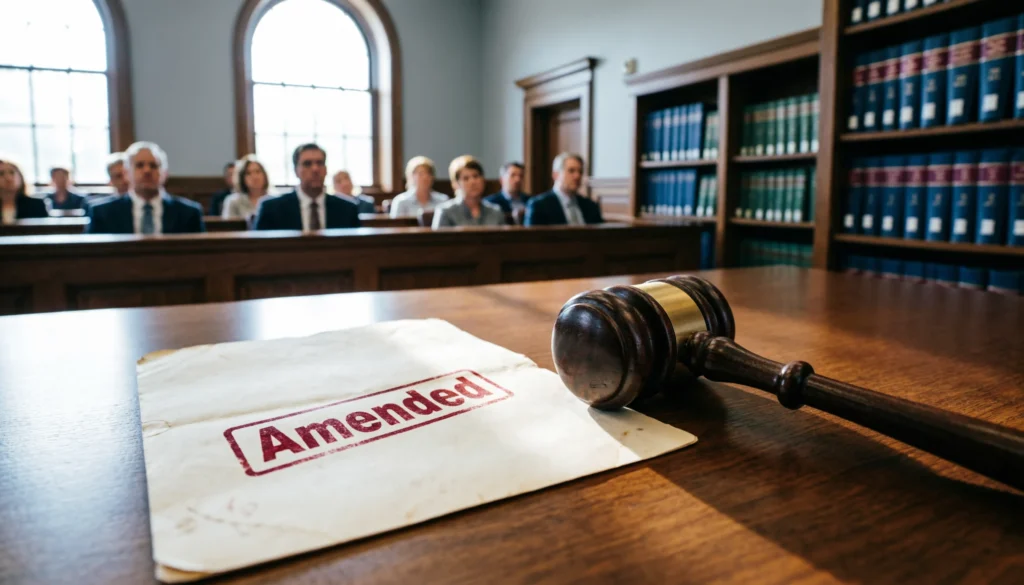
Amended in court means that a legal document, charge, complaint, motion, or judgment has been officially changed, corrected, or updated after it was originally filed.
If you’ve ever read a court document and noticed the word “amended” stamped at the top, you might have wondered: Did something go wrong? Was there a mistake? Or is this just a normal part of the legal process?
In reality, the word amended is extremely common in legal proceedings. It doesn’t always mean something bad happened. Often, it simply means a correction, clarification, or update was made.
Let’s break it down clearly.
The amendment can fix errors, add new information, remove details, or modify legal claims. Once amended, the new version replaces the original document.
Now let’s explore this term in depth so you fully understand how and why it’s used in legal settings.
Understanding the Word “Amended” in Legal Context
In everyday English, amend simply means to change or improve something. In court, the meaning is similar but more formal and structured.
When something is amended in court, it means:
• A document was modified after filing
• The court approved a correction or update
• A party requested changes to an existing legal filing
• The legal record has been updated
For example:
• An amended complaint
• An amended petition
• An amended charge
• An amended judgment
Each of these means the original document was changed in some way.
Origin and Legal History of “Amended”
The word amend comes from the Latin term emendare, which means “to correct” or “to free from fault.” It entered English through Old French in the Middle Ages.
In legal history, amendments became essential as court systems grew more formal. Early legal systems required strict procedures. If mistakes were made, cases could be dismissed entirely. Over time, courts recognized that fairness sometimes requires allowing corrections.
Today, most legal systems including those in the United States, the United Kingdom, Canada, Australia, and Pakistan allow amendments under specific rules.
For example:
• In the United States federal system, amendments to pleadings are governed by the Federal Rules of Civil Procedure
• Criminal procedure is often governed by the Federal Rules of Criminal Procedure
These rules explain when and how documents can be amended.
Why Documents Get Amended in Court
There are many reasons a court document might be amended. Not all amendments mean something serious or dramatic happened.
Here are common reasons:
1. Clerical Errors
• Misspelled names
• Wrong dates
• Incorrect addresses
• Typographical mistakes
These are simple corrections.
2. Adding New Information
• New evidence discovered
• Additional facts
• Updated damages amounts
• Additional legal claims
3. Changing Legal Strategy
• Narrowing claims
• Removing weak arguments
• Strengthening specific points
4. Prosecutorial Adjustments in Criminal Cases
• Reducing charges
• Adding charges
• Clarifying the legal statute violated
Types of Amended Court Documents
Here is a helpful table showing common amended court filings and what they mean.
Table 1: Common Amended Legal Documents
| Document Type | What It Means | Example Situation |
|---|---|---|
| Amended Complaint | Plaintiff updated the original lawsuit filing | Adding a new claim for damages |
| Amended Petition | A revised formal request to the court | Updating custody terms in family court |
| Amended Indictment | Prosecutor changed formal criminal charges | Adding an additional charge |
| Amended Judgment | Court corrected or updated its final decision | Fixing a sentencing error |
| Amended Answer | Defendant revised their response | Adding new defenses |
What Does “Amended Complaint” Mean in Court?
An amended complaint is one of the most searched legal phrases.
In civil lawsuits, the complaint is the first document filed by the plaintiff. If they realize something is missing or incorrect, they may file an amended complaint.
Example:
Friendly tone context:
“We’ve filed an amended complaint to include the new evidence.”
Neutral legal tone:
“Plaintiff files this First Amended Complaint pursuant to Rule 15.”
Negative or strategic tone:
“The amended complaint appears to attempt to cure deficiencies in the original filing.”
Notice how tone changes perception even though the legal meaning stays the same.
First Amended, Second Amended, and So On
You may see phrases like:
• First Amended Complaint
• Second Amended Petition
• Third Amended Motion
Each amendment replaces the previous version. Courts often require permission after the first amendment.
Table 2: Amendment Numbering Explained
| Term | Meaning |
|---|---|
| Original Complaint | First version filed |
| First Amended Complaint | First revision |
| Second Amended Complaint | Second revision |
| Final Amended Complaint | Last approved version |
What Does “Amended Charges” Mean in Criminal Court?
In criminal cases, amended charges can significantly impact a defendant.
This could mean:
• Charges were reduced
• Charges were increased
• Charges were clarified
• A plea agreement changed the offense level
For example:
Original charge: Felony theft
Amended charge: Misdemeanor theft
This is often seen in plea negotiations.
However, sometimes amended charges can be more serious, depending on new evidence.
Does Amended Mean the Original Was Wrong?
Not necessarily.
An amendment does not automatically mean:
• The original filing was false
• Someone committed misconduct
• The case is weak
Sometimes it simply means the legal team refined the document.
However, repeated amendments might suggest:
• Poor preparation
• Strategic adjustments
• Complex or evolving facts
Legal Procedure for Amending a Court Document
Courts do not allow unlimited changes.
Generally, the process includes:
• Filing a motion to amend
• Requesting court permission
• Notifying the other party
• Explaining the reason for amendment
In some systems, the first amendment can be filed “as a matter of right” within a certain time frame. After that, court approval is required.
Comparison With Similar Legal Terms
Understanding related terms helps avoid confusion.
Table 3: Amended vs Similar Legal Terms
| Term | Meaning | Key Difference |
|---|---|---|
| Amended | Changed or corrected | Official update to a filed document |
| Supplemented | Additional information added | Does not replace original |
| Corrected | Fixed minor error | Often clerical only |
| Vacated | Cancelled by court | Removes prior decision |
| Modified | Altered part of an order | May not replace entire document |
Important distinction:
An amended document replaces the earlier one. A supplemented document adds to it.
Real World Usage Examples
Let’s look at how the word appears in actual court communication.
Formal legal language:
“The State hereby files an Amended Information.”
Neutral explanation:
“The court issued an amended judgment to correct a sentencing calculation.”
Professional email tone:
“Please find attached the amended petition reflecting the updated custody schedule.”
Concerned tone:
“Why were the charges amended at the last hearing?”
Dismissive tone:
“They had to amend their complaint because it was incomplete.”
Context matters.
Alternate Meanings Outside Court
While this article focuses on court usage, “amended” is also used in:
• Legislative processes such as amendments to laws or constitutions
• Contracts and business agreements
• Academic policies
• Organizational bylaws
For example, the United States Constitution contains formal amendments that change its original text.
However, in legal court settings, amended specifically refers to changes in filed legal documents.
Professional Alternatives to Saying “Amended”
In formal writing, you may also see:
• Revised
• Updated
• Modified
• Corrected
• Restated
• Refiled
However, in court documents, “amended” is usually the correct technical term.
Does an Amendment Help or Hurt a Case?
It depends.
An amendment can help when:
• It strengthens claims
• It corrects a damaging mistake
• It includes important new evidence
• It clarifies confusing language
It can hurt when:
• It appears reactive or defensive
• It delays proceedings
• It exposes weaknesses
• The court denies the amendment
Each situation is unique.
FAQs
Here are common search queries people ask about amended in court.
What does amended mean in court documents?
It means the document was officially changed or corrected after its original filing. The amended version replaces the earlier version in the court record.
What is an amended complaint in a lawsuit?
An amended complaint is a revised version of the original lawsuit filing. It may add claims, fix errors, or update factual information.
Can charges be amended after filing?
Yes. In many criminal cases, prosecutors can amend charges before trial, often due to new evidence or plea negotiations. Court approval may be required.
Does amended mean dismissed?
No. Amended means changed. Dismissed means the case or claim was thrown out.
How many times can a complaint be amended?
This depends on court rules. Many systems allow one amendment automatically, but additional amendments require judicial approval.
What happens after a document is amended?
The opposing party usually has the opportunity to respond to the amended filing. Deadlines may reset depending on court rules.
Is an amended judgment final?
Yes, if the court issues an amended judgment, that updated version becomes the official ruling unless further appealed.
Does amended mean guilty in criminal court?
No. Amended refers to changes in charges or filings. It does not determine guilt or innocence.
Conclusion
So, what does amended mean in court?
It means a legal document or charge has been formally changed, corrected, or updated after its original filing. The amended version becomes the official record moving forward.
Amendments are part of how courts ensure fairness and accuracy. They allow legal parties to fix mistakes, clarify arguments, and respond to new information.
Rather than seeing the word amended as a red flag, think of it as a procedural tool. It keeps the legal process precise and adaptable.
If you ever receive or review an amended filing, check what changed, why it changed, and how it impacts your position. That context matters more than the word itself.
Legal language can feel intimidating. But once you break it down, it becomes much clearer.
Read More Related Articles:
- What Does OG Mean in Fortnite? Simple Explanation for New Players In 2026
- What Does DNF Mean in F1: Real-Life Race Examples (2026)
- What Does Folding Mean in Slang? Definition, Origin, Examples & Usage (2026)

John Miller is a professional meanings writer at Meanzy.com, specializing in word definitions, internet slang, acronyms, and text abbreviations. He focuses on delivering clear, accurate explanations with practical examples, helping readers easily understand modern digital terms and their real-life usage.