
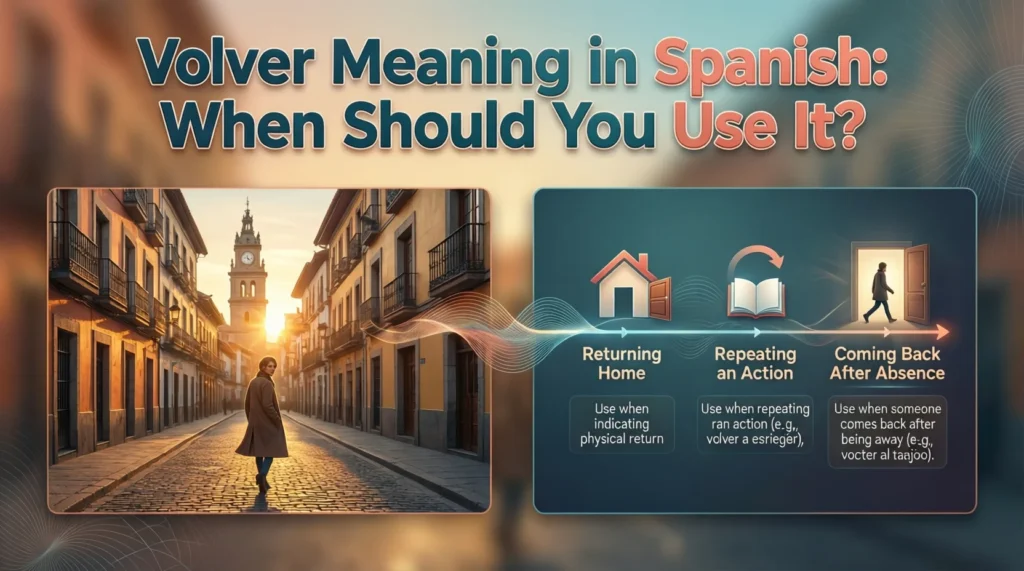
Volver is a Spanish verb that means “to return,” “to come back,” or “to go back” to a place, situation, or state. It is used to describe physical returns, repeated actions, and emotional or metaphorical comebacks.
Volver is one of those Spanish verbs you will see everywhere. In songs, conversations, books, and everyday messages, it keeps popping up. If you are learning Spanish or simply curious about the language, understanding volver will instantly level up your comprehension.
At its core, volver is simple. But in real life, it carries emotion, intention, and sometimes nostalgia. Let’s break it all down clearly and naturally.
Why “Volver” Matters in Spanish
Spanish speakers rely heavily on volver because it is flexible and expressive. It can describe something as basic as going back home or something deeper like returning to an old habit, relationship, or feeling.
You will hear it in daily speech, formal writing, music lyrics, and even motivational phrases. Learning how it works makes your Spanish sound more natural and confident.
The Origin of the Word “Volver”
The verb volver comes from the Latin word volvere, which means “to turn” or “to roll.” Over time, this idea of turning evolved into the modern Spanish meaning of returning or coming back.
That original sense of movement is still present today. Whether you are turning back physically or mentally, volver captures that motion.
Historical Evolution at a Glance
| Stage | Meaning | Example Concept |
|---|---|---|
| Latin volvere | To turn or roll | Turning a wheel |
| Old Spanish | To turn back | Changing direction |
| Modern Spanish | To return or repeat | Coming back home |
How Common Is “Volver” in Real Life?
Very common. Volver is considered a high frequency verb in Spanish. Native speakers use it daily, and learners encounter it early in their studies.
You will find it in:
• Casual conversations
• News headlines
• Songs and poetry
• Movies and TV shows
• Professional and written Spanish
In fact, there is even a famous Spanish song and movie titled “Volver”, highlighting how emotionally powerful the word can be.
Core Meanings of Volver in Spanish
The verb volver has a few main uses. Understanding each one helps you recognize it instantly.
1. To Return to a Place
This is the most literal and common meaning.
Examples
• Voy a volver a casa.
I am going to return home.
• Ella volvió al trabajo después de las vacaciones.
She returned to work after the vacation.
2. To Do Something Again
Volver is often used with another verb to show repetition.
Examples
• Voy a volver a intentarlo.
I am going to try again.
• No quiero volver a cometer el mismo error.
I do not want to make the same mistake again.
3. To Become or Change Again
Here, volver expresses a change of state.
Examples
• Volvió a estar feliz.
They became happy again.
• Después de la tormenta, todo volvió a la normalidad.
After the storm, everything returned to normal.
Common Sentence Structures With Volver
Understanding how volver fits into sentences makes it easier to use.
Basic Structure
Volver + a + infinitive verb
Example
Voy a volver a estudiar español.
This structure means you will do something again.
Structure Overview Table
| Structure | Meaning | Example |
|---|---|---|
| Volver + place | Return to a location | Volver a casa |
| Volver a + verb | Do again | Volver a llamar |
| Volver a + state | Return to a condition | Volver a ser feliz |
Tone and Emotion When Using “Volver”
The tone of volver depends entirely on context. It can feel warm, neutral, or even dismissive.
Friendly or Emotional Tone
Often used in affectionate or hopeful contexts.
Examples
• Siempre volveré por ti ❤️
I will always come back for you.
• Qué bueno verte volver 😊
It is so nice to see you back.
Neutral Everyday Tone
Used in normal conversation.
Examples
• Voy a volver mañana.
I will return tomorrow.
• Él volvió temprano.
He came back early.
Negative or Dismissive Tone
Sometimes used with frustration.
Examples
• No vuelvas a hacer eso.
Do not do that again.
• Nunca quiero volver a ese lugar.
I never want to return to that place.
Volver Verb Conjugation Overview
Volver is an irregular verb because it changes its stem in some tenses.
Present Tense Conjugation
| Pronoun | Volver |
|---|---|
| Yo | vuelvo |
| Tú | vuelves |
| Él / Ella | vuelve |
| Nosotros | volvemos |
| Vosotros | volvéis |
| Ellos | vuelven |
Notice how the “o” changes to “ue” in most forms.
Examples of Volver in Real Context
Here is a practical table showing how volver works in different situations.
Labeled Example Table
| ContextSpanish SentenceEnglish Meaning | ||
|---|---|---|
| Travel | Volvimos a España el lunes. | We returned to Spain on Monday |
| Work | Voy a volver a llamar al cliente. | I will call the client again |
| Emotions | Ella volvió a confiar en él. | She trusted him again |
| Warning | No vuelvas a llegar tarde. | Do not be late again |
Comparison With Similar Spanish Verbs
Spanish has several verbs related to movement and return. Let’s compare them.
Volver vs Regresar
Both mean “to return,” but volver is more common and flexible.
| Verb | Usage | Example |
|---|---|---|
| Volver | General and emotional | Volver a casa |
| Regresar | Slightly formal | Regresar al país |
Retornar vs Volver
Retornar is formal and often used in writing or official contexts.
| Verb | Tone | Common Use |
|---|---|---|
| Volver | Natural, spoken | Everyday speech |
| Retornar | Formal | News, reports |
lr vs Volver
Ir means to go, not return.
| Verb | Direction | Example |
|---|---|---|
| Ir | Away from speaker | Voy al trabajo |
| Volver | Back to origin | Vuelvo del trabajo |
Alternate and Extended Meanings of Volver
Beyond its main meaning, volver appears in many expressions.
Common Expressions With Volver
- Volver en sí
- To regain consciousness or awareness
- Volver loco
- To drive one to their limit
- Volver atrás
- To go back or reconsider
- Volver a empezar
- To start over
These expressions add depth and emotion to Spanish communication.
Polite and Professional Alternatives to Volver
In formal settings, you may want a softer or more professional option.
Professional Alternatives
| Alternative | When to Use | Example |
|---|---|---|
| Regresar | Formal speech | Regresaré a la oficina |
| Retornar | Written or official | Retornar al país |
| Reanudar | Resume an action | Reanudar el trabajo |
Volver in Music, Movies, and Culture
One of the reasons volver feels so emotional is its presence in art and culture.
• The famous song “Volver” by Carlos Gardel talks about returning after time and pain.
• The Spanish film “Volver” by Pedro Almodóvar explores memory, family, and emotional returns.
In culture, volver often symbolizes nostalgia, second chances, and personal growth.
FAQs
What does volver mean in English?
It means to return, to come back, or to do something again, depending on the context.
Is volver regular or irregular?
It is an irregular verb, with stem changes in some tenses (for example, vuelvo, vuelve).
Can volver mean “again”?
Yes. When followed by “a” + an infinitive, it means to do something again (e.g., volver a intentar).
What is the difference between volver and regresar?
Volver is more common and often carries emotional nuance, while regresar sounds slightly more formal and neutral.
Can volver be used emotionally?
Absolutely. It’s often used to express emotions, memories, or personal transformation.
Is volver used in formal Spanish?
Yes, it is. However, more formal alternatives like retornar are sometimes preferred.
How do you say “never again” using volver?
You can say nunca volveré a hacerlo.
Does volver always involve movement?
Not always. It can also describe emotional, mental, or symbolic change—not just physical movement.
Practical Tips for Using Volver Naturally
• Use volver when talking about repeating actions
• Combine it with emotions to sound expressive
• Practice common phrases like volver a intentar
• Listen to native speakers to catch natural tone
The more you hear it, the more intuitive it becomes.
Conclusion:
Volver is more than just a verb meaning “to return.” It reflects repetition, emotion, growth, regret, hope, and second chances. Whether you are talking about going back home, trying again, or rediscovering yourself, volver fits naturally.
Mastering this verb helps you sound more fluent, more human, and more connected to Spanish culture. Once you start using it, you will notice how often it appears everywhere.
Read More Related Articles:
- Muy Meaning in Spanish: How to Use It Correctly (2026)
- Como Estas Mean in English: Usage Explained (2026)

Megan Foster is a thoughtful and creative content creator at Meanzy.com with a strong curiosity for language and communication. Known for her clarity and attention to detail, she simplifies confusing slang, acronyms, and modern terms into easy, relatable meanings readers can trust.