
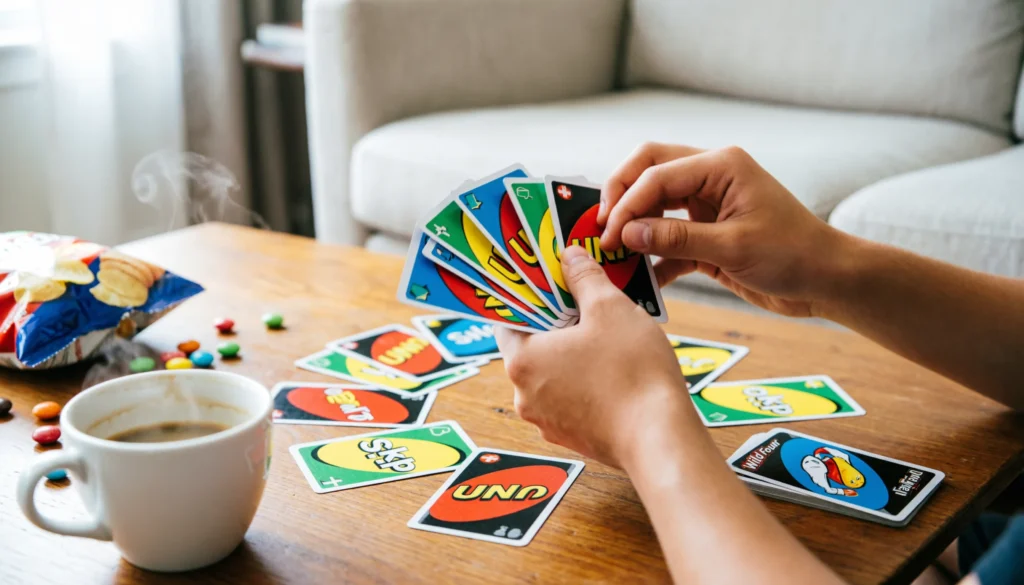
In UNO, “shuffle cards” refers to the action of thoroughly mixing the deck to ensure that the order of cards is random before dealing to players or when the draw pile runs out. Shuffling prevents predictability, keeps the game fair, and adds excitement by creating unexpected combinations of cards.
If you’ve ever played UNO and suddenly had your entire hand mixed up with everyone else’s, you’ve likely encountered the Shuffle Cards rule. But what exactly does “shuffle cards” mean in UNO, and how does it affect the game?
In certain UNO versions—especially UNO Attack and some modern editions—the Shuffle Cards action forces all players to combine their hands, shuffle them together, and redistribute the cards evenly. This can completely change the direction of the game in seconds, turning a near win into a major setback.
Understanding how the Shuffle Cards rule works helps you prepare for unexpected twists and adjust your strategy quickly. In this guide, we’ll explain the rule clearly, explore when it applies, and show how it can dramatically impact your chances of winning.
Origin of Shuffle Cards in UNO
UNO, the popular card game created in 1971 by Merle Robbins in Ohio, relies heavily on strategy, luck, and timing. The concept of shuffling cards, however, predates UNO and comes from traditional card games like Poker, Bridge, and Rummy, where randomizing the deck ensures fairness.
In UNO, shuffling isn’t just about fairness—it’s about keeping the game dynamic. For example, drawing a Wild Draw Four card immediately after a shuffle can change the entire flow of the game, adding suspense and excitement.
How Shuffle Cards is Used in UNO
Shuffling is a core part of UNO gameplay. Here’s when it’s typically done:
- Before starting a game: To deal each player seven random cards.
- During gameplay: When the draw pile runs out, the discard pile is shuffled to form a new draw pile.
- After a mishap: If cards are dropped or order is unintentionally revealed, a shuffle ensures fairness.
Step-by-Step Example of Shuffling in UNO:
- Gather all cards into a single stack.
- Split the deck roughly in half.
- Interweave the two halves together.
- Repeat 2-3 times for randomness.
- Place the shuffled cards face down to form the draw pile.
This simple process keeps gameplay unpredictable and engaging for all players.
Examples of “Shuffle Cards” in Context
- Friendly context: “Hey, before we start, let’s shuffle the cards so nobody gets an advantage 😄.”
- Neutral context: “Please shuffle the cards. It’s your turn to deal.”
- Dismissive context: “You didn’t shuffle the cards? That’s unfair!”
Comparison With Related Terms
In UNO, “shuffle cards” is often confused with or related to other card terms:
| Term | Meaning | Difference from Shuffle Cards |
|---|---|---|
| Draw cards | Taking a card from the draw pile | Doesn’t involve randomizing the deck |
| Deal cards | Giving cards to players at the start | Usually comes after shuffling |
| Reshuffle | Shuffling the discard pile into the draw pile | Happens during gameplay when the draw pile is empty |
| Stack cards | Placing cards on top of each other | Refers to placement, not randomization |
Alternate Meanings of Shuffle Cards
While in UNO, “shuffle cards” is straightforward, in some contexts it can mean:
- Music playlists: Randomizing the order of songs (“shuffle the playlist”).
- Digital card games: Automatically mixing cards in online games for fairness.
In UNO, however, it specifically refers to the physical or virtual deck of cards being randomized.
Polite and Professional Alternatives
When instructing someone to shuffle cards, here are friendly alternatives:
- “Could you please mix the cards before dealing?”
- “Let’s make sure the cards are well-shuffled.”
- “Please randomize the deck so everyone has an equal chance.”
Why Shuffling Cards is Important in UNO
Shuffling is not just a formality—it’s crucial for gameplay balance. Here’s why:
- Fairness: Prevents players from predicting cards.
- Randomness: Ensures each game is different.
- Excitement: Creates surprise moments with Wild or Skip cards.
- Strategy: Forces players to adapt instead of relying on card order.
Examples of Shuffle Cards in Real-World Gameplay
| Scenario | Action | Outcome |
|---|---|---|
| New Game Start | Shuffle the full deck | All players get random hands |
| Draw Pile Empty | Shuffle discard pile | Game continues without interruption |
| Card Drop | Shuffle all cards | Fair restart after accidental reveal |
Tips for Shuffling UNO Cards Effectively
- Riffle shuffle: Split the deck and interweave the halves.
- Overhand shuffle: Pull small groups from the top and place at the bottom repeatedly.
- Table shuffle: Slide sections of the deck over each other on the table for extra randomness.
- Avoid excessive shuffling that can bend or damage cards.
FAQs
1. What does shuffle cards mean in UNO?
It means to mix the deck thoroughly so that the order of cards is random and unpredictable.
2. How often should you shuffle in UNO?
At the start of each game, whenever the draw pile runs out, and if cards are accidentally revealed.
3. Can I skip shuffling in UNO?
Technically yes, but it can lead to unfair gameplay or predictable outcomes.
4. Does shuffling affect strategy in UNO?
Yes, it ensures that players cannot rely solely on memory or card tracking, making strategy more dynamic.
5. What is the best way to shuffle UNO cards?
A combination of riffle and overhand shuffling provides the most randomness without damaging the cards.
6. What happens if you forget to shuffle the discard pile?
Players may face predictable draws, reducing the fairness and fun of the game.
7. Can digital UNO games shuffle cards automatically?
Yes, most online versions of UNO automatically shuffle the deck after each round.
8. Are there professional terms for shuffling in UNO tournaments?
Yes, official tournament rules refer to it as “randomizing the deck” or “preparing the draw pile.”
Conclusion
Shuffling cards in UNO may seem simple, but it is essential for fair and exciting gameplay. By randomizing the deck, shuffling prevents predictability, enhances strategy, and ensures every game feels fresh. Whether you’re playing casually with friends or in a competitive setting, mastering the shuffle keeps the game fair, fun, and unpredictable. Remember to use polite phrasing when asking others to shuffle and practice proper shuffling techniques to protect your cards.
Read More Related Articles:
- Bonsoir Meaning Explained: When Hello Turns into Good Evening In 2026
- COP Slang Explained: From Police Officer to “Getting Something” (2026)
- What Does Blue Mean in the Bible? Spiritual Significance (2026)

John Miller is a professional meanings writer at Meanzy.com, specializing in word definitions, internet slang, acronyms, and text abbreviations. He focuses on delivering clear, accurate explanations with practical examples, helping readers easily understand modern digital terms and their real-life usage.