
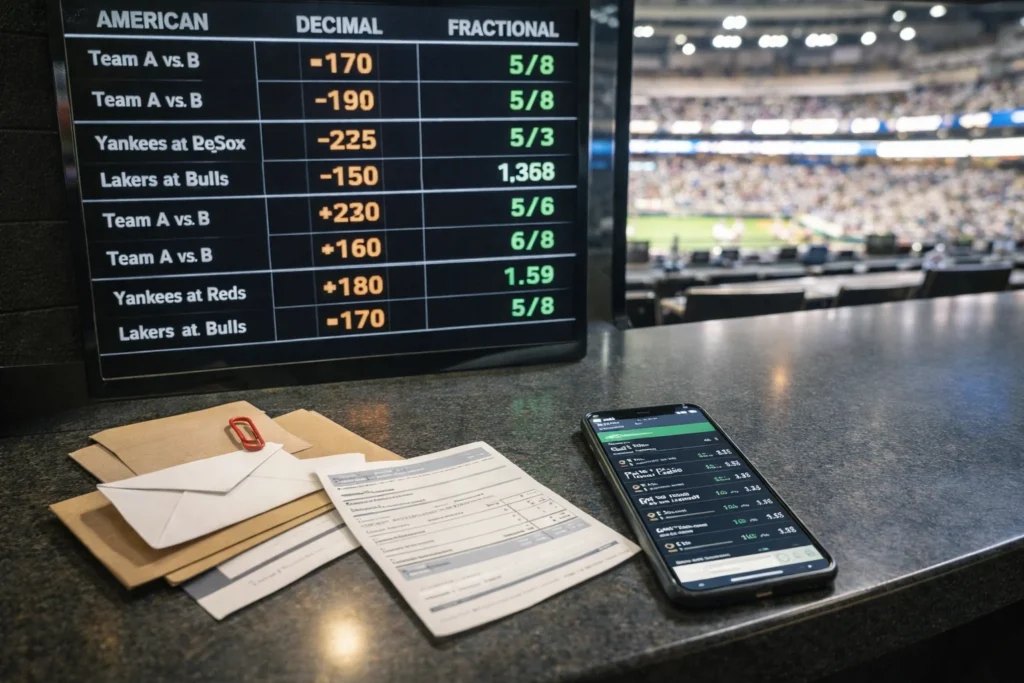
Sports betting odds are numbers set by sportsbooks that show two things: the implied probability of an outcome and how much money you can win based on your wager.
In simple terms, odds tell you how likely something is to happen and how much you will be paid if you are right.
If you have ever opened a sportsbook app and seen numbers like +150, -110, or 2.50 next to a team’s name, you may have wondered what they actually mean. Are they scores? Rankings? Predictions?
Understanding sports betting odds is the key to knowing how much you can win, how likely an outcome is, and whether a bet offers good value. Once you understand the numbers, sports betting becomes much clearer and far less intimidating.
Now let’s break it all down in a friendly, practical way.
What Do the Odds Mean in Sports Betting?
At their core, odds answer two important questions:
- How likely is this outcome?
- How much money will I win if I bet on it?
For example:
- If a team has odds of -200, they are considered more likely to win.
- If a team has odds of +300, they are considered the underdog.
- If odds are 2.00 in decimal format, you double your money if you win.
Odds are not random numbers. They are carefully calculated by sportsbooks to balance risk and attract action on both sides of a bet.
The Origin of Sports Betting Odds
Sports betting dates back centuries. Organized betting systems became popular in the United Kingdom, particularly in horse racing. The modern betting structure evolved alongside major sporting events like the Super Bowl in the United States and global tournaments such as the FIFA World Cup.
Originally, bookmakers used fractional odds, which are still common in the UK. As betting expanded to the US, American odds became standard. Online sportsbooks later popularized decimal odds because they are easier to calculate and understand globally.
Today, betting odds are used in:
- Football
- Basketball
- Baseball
- Soccer
- Tennis
- MMA
- Esports
They have become a universal language in the sports betting industry.
The Three Main Types of Betting Odds
There are three major formats used worldwide:
- American odds
- Decimal odds
- Fractional odds
Let’s compare them clearly.
Table 1: Odds Format Comparison
| Format | Example (Favorite) | Example (Underdog) | Common Regions |
|---|---|---|---|
| American | -150 | +200 | USA |
| Decimal | 1.67 | 3.00 | Europe, Canada |
| Fractional | 2/3 | 2/1 | UK, Ireland |
Even though they look different, they all represent the same information.
American Odds Explained
American odds use positive and negative numbers.
Negative Odds
Example: -150
This means you must bet 150 dollars to win 100 dollars profit.
Negative odds indicate the favorite.
Positive Odds
Example: +200
This means if you bet 100 dollars, you win 200 dollars profit.
Positive odds indicate the underdog.
Quick Example Table
| American Odds | Bet Amount | Profit if Win | Total Payout |
|---|---|---|---|
| -150 | 150 | 100 | 250 |
| +200 | 100 | 200 | 300 |
| -110 | 110 | 100 | 210 |
Notice that -110 is very common in point spread betting. It includes the sportsbook’s built in commission, often called the “vig” or “juice.”
Decimal Odds Explained
Decimal odds are simpler for beginners.
Example: 2.50
You multiply your stake by the number.
If you bet 100:
100 x 2.50 = 250 total payout
Your profit is 150.
Decimal Odds Table
| Decimal Odds | Bet | Total Payout | Profit |
|---|---|---|---|
| 1.50 | 100 | 150 | 50 |
| 2.00 | 100 | 200 | 100 |
| 3.50 | 100 | 350 | 250 |
Decimal odds always include your original stake in the number.
Fractional Odds Explained
Fractional odds are traditional in the UK.
Example: 5/1
For every 1 dollar you bet, you win 5 dollars profit.
If you bet 100:
You win 500 profit plus your 100 stake back.
These are commonly seen in horse racing.
What Do Odds Mean in Terms of Probability?
Odds also represent implied probability.
Here is how that works.
If decimal odds are 2.00, the implied probability is 50 percent.
Formula for decimal odds probability:
1 divided by decimal odds x 100
Example:
1 divided by 2.00 = 0.50
0.50 x 100 = 50 percent
Table 2: Odds and Implied Probability
| Decimal Odds | Implied Probability |
|---|---|
| 1.50 | 66.6% |
| 2.00 | 50% |
| 3.00 | 33.3% |
| 5.00 | 20% |
This means the higher the odds, the lower the implied probability.
Real World Usage of Sports Betting Odds
You will see odds in many contexts:
- Point spreads
- Moneylines
- Totals
- Parlays
- Futures bets
For example, during the National Football League playoffs, you might see:
Team A -7 (-110)
Team B +7 (-110)
Here, -7 is the point spread, and -110 is the price you pay.
In the National Basketball Association, you might see:
Lakers +250 to win the championship
This means they are underdogs compared to other teams.
Tone and Context in Sports Conversations
Odds can carry emotional tone depending on context.
Friendly tone:
“We’re only +180? That’s not bad!”
Neutral tone:
“The implied probability is around 36 percent.”
Negative or dismissive tone:
“They’re -400? That’s way too expensive.”
Understanding this helps you interpret sports betting discussions online or in betting forums.
Comparing Sports Betting Odds With Related Terms
Many beginners confuse odds with other betting terms.
Spread Vs Odds
- Odds show payout and probability.
- Spread refers to the margin of victory.
Odds vs Moneyline
- Moneyline is a type of bet.
- Odds apply to moneyline bets.
Odds vs Vig
- Vig is the commission sportsbooks charge.
- Odds include the vig.
Table 3: Key Differences
| Term | Meaning |
|---|---|
| Odds | Payout and implied probability |
| Spread | Predicted margin of victory |
| Moneyline | Bet on outright winner |
| Vig | Sportsbook commission |
Alternate Meanings of Odds
Outside sports betting, odds can mean:
- Probability in statistics
- Likelihood in everyday language
- Risk evaluation in insurance
For example:
“The odds are in your favor.”
In casual conversation, odds simply mean chances.
Professional Alternatives and Polite Usage
Instead of saying:
“The odds are bad.”
You might say:
“The probability does not justify the risk.”
Instead of:
“That line is terrible.”
You might say:
“That price does not offer value.”
Using professional language is helpful when discussing betting strategy seriously.
Practical Tips for Understanding Betting Odds
Here are useful tips for beginners:
- Always check implied probability before betting.
- Compare odds across sportsbooks.
- Do not assume favorites are always safe.
- Understand how vig affects long term profitability.
- Use decimal odds if you prefer easier math.
If you treat odds as probability tools instead of gambling triggers, you make smarter decisions.
FAQs
What do plus and minus odds mean in sports betting?
Plus odds indicate an underdog and show how much profit you win on a 100 dollar bet. Minus odds indicate a favorite and show how much you must bet to win 100 dollars.
How do you read -110 odds?
You must bet 110 dollars to win 100 dollars profit. This is common in point spread and totals betting.
Are higher odds better?
Higher odds pay more but represent lower probability. They are not automatically better. Value depends on true probability versus implied probability.
What does 2.5 odds mean?
In decimal format, 2.5 means you multiply your bet by 2.5. A 100 dollar bet would return 250 total.
How do sportsbooks set betting odds?
Sportsbooks use statistical models, historical data, betting trends, and risk management strategies to create balanced lines.
What does implied probability mean?
It is the percentage chance an outcome is expected to occur based on the odds.
Why do odds change before a game?
Odds move due to betting volume, injuries, weather updates, or new information.
Can you calculate probability from American odds?
Yes. For negative odds, divide the absolute value by absolute value plus 100. For positive odds, divide 100 by odds plus 100.
Conclusion:
So, what do the odds mean in sports betting?
They represent both probability and payout. They tell you how likely something is to happen and how much money you stand to win.
Key takeaways:
- Negative odds mean favorites.
- Positive odds mean underdogs.
- Decimal odds are easiest for quick calculations.
- Odds reflect implied probability.
- Value matters more than just picking winners.
If you learn to interpret odds correctly, you move from guessing to analyzing. And that shift makes all the difference.
Whether you are watching the next Super Bowl or placing a futures bet on the FIFA World Cup, understanding odds gives you clarity and confidence.
Read More Related Articles:
- BEO Mean in Text Messages: Slang Meaning You Should Know (2026)
- D Meaning in Fantasy Football: It’s Not Just a Letter! In 2026
- Double Chance Meaning in Soccer: How It Works & Smart Betting Strategy (2026)

Megan Foster is a thoughtful and creative content creator at Meanzy.com with a strong curiosity for language and communication. Known for her clarity and attention to detail, she simplifies confusing slang, acronyms, and modern terms into easy, relatable meanings readers can trust.