
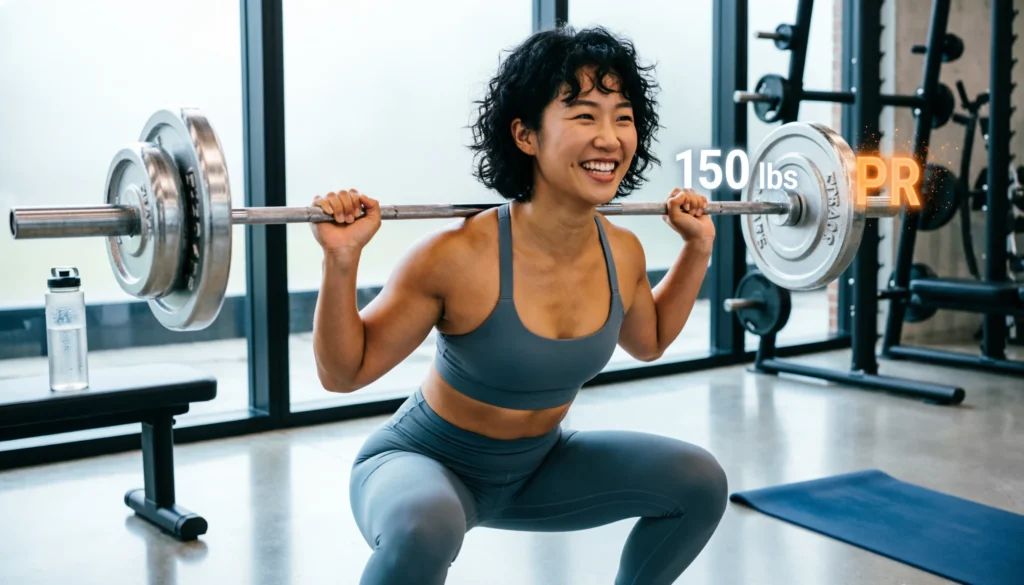
In fitness, PR stands for “Personal Record”, which refers to the best performance an individual has ever achieved in a specific exercise, lift, or workout. It’s a personal milestone that tracks progress, motivates improvement, and sets benchmarks for future workouts.
PR is one of the most exciting terms you’ll hear in fitness—and for good reason. In workouts and training programs, PR stands for Personal Record (or Personal Best). It refers to the best result you have ever achieved in a specific exercise, movement, or performance metric, such as lifting a certain weight, running a distance faster than before, or completing more reps than ever.
In gyms, CrossFit boxes, and fitness apps, hitting a PR is a big deal because it marks personal progress, not comparison with others. Whether it’s a new one-rep max on the bench press or your fastest 5K time, a PR shows that your strength, endurance, or skill has improved.
More than just a number, a PR is a motivational milestone. It helps lifters and athletes track improvement over time, stay consistent, and celebrate small wins that add up to long-term fitness success.
Origin of PR in Fitness
The concept of a personal record (PR) has its roots in competitive strength sports like powerlifting, weightlifting, and bodybuilding. Athletes began tracking their maximum lifts or fastest times to measure improvement. Over time, this idea expanded into general fitness and even endurance sports such as running, rowing, and cycling.
PRs are not just numbers—they symbolize progress, dedication, and personal achievement. While competitive athletes may chase PRs to win competitions, gym enthusiasts often use them as a motivational tool to push past plateaus and celebrate small victories. 🏋️♂️💪
How PR Is Used in Fitness
In everyday fitness, PR can refer to several contexts:
- Strength Training: Achieving your heaviest deadlift, squat, or bench press to date.
- Cardio Workouts: Running your fastest mile or completing a 5k in record time.
- Functional Fitness: Completing more repetitions of a movement or finishing a challenging circuit faster than ever.
Tracking PRs allows fitness enthusiasts to measure progress objectively, avoid plateaus, and plan progressive overload strategies in weightlifting or training programs.
Examples of PRs in Fitness
Here are some examples to clarify how PR is applied in real life:
| Exercise Type | Example of PR | Context |
|---|---|---|
| Bench Press | 185 lbs for 5 reps | First time reaching this weight |
| Deadlift | 315 lbs single lift | Personal best ever |
| Running | 5k in 22 minutes | Fastest personal time recorded |
| Squat | 225 lbs for 8 reps | Breaking through a previous plateau |
| Pull-Ups | 20 consecutive pull-ups | Achieving a new endurance milestone |
PRs can be measured by weight, distance, reps, or time, depending on the activity. The key is that it reflects your personal best, not a standard comparison with others.
PR in Different Fitness Communities
The popularity of PR tracking has grown alongside social media and fitness apps. Gyms, fitness influencers, and online communities often encourage members to celebrate PRs:
- Friendly Tone: “Just hit a new PR on squats! Feels amazing!” 😄
- Neutral Tone: “My PR for the bench press is now 150 lbs.”
- Negative/Dismissive Tone: “Everyone’s always bragging about PRs—who cares about numbers?”
Even if someone finds the concept trivial, PR remains an essential goal-setting metric for measurable improvement.
Comparing PR to Related Terms
While PR is widely used, there are a few related terms and abbreviations in fitness:
| Term | Meaning | Difference from PR |
|---|---|---|
| PB | Personal Best | Essentially the same as PR; more common in running |
| Max / 1RM | One-Rep Max | Refers specifically to the maximum weight for one rep |
| Goal | Target performance | Not necessarily achieved yet |
| Record | Can refer to a personal or official record | Official records are often competitive benchmarks |
Most fitness communities use PR and PB interchangeably, although PR tends to emphasize personal growth in strength and endurance, while PB may be more common in endurance sports.
Alternate Meanings of PR
Although in fitness, PR usually refers to a personal record, the abbreviation PR can have other meanings depending on the context:
- Public Relations – managing a brand or personal image
- Puerto Rico – standard country abbreviation
- Progress Report – in education or business settings
In fitness discussions, these alternate meanings are rarely used, so context is usually clear.
Polite or Professional Alternatives
For a more formal or professional tone, especially in gyms, fitness blogs, or coaching, you can use phrases like:
- Personal Best
- Highest Achievement
- Record Performance
Example: “Congratulations on achieving your personal best in the 100-meter sprint!”
Why Tracking PR Is Important
Tracking PRs in your fitness journey provides multiple benefits:
- Motivation: Seeing tangible progress encourages consistency.
- Goal Setting: Helps set realistic, incremental targets.
- Performance Analysis: Identifies strengths and weaknesses.
- Plateau Breaking: Encourages strategic progression to avoid stagnation.
- Celebration: Small wins boost mental health and satisfaction. 🎉
Without tracking PRs, it’s easy to train blindly, which may slow progress or increase injury risk.
Examples of PR Progression
Consider a beginner lifter tracking their bench press over six months:
| Month | Bench Press PR | Notes |
|---|---|---|
| 1 | 95 lbs | Initial baseline |
| 2 | 115 lbs | Added 20 lbs, focus on form |
| 3 | 130 lbs | Improved strength and consistency |
| 4 | 145 lbs | Started structured program |
| 5 | 160 lbs | Achieved new PR, confident in technique |
| 6 | 175 lbs | Plateau approached, plan to adjust program |
Tracking progress like this visually and numerically reinforces achievements and guides future workouts.
PR in Cardio and Endurance Training
PRs are not limited to lifting. Endurance athletes track speed, distance, and time:
- Running: Fastest mile, 5k, 10k, or marathon time
- Cycling: Longest ride or fastest route completion
- Swimming: Personal best lap times
Tracking PRs in cardio helps athletes optimize pace, stamina, and training load, ensuring improvement over time.
PR in Group Fitness or Challenges
Many group fitness programs, bootcamps, and CrossFit classes use PRs to encourage healthy competition:
- Leaderboard Tracking: Members share weekly or monthly PRs.
- Challenges: “Set a new PR on your deadlift this month.”
- Community Motivation: PRs create a culture of growth and support.
While some may view PR competition negatively, it can enhance accountability and camaraderie when approached positively.
Common Mistakes When Chasing PRs
Even though PRs are valuable, they can be misused:
- Overemphasis on Numbers: Prioritizing PR over form can lead to injury.
- Ignoring Recovery: PR attempts require proper rest and nutrition.
- Comparison with Others: PR is personal, not a benchmark against peers.
Always remember: PR is about your progress, not anyone else’s. 🏆
FAQs
1. What is considered a PR in fitness?
A PR, or personal record, is any performance—weight, reps, distance, or time—that surpasses your previous best in a particular exercise or workout.
2. Is PR the same as PB?
Yes, PB stands for personal best and is often used interchangeably with PR, especially in endurance sports.
3. How often should I try to set a PR?
It depends on your training program. Beginners may see frequent PRs, while advanced athletes might achieve them every few months with progressive overload.
4. Can PRs apply to bodyweight exercises?
Absolutely. Examples include push-ups, pull-ups, squats, or even holding a plank longer than ever.
5. Should I attempt PRs every workout?
No. PR attempts should be planned to avoid overtraining. Focus on consistent progress, not constant maximum effort.
6. How do I track PRs effectively?
Use a workout journal, mobile app, or fitness tracker to log your weight, reps, distance, or time for each exercise.
7. Are PRs only for competitive athletes?
Not at all. Anyone can track personal progress and celebrate achievements regardless of experience level.
8. Can PRs improve motivation?
Yes, seeing tangible improvement boosts morale, reinforces consistency, and makes workouts more rewarding.
Conclusion:
PR stands for Personal Record and refers to the best performance you’ve personally achieved in a specific exercise or activity. It applies across strength training, cardio workouts, and functional fitness, making it a universal way to measure progress. Tracking PRs helps boost motivation, supports clear goal-setting, and shows tangible improvement over time.
However, PRs should always remain personal rather than competitive to avoid unnecessary risk or injury. In more professional or formal contexts, terms like PB (personal best), personal best, or record performance are often used as suitable alternatives.
Read More Related Articles:
- What Does Offsides Mean in Football? Football’s Most Misunderstood Rule In 2026
- What Does 7Y Mean in Shoe Size? With Buying Tips (2026)
- What Does Pump Mean in the Gym? The Feeling Lifters Chase In 2026

John Miller is a professional meanings writer at Meanzy.com, specializing in word definitions, internet slang, acronyms, and text abbreviations. He focuses on delivering clear, accurate explanations with practical examples, helping readers easily understand modern digital terms and their real-life usage.