
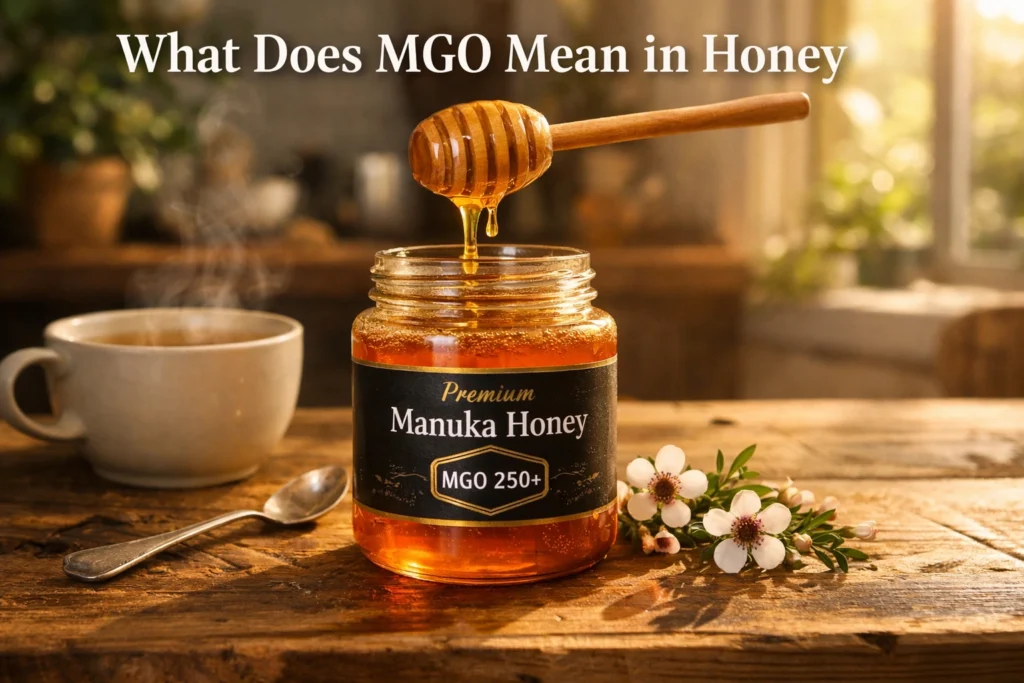
MGO in honey stands for Methylglyoxal, a naturally occurring compound responsible for the antibacterial properties of certain types of honey, particularly Manuka honey.
For example:
MGO 100+ means the honey contains at least 100 mg of methylglyoxal per kilogram
MGO 250+ means at least 250 mg/kg
MGO 550+ means at least 550 mg/kg
Honey has always been known as a natural sweetener, but in recent years certain types of honey have gained global attention for their potential health benefits. If you have ever looked at a jar of premium honey and noticed labels like MGO 100+, MGO 250+, or MGO 550+, you may have wondered what those numbers actually mean.
Understanding what MGO means in honey can help you choose better quality honey and understand why some jars cost significantly more than others.
In simple terms, MGO is one of the most important indicators of honey’s antibacterial strength and purity, especially in certain specialty honeys.
The number next to MGO indicates the concentration of methylglyoxal in milligrams per kilogram (mg/kg) of honey. A higher MGO rating generally means stronger antibacterial activity and higher quality honey.
The higher the number, the stronger the honey’s natural bioactive properties.
Why MGO in Honey Matters
Not all honey is created equal. While regular honey contains beneficial nutrients and enzymes, certain varieties contain higher levels of compounds that may support health and wellness.
MGO is especially important because it contributes to honey’s natural antibacterial activity.
This is one reason why some types of honey are used for:
- Supporting immune health
- Soothing sore throats
- Wound care and skin healing
- Digestive support
- General wellness routines
The presence of methylglyoxal is what makes certain honeys stand out from ordinary supermarket honey.
The Origin of MGO in Honey
The discovery of methylglyoxal in honey changed how scientists evaluate honey quality.
Researchers studying honey from New Zealand found that certain honeys had unusually strong antibacterial properties. Further investigation revealed that these properties came from methylglyoxal, which forms naturally during the honey production process.
The compound develops from another substance called dihydroxyacetone (DHA) found in nectar.
Here is how the process works in simple terms:
- Bees collect nectar from specific flowers.
- The nectar contains DHA.
- During honey maturation, DHA converts into methylglyoxal.
- The final honey contains measurable MGO levels.
This process is especially common in Manuka honey, which is why MGO ratings are most often associated with this variety.
Types of Honey That Commonly Contain MGO
While many types of honey contain small traces of methylglyoxal, it is most commonly measured in specialty honey.
Honey Types and MGO Presence
| Honey Type | MGO Presence | Notes |
|---|---|---|
| Manuka Honey | Very High | Known for strong antibacterial activity |
| Raw Wildflower Honey | Low | Contains natural enzymes but minimal MGO |
| Clover Honey | Very Low | Mostly used as a sweetener |
| Forest Honey | Moderate | May contain trace bioactive compounds |
Manuka honey is the most famous example because the Manuka flower nectar naturally produces high DHA levels, which later convert to MGO.
Understanding MGO Ratings in Honey
When shopping for honey, the MGO rating tells you the strength of the honey’s bioactive compounds.
MGO Rating Guide
| MGO Rating | Strength Level | Typical Use |
|---|---|---|
| MGO 30+ | Mild | Daily consumption |
| MGO 100+ | Moderate | General wellness |
| MGO 250+ | Strong | Immune support |
| MGO 400+ | Very strong | Premium medicinal-grade honey |
| MGO 550+ | Ultra strong | Therapeutic use |
Higher ratings usually mean higher price because the honey is rarer and more concentrated.
How MGO Honey Is Used in Real Life
People around the world use MGO-rich honey for a variety of reasons. Some use it simply for taste, while others seek its potential health benefits.
Common Uses
- Adding to tea for sore throat relief
- Taking a spoon daily for immune support
- Using it in skincare routines
- Applying it to minor wounds
- Mixing it with warm water and lemon
While honey is not a medical treatment, its natural antibacterial properties have been widely researched.
Examples of MGO Honey Labels and Their Meaning
Understanding labels helps consumers make informed decisions.
Example Honey Labels
| Honey Label | What It Means | Strength |
|---|---|---|
| MGO 100+ | Contains at least 100 mg/kg methylglyoxal | Moderate |
| MGO 250+ | Contains at least 250 mg/kg | Strong |
| MGO 400+ | Contains at least 400 mg/kg | Very strong |
| MGO 550+ | Contains at least 550 mg/kg | Extremely potent |
When people search for high MGO honey, they usually want stronger antibacterial properties.
Real World Usage Examples
Even though MGO is a scientific term, it often appears in marketing, health blogs, and product labels.
Here are some example situations.
1 (Neutral tone)
“I prefer buying MGO 250 honey because it offers stronger antibacterial benefits.”
2 (Friendly tone)
“Add a spoon of MGO 100 honey to your tea when you have a sore throat.”
3 (Informational tone)
“This Manuka honey contains MGO 400+, indicating a high concentration of methylglyoxal.”
These examples show how the term is used in everyday discussions about honey quality.
MGO vs UMF: Understanding the Difference
If you shop for premium honey, you might see another label called UMF.
Both MGO and UMF measure honey quality but they work differently.
MGO vs UMF Comparison
| Feature | MGO | UMF |
|---|---|---|
| Full Form | Methylglyoxal | Unique Manuka Factor |
| Measures | Antibacterial compound | Overall quality markers |
| Focus | Chemical concentration | Multiple bioactive elements |
| Used For | Strength indicator | Certification system |
UMF evaluates several factors including:
- Methylglyoxal
- Leptosperin
- DHA
MGO specifically measures just the methylglyoxal level.
Both systems help verify authentic and high quality honey.
Alternate Meanings of MGO
Although MGO in honey refers to methylglyoxal, the abbreviation can have other meanings in different industries.
Here are a few examples.
| Industry | Meaning |
|---|---|
| Chemistry | Methylglyoxal |
| Government | Municipal Government Organization |
| Environment | Marine Gas Oil |
| Business | Managed Growth Organization |
However, when used on honey labels, it almost always refers to methylglyoxal.
How to Choose High Quality MGO Honey
When shopping for honey, especially online, it helps to know what to look for.
Tips for Choosing Good MGO Honey
Look for certified brands
Check the MGO rating
Choose raw or minimally processed honey
Verify the origin country
Avoid extremely cheap “Manuka” honey
Authentic honey with higher MGO levels usually costs more due to limited production and testing requirements.
Professional or Health Conscious Alternatives
Some people prefer describing honey quality in more scientific terms.
Instead of simply saying “high quality honey,” professionals may use phrases like:
- High methylglyoxal honey
- Active Manuka honey
- Antibacterial honey
- Certified bioactive honey
These terms help communicate the honey’s properties more accurately.
FAQs
What does MGO stand for in honey?
MGO stands for methylglyoxal, a naturally occurring compound that gives certain types of honey, especially Manuka honey, their antibacterial properties.
Is higher MGO honey better?
Generally yes. Higher MGO levels indicate stronger antibacterial activity and more concentrated bioactive compounds.
What is the best MGO rating for honey?
For everyday use, many people choose MGO 100+ or MGO 250+. Higher ratings such as MGO 400+ or MGO 550+ are considered premium.
Is MGO the same as UMF in honey?
No. MGO measures the amount of methylglyoxal, while UMF is a broader certification that measures multiple quality markers in Manuka honey.
Can regular honey contain MGO?
Yes, but usually in very small amounts. Manuka honey naturally contains much higher levels.
Why is MGO honey expensive?
High MGO honey requires specific flowers, controlled harvesting, laboratory testing, and limited production, which increases cost.
Is MGO honey good for sore throats?
Many people use MGO rich honey to soothe sore throats due to its natural antibacterial and soothing properties.
How can you tell if MGO honey is authentic?
Look for laboratory tested ratings, reputable brands, proper labeling, and origin information.
Conclusion
Understanding what MGO means in honey helps consumers make smarter choices when buying premium honey products.
MGO stands for methylglyoxal, a naturally occurring compound responsible for the antibacterial strength found in certain types of honey. The higher the MGO rating, the more concentrated the compound and the stronger the honey’s bioactive properties.
While many types of honey offer natural sweetness and nutritional benefits, high MGO honey is especially valued for its potency and purity. This is why products like Manuka honey often display their MGO levels clearly on the label.
When choosing honey, pay attention to:
- MGO ratings
- authenticity certifications
- origin and purity
- intended use
By understanding these details, you can confidently select honey that suits your taste, health goals, and budget.
Read More Related Articles:
- What Does Joy Mean in the Bible: More Than Just Happiness In 2026
- What Does 3 Knocks Mean in the Bible: Myth or Biblical Symbol In 2026
- iMsg Mean in Text Instagram: Everything You Need to Know In 2026

John Miller is a professional meanings writer at Meanzy.com, specializing in word definitions, internet slang, acronyms, and text abbreviations. He focuses on delivering clear, accurate explanations with practical examples, helping readers easily understand modern digital terms and their real-life usage.