
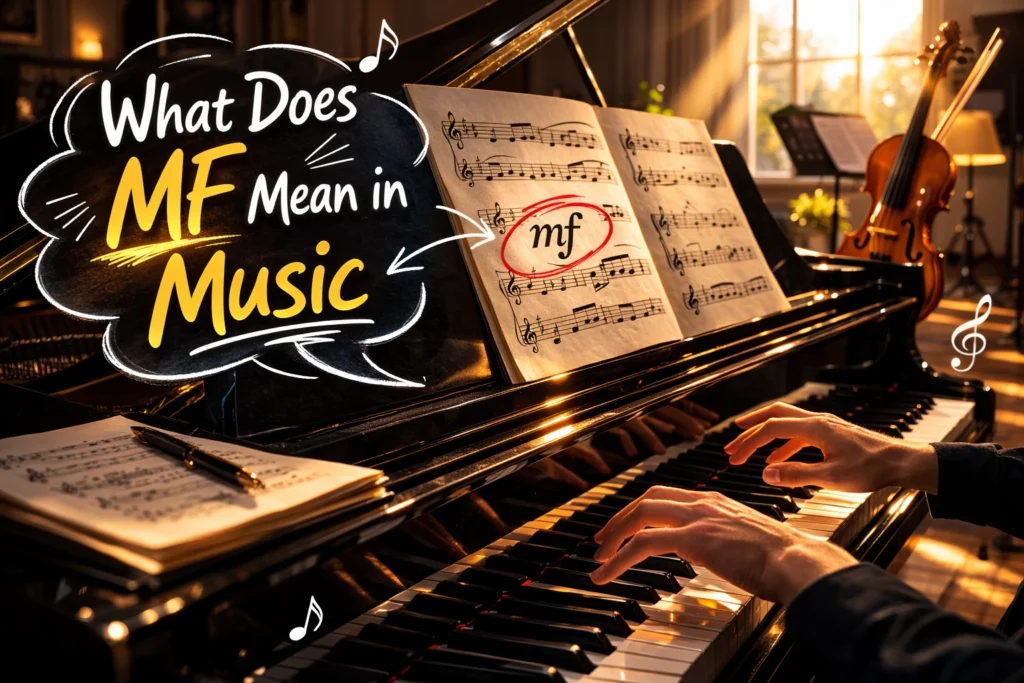
In music, MF stands for “mezzo-forte”, an Italian term used in musical notation to indicate a moderately loud dynamic level.
It instructs musicians to play with more intensity than “mezzo-piano” (moderately soft) but not as loudly as “forte” (loud). MF is crucial for expressing emotion, creating contrast, and bringing life to sheet music.
If you’ve ever looked at sheet music and noticed the letters “MF” written beneath the staff, you might have wondered what they actually mean. Is it a tempo marking? A style instruction? Or something else entirely? In music, even two small letters can completely shape how a piece sounds — and MF is one of the most important dynamic markings performers rely on.
In simple terms, MF stands for mezzo-forte, an Italian musical term that means “moderately loud.” But its role goes far beyond just volume. MF helps musicians balance expression, control intensity, and create contrast within a performance. It sits between softer dynamics like mp (mezzo-piano) and louder ones like f (forte), acting as a powerful middle ground in musical storytelling.
Whether you’re a beginner pianist, a violinist in an orchestra, or someone exploring music theory, understanding MF is key to playing music as the composer intended. This guide will walk you through its origin, practical usage, examples, comparisons, and even common pitfalls, so you can master MF with confidence.
Origin of MF in Music
The term MF (mezzo-forte) comes from Italian musical terminology, which has been the foundation of Western classical music for centuries. Italian terms like piano, forte, crescendo, and diminuendo became standard because Italy was the birthplace of many influential composers and music theorists.
- Mezzo means “medium” or “moderate.”
- Forte means “strong” or “loud.”
Together, mezzo-forte literally means “moderately loud,” guiding musicians to strike a balance between softness and intensity.
Why Italian?
During the 17th and 18th centuries, Italian composers and teachers dominated music education. Their terminology was printed in widely circulated sheet music, creating a universal language that musicians around the world still use today.
How MF Is Used in Music
MF appears primarily in sheet music to indicate volume and intensity. Musicians encounter it in a variety of contexts:
- Classical compositions: Piano scores, orchestral pieces, and chamber music often include MF to add depth and contrast.
- Contemporary music arrangements: MF is still relevant in modern compositions, pop arrangements, and digital sheet music.
- Orchestras and ensembles: Conductors may instruct certain sections to play mezzo-forte to maintain balance across instruments.
Dynamic Comparison Table:
| Symbol | Meaning | Relative Volume |
|---|---|---|
| pp | Pianissimo | Very soft |
| p | Piano | Soft |
| mp | Mezzo-piano | Moderately soft |
| mf | Mezzo-forte | Moderately loud |
| f | Forte | Loud |
| ff | Fortissimo | Very loud |
MF sits comfortably between mp and f, providing a versatile middle ground that allows instruments and voices to blend naturally while still standing out.
Examples of MF in Music
MF appears in a wide range of musical compositions, from classical to modern. Here are some real-world examples:
MF in Sheet Music Examples
| Song/Composition | Instrument | Dynamic Marking | Context |
|---|---|---|---|
| Beethoven’s Moonlight Sonata (1st Movement) | Piano | MF | Used in the first theme to create a melody that is gentle yet noticeable. |
| Mozart’s Eine Kleine Nachtmusik | Strings | MF | Orchestral strings play at mezzo-forte to balance with winds. |
| Contemporary Pop Arrangement | Guitar & Vocals | MF | Section slightly louder than the verse but not as strong as the chorus. |
Tone and Context:
- Friendly tone: MF gives music warmth, allowing melodies to shine without overwhelming other instruments.
- Neutral tone: MF provides a balanced, moderate sound suitable for accompaniment or ensemble blending.
- Dismissive/negative tone: If misinterpreted as too soft in a strong passage, MF may feel underwhelming or lack impact.
MF Compared to Other Musical Dynamics
Understanding MF becomes easier when compared to related dynamic markings:
| Term | Abbreviation | Meaning | How It Differs From MF |
|---|---|---|---|
| Mezzo-piano | mp | Moderately soft | Softer than MF, less intensity |
| Forte | f | Loud | Louder than MF, more emphasis |
| Pianissimo | pp | Very soft | Much quieter, delicate touch |
| Fortissimo | ff | Very loud | Very strong, highly expressive |
| Mezzo-forte | mf | Moderately loud | Balanced, moderate strength |
MF acts as a bridge between softness and loudness, making it essential for smooth transitions and expressive musical phrasing.
Alternate Meanings of MF in Music
While MF nearly always refers to mezzo-forte, there are some informal or alternate meanings in modern contexts:
- MF as slang: Online or in lyrics, MF can be an abbreviation for a strong expletive. ⚠️ This is not musical terminology and should be avoided in professional or formal discussions.
- Professional alternatives: Always use “mezzo-forte” or the MF marking in sheet music to maintain clarity and professionalism.
Practical Tips for Playing MF Correctly
Playing MF is not just about pressing harder—it requires control and nuance. Here’s how to achieve it:
- Control your volume: Increase intensity gradually, keeping tone quality consistent.
- Observe context: MF may sound louder or softer depending on surrounding dynamics.
- Use phrasing: Combine dynamic markings with articulation and expression.
- Practice with contrasts: Alternate between mp, mf, and f to understand relative volume.
- Listen carefully: In ensembles, adjust MF to blend seamlessly with other instruments.
FAQs
1. What does MF mean in music?
MF stands for mezzo-forte, indicating a moderately loud dynamic level.
2. How is MF different from MP or F?
MF is louder than MP (mezzo-piano) but softer than F (forte), providing a balanced sound.
3. Can MF vary by instrument?
Yes. For example, MF on a piano may sound softer than MF on a trumpet due to instrument projection.
4. Is MF used in modern music?
Absolutely. MF appears in piano sheets, band arrangements, and even pop and orchestral compositions.
5. How do I practice MF on piano?
Play sections marked mp, mf, and f consecutively, focusing on tone while adjusting volume.
6. Does MF affect emotional expression?
Yes. MF conveys moderate intensity, warmth, and balance in musical phrasing.
7. Can MF be combined with other dynamics?
Yes. MF often appears with crescendos or decrescendos to indicate gradual volume changes.
8. What are common mistakes with MF?
Beginners may play MF too loud or too soft. Always consider context and surrounding dynamics.
Conclusion
MF, or mezzo-forte, is a core musical dynamic that helps musicians balance expression and volume. It sits between MP and F, offering a versatile middle ground that allows melodies to shine while maintaining harmony within ensembles.
Key Takeaways:
- MF = Moderately loud, louder than MP but softer than F
- Italian origins provide a universal musical vocabulary
- Correct execution requires context, control, and phrasing
- Avoid confusing MF with informal slang abbreviations
- Practice alongside other dynamics to develop precision and expression
Mastering MF ensures your performances are expressive, professional, and faithful to the composer’s intent.
Read More Related Articles:
- What Does “Danke” Means? Friendly Guide In 2026
- Nerf Mean in Gaming: Simple Explanation for New Players In 2026
- Balk Meaning in Baseball: Why This Rule Stops Runners Cold In 2026

John Miller is a professional meanings writer at Meanzy.com, specializing in word definitions, internet slang, acronyms, and text abbreviations. He focuses on delivering clear, accurate explanations with practical examples, helping readers easily understand modern digital terms and their real-life usage.