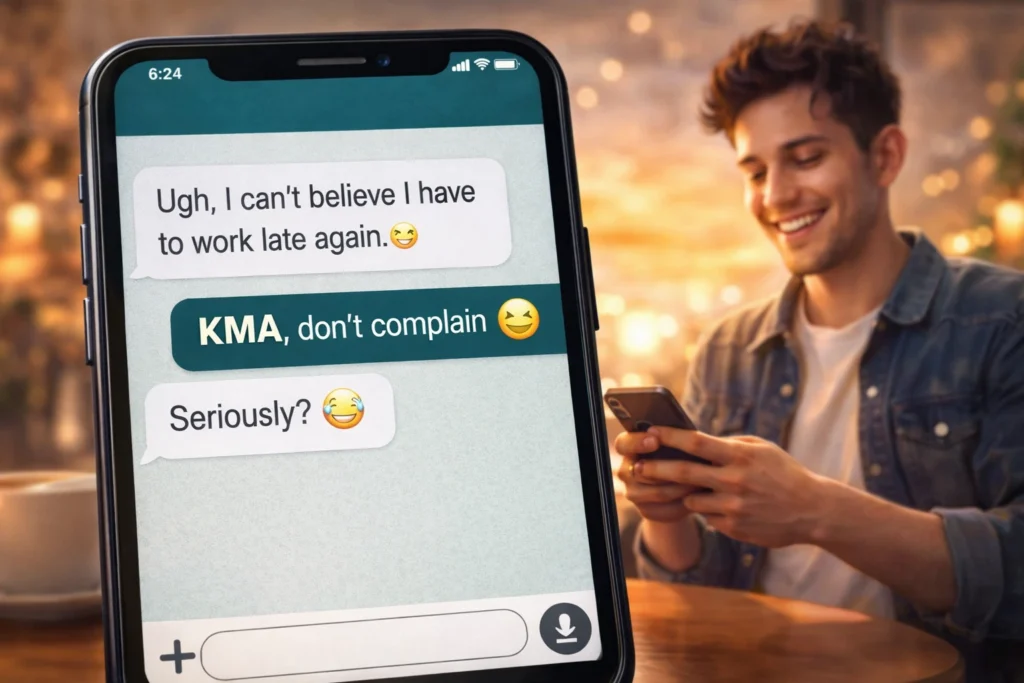
KMA in text messaging stands for Kiss My Ass.
It is a slang expression often used to dismiss someone, express frustration, or convey defiance in a blunt or rude manner. The tone of KMA can vary from playful teasing among friends to serious irritation or anger.
In the world of texting, instant messaging, and social media, abbreviations and acronyms have become a language of their own. From LOL to BRB, these short forms help people communicate quickly and efficiently. However, some abbreviations are a little more cryptic and can leave you wondering about their meaning. One of these is KMA. If you have come across KMA in a message, comment, or post, you might be curious about what it means, how it is used, and whether it is friendly or offensive.
Understanding the meaning and context of KMA can help you respond appropriately and avoid miscommunication. Whether you are texting a friend or engaging on social media, knowing how to interpret KMA is essential for clear and effective communication.
The Origin of KMA
The phrase Kiss My Ass has been part of English slang for decades. It is commonly used to tell someone off or show that you do not care about their opinion. With the rise of the internet, texting, and instant messaging, people started shortening words and phrases to communicate faster. This is how Kiss My Ass became KMA.
The abbreviation first gained popularity in the late 1990s and early 2000s when chat rooms, online forums, and early instant messaging platforms such as MSN Messenger and AOL Instant Messenger were widely used. People needed quick ways to type out expressions, and KMA fit perfectly. It was faster to type and more discreet than writing the full phrase.
Over time, KMA made its way into social media platforms such as Twitter, Facebook, Reddit, TikTok, and Instagram. It is now a common abbreviation that many internet users recognize. Despite its casual nature, it is important to understand that KMA is inherently rude or dismissive, depending on context.
How KMA is Used in Texting
KMA can appear in conversations with friends, on social media posts, or in online arguments. Its meaning and tone depend on the context in which it is used. Here are some of the main ways people use KMA:
Friendly or Playful Tone
Among friends who enjoy joking and teasing each other, KMA can be used in a playful way. It often conveys mock frustration or humorous defiance rather than genuine anger. For example:
- Friend 1: I beat you again at Mario Kart.
- Friend 2: KMA! I will get you next time. 😏
In this example, KMA is used as part of friendly banter. The addition of the smirking emoji helps soften the impact and shows that the message is not meant to offend.
Neutral Tone
Sometimes, KMA is used in a more lighthearted, non-aggressive way. It can express personal empowerment or playful rebellion without targeting anyone in particular. For instance:
- I decided to eat dessert first. KMA, I work hard all week. 🍰
- Skipping the boring meeting today. KMA, I deserve a break.
Here, KMA expresses defiance toward a general situation rather than a person. It can be humorous and relatable without being offensive.
Negative or Dismissive Tone
KMA is most often used to express anger or irritation. When someone uses KMA in this context, it is blunt, dismissive, and often offensive:
- Stop telling me how to live my life. KMA!
- You think I care about your opinion? KMA.
In these examples, KMA clearly communicates frustration or dismissal and should be interpreted as an insult.
KMA Examples in Different Contexts
To better understand how KMA is used, here is a table showing examples in friendly, neutral, and negative contexts:
| Context | Message Example | Tone |
|---|---|---|
| Friendly | Haha, KMA! You will never beat me at Mario Kart 😆 | Playful |
| Neutral | I am eating all the ice cream first. KMA, I deserve it 🍦 | Lighthearted |
| Negative | Stop giving me advice I did not ask for. KMA! | Dismissive |
| Sarcastic | Oh sure, I will follow your instructions… KMA 😤 | Sarcasm |
These examples show how context, punctuation, and emojis can change the way KMA is perceived.
Comparison With Related Abbreviations
KMA is part of a larger family of internet acronyms that express annoyance, defiance, or dismissal. Here is a comparison of KMA with other common abbreviations:
| Abbreviation | Meaning | Tone |
|---|---|---|
| KMA | Kiss My Ass | Can be playful, neutral, or rude |
| GTFO | Get The F*** Out | Aggressive, dismissive |
| STFU | Shut The F*** Up | Direct, often harsh |
| SMH | Shaking My Head | Mild disappointment or disbelief |
| LOL | Laugh Out Loud | Lighthearted, not offensive |
The key difference is that KMA can be playful in some contexts, while abbreviations like GTFO or STFU are more aggressive and less likely to be used in friendly banter.
Alternate Meanings of KMA
While KMA is most commonly used as a slang abbreviation for Kiss My Ass, it can have other meanings in specific contexts. These alternate meanings are rare in casual texting but may appear in professional or technical settings:
| Context | Meaning |
|---|---|
| Aviation | Korea Meteorological Administration |
| Education | Knowledge Management Association |
| Technology | Key Management Authority (used in IT security) |
In texting and social media, however, the vast majority of KMA usage refers to the slang phrase.
Polite or Professional Alternatives to KMA
If you want to express disagreement, frustration, or defiance without being offensive, there are many alternatives that are more appropriate in professional or public settings:
- I respectfully disagree.
- Noted, but I will make my own decision.
- I appreciate your input, but I have a different approach.
- I am choosing to ignore that advice.
- Emoji alternatives such as 🙄 or 😅 can convey mild annoyance or disbelief.
Using these alternatives allows you to communicate your feelings clearly while maintaining professionalism and respect.
Practical Tips for Using KMA
When considering using KMA, it is essential to evaluate your audience and the situation. Here are some tips:
- Know your audience. Friends may understand playful use, but colleagues may not.
- Consider the tone. Emojis or punctuation can soften or clarify your intent.
- Avoid professional contexts. KMA should not appear in emails, work messages, or formal communications.
- Combine humor. Adding humor can indicate that KMA is playful and not meant to offend.
- Use sparingly. Overusing KMA may make you come across as rude or confrontational.
Additional Examples of KMA in Real Life Texts
| Scenario | Example Text | Suggested Tone |
|---|---|---|
| Gaming | You beat me again? KMA! Next time I win 😎 | Playful |
| Argument | Stop telling me what to do. KMA! | Negative / Dismissive |
| Social Media | Ignore the haters. KMA ✌️ | Neutral / Confident |
| Joke with Friends | I am eating all the pizza. KMA 😜 | Playful |
| Work Chat (Wrong Use) | Your advice is useless. KMA | Not Recommended |
These examples show that the same abbreviation can carry different tones depending on context and audience.
How to Recognize KMA in Context
Recognizing KMA requires attention to context, tone, and surrounding words or emojis. Here are some tips:
- Look for punctuation and capitalization. All caps often indicate stronger emphasis.
- Emojis can help you determine whether it is playful or serious.
- Consider the relationship between the sender and recipient. Friends are more likely to use it playfully, while strangers may use it aggressively.
- Pay attention to the platform. KMA on TikTok or Instagram is often humorous, while in a direct chat, it may be personal.
FAQs
1. Is KMA offensive?
Yes, KMA can be considered offensive depending on context. It is usually blunt and dismissive.
2. Can KMA be used in friendly chats?
Yes, among friends, KMA can be playful or humorous, especially with emojis to soften the tone.
3. What does KMA mean on social media?
KMA generally retains its slang meaning of Kiss My Ass, and is often used in comments, memes, or posts.
4. Is it appropriate to use KMA at work?
No, it is best avoided in professional settings. Polite alternatives should be used instead.
5. Can KMA have other meanings?
Yes, in specific contexts such as aviation, education, or IT, KMA may have a technical meaning, but these are rarely used in casual texting.
6. How is KMA different from GTFO?
KMA can sometimes be playful or sarcastic, whereas GTFO is aggressive and less likely to be used in friendly conversations.
7. Are there emoji versions of KMA?
There are no official emoji versions, but people often pair KMA with 😏, 🙄, or 😤 to convey the same sentiment.
8. How did KMA become popular?
KMA became popular in chat rooms, forums, and instant messaging platforms as a fast shorthand for Kiss My Ass. It is widely recognized in internet and texting culture today.
Conclusion
KMA is a popular texting abbreviation that communicates frustration, defiance, or humor depending on context. Understanding its meaning, tone, and audience is crucial to using it effectively. While it can be playful among friends, it can also be offensive in professional or formal contexts.
Key Takeaways
- KMA means Kiss My Ass, a slang expression used in texting and social media.
- Its tone can be playful, neutral, sarcastic, or negative.
- Emojis and context play a critical role in interpretation.
- Avoid using KMA in professional settings.
- Polite alternatives exist for expressing disagreement or defiance.
By knowing when and how to use KMA, you can communicate clearly, express your feelings, and avoid misunderstandings in digital conversations.
Read More Related Articles:
- What Does 2 Mean in the Bible: Witness and Divine Partnership In 2026
- What Does Indignation Mean in the Bible? Biblical Context In 2026
- What Does M Mean in a Car? Manual Mode Explained (2026)

Rachel Monroe is a digital content writer at Meanzy.com who focuses on explaining modern words, phrases, and online expressions. Her writing style is simple, practical, and reader-focused, helping users quickly understand the meaning and usage of today’s evolving language.