
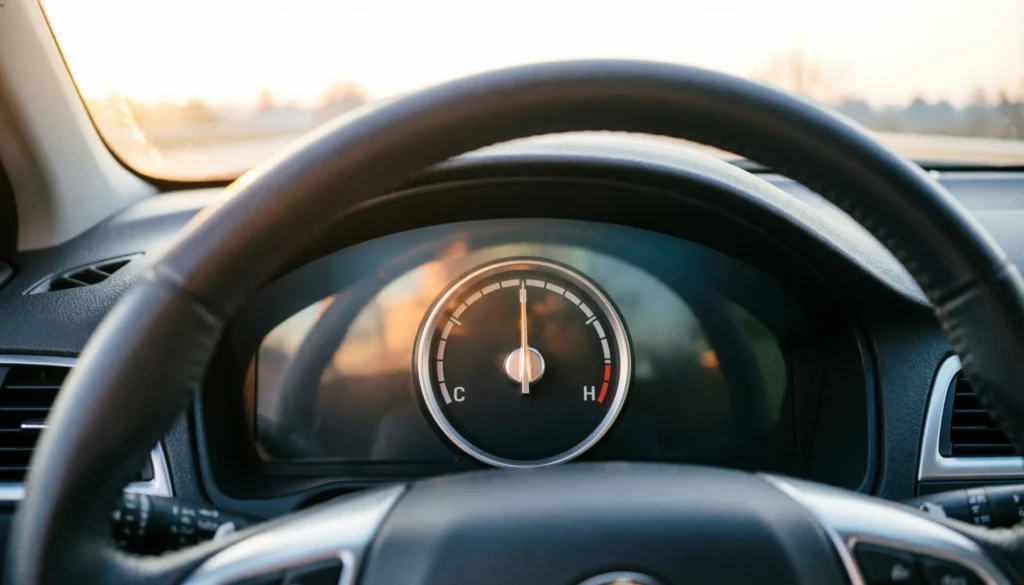
C and H in a car refer to Cold and Hot on the engine temperature gauge.
They indicate the temperature of your engine coolant and help you monitor whether your engine is running at a safe operating temperature.
If you have ever looked at your car dashboard and noticed the letters C and H with a needle moving between them, you might have wondered what they actually mean. Are they warning signs? Do they indicate a problem? Or are they simply part of normal vehicle operation?
Simple, right? But understanding what these letters truly mean can help you avoid expensive engine damage and drive more confidently.
In this detailed guide, you will learn how the C and H gauge works, why it matters, what to do if the needle moves too far, and how it compares to other temperature warning systems.
Understanding the C and H Temperature Gauge
Every modern vehicle has an engine temperature monitoring system. In many cars, this is displayed as a gauge with two letters:
- C stands for Cold
- H stands for Hot
Between these two letters is a needle that moves depending on your engine’s temperature.
What Does C Mean in a Car?
C means Cold. When you first start your vehicle, especially in the morning, the needle typically rests near the C mark. This means your engine has not yet warmed up.
It is completely normal for the needle to start at C. Engines are designed to gradually warm up after ignition.
What Does H Mean in a Car?
H means Hot. If the needle moves close to or reaches the H mark, your engine is overheating. This is not normal and requires immediate attention.
An overheating engine can cause serious damage such as:
- Blown head gasket
- Warped cylinder head
- Coolant leaks
- Engine seizure
That is why monitoring this gauge is important.
How the Engine Temperature Gauge Works
Your car uses a component called a coolant temperature sensor. This sensor measures the temperature of the engine coolant and sends information to the dashboard gauge.
Here is a simplified breakdown:
- Engine starts cold
- Coolant begins circulating
- Temperature rises gradually
- Gauge needle moves from C toward the middle
- Once warmed up, needle stays near the center
Most vehicles operate best when the needle sits slightly below or around the midpoint between C and H.
Ideal Temperature Position on the Gauge
Here is a quick reference table:
Table 1: Temperature Gauge Meaning
| Gauge Position | Meaning | Is It Safe? | Action Needed |
|---|---|---|---|
| Near C | Engine is cold | Yes | Normal at startup |
| Middle | Normal operating temperature | Yes | No action required |
| Near H | Engine overheating | No | Stop vehicle safely |
| On H | Severe overheating | No | Turn engine off immediately |
If your needle consistently stays near H, you should get your car inspected as soon as possible.
Why C and H Matter More Than You Think
Many drivers ignore dashboard gauges until something goes wrong. But the C and H indicator gives early warnings before serious damage occurs.
Overheating is one of the most common causes of engine failure worldwide. Proper temperature regulation depends on several components such as:
- Radiator
- Thermostat
- Water pump
- Coolant level
- Cooling fans
If any of these fail, your gauge will alert you.
Think of C and H as your engine’s health monitor.
Origin and Evolution of the C and H Gauge
The C and H temperature gauge became standard in automobiles in the mid twentieth century as vehicles became more advanced and complex.
Early cars did not have sophisticated temperature displays. Drivers relied on steam or engine behavior to notice overheating. As automotive engineering improved, manufacturers added visual gauges to prevent engine damage.
Today, some vehicles have replaced traditional C and H gauges with digital temperature displays or warning lights.
For example, brands like Toyota and Honda still commonly use analog or semi digital temperature indicators, while newer models from Tesla may display temperature information digitally through a touchscreen interface.
Even though the display style may change, the concept remains the same.
Real World Usage Scenarios
Let us look at how C and H appear in everyday driving situations.
Friendly Scenario
You start your car in the morning. The needle is at C. After five minutes of driving, it moves to the middle.
Everything is normal. 😊
Neutral Scenario
You are driving on the highway. The needle stays steady at the midpoint for hours.
This indicates the cooling system is functioning correctly.
Negative Scenario
You are stuck in traffic on a hot day. The needle begins creeping toward H.
This could signal:
- Low coolant
- Faulty radiator fan
- Thermostat issue
You should turn off the air conditioning, pull over safely, and let the engine cool down.
Common Causes of Overheating
If the gauge moves toward H, these are the most common reasons:
- Low coolant level
- Leaking radiator
- Broken thermostat
- Malfunctioning water pump
- Cooling fan failure
- Blocked coolant hoses
Table 2: Overheating Causes and Solutions
| Problem | Symptoms | Quick Fix | Long Term Fix |
|---|---|---|---|
| Low coolant | Gauge near H | Add coolant | Fix leaks |
| Faulty thermostat | Temperature spikes | Replace thermostat | Professional service |
| Broken radiator fan | Overheats in traffic | Check fan fuse | Replace fan |
| Water pump failure | Coolant leak | Tow vehicle | Replace pump |
Comparison With Related Dashboard Indicators
C and H are not the only temperature related indicators in a vehicle.
Table 3: C and H vs Temperature Warning Light
| Indicator Type | What It Shows | Detail Level | When It Activates |
|---|---|---|---|
| C and H Gauge | Continuous temperature range | High | Always visible |
| Red temperature light | Engine overheating | Low | Only during danger |
| Digital temperature reading | Exact temperature value | Very High | Constant |
A gauge provides more information than a warning light because you can see gradual temperature changes.
Alternate Meanings of C and H in Cars
While most commonly related to engine temperature, C and H may occasionally represent other things depending on context.
In climate control systems:
- C may represent Cooling mode
- H may represent Heating mode
In older mechanical systems, C and H could indicate Choke settings in carbureted engines, though this is rare today.
Always check your vehicle’s owner manual for confirmation.
Practical Tips for Drivers
Here are some easy ways to keep your engine temperature healthy:
- Check coolant levels monthly
- Replace coolant as recommended
- Inspect hoses for leaks
- Watch the gauge during long drives
- Avoid driving with an overheating engine
If the needle reaches H, do not open the radiator cap immediately. Wait until the engine cools completely.
Safety first.
FAQs
What does it mean when the temperature gauge is on C?
It means the engine is cold. This is normal when starting the car. The engine will warm up after a few minutes of driving.
Is it bad if the needle stays near C while driving?
Yes, if it never moves from C, your thermostat might be stuck open. The engine may not reach proper operating temperature.
What should I do if the gauge reaches H?
Pull over safely, turn off the engine, and allow it to cool. Check coolant levels once the engine is cool.
Can I drive my car if it is overheating?
It is not recommended. Driving with the gauge near H can cause severe engine damage.
Why does my temperature go up in traffic but normal on highway?
This often indicates a cooling fan issue because airflow is limited when the vehicle is not moving.
Does cold weather affect the C and H gauge?
Yes, engines take longer to warm up in cold weather, so the needle may stay near C for a longer time.
Is the middle of the gauge always safe?
Yes, the midpoint generally represents normal operating temperature.
Why does my gauge fluctuate slightly?
Minor fluctuations are normal, especially when climbing hills or using air conditioning.
Conclusion
So what does C and H mean in a car?
It is a simple yet essential indicator of your engine’s temperature. C stands for Cold and H stands for Hot. The needle moving between them helps you monitor engine health in real time.
Keeping an eye on this gauge can prevent costly repairs and ensure smooth driving. Ideally, the needle should stay around the middle once the engine is warmed up.
If it creeps toward H, take it seriously. If it stays stuck near C, investigate. Small signals can prevent big problems.
Understanding your dashboard is part of being a responsible driver.
Read More Related Articles:
- Condensation Mean in the Water Cycle: Turning Water Vapor Into Clouds In 2026
- “How Many More” Mean in Math: Subtraction Made Simple In 2026
- What Does Folding Mean in Slang? Definition, Origin, Examples & Usage (2026)

Megan Foster is a thoughtful and creative content creator at Meanzy.com with a strong curiosity for language and communication. Known for her clarity and attention to detail, she simplifies confusing slang, acronyms, and modern terms into easy, relatable meanings readers can trust.