
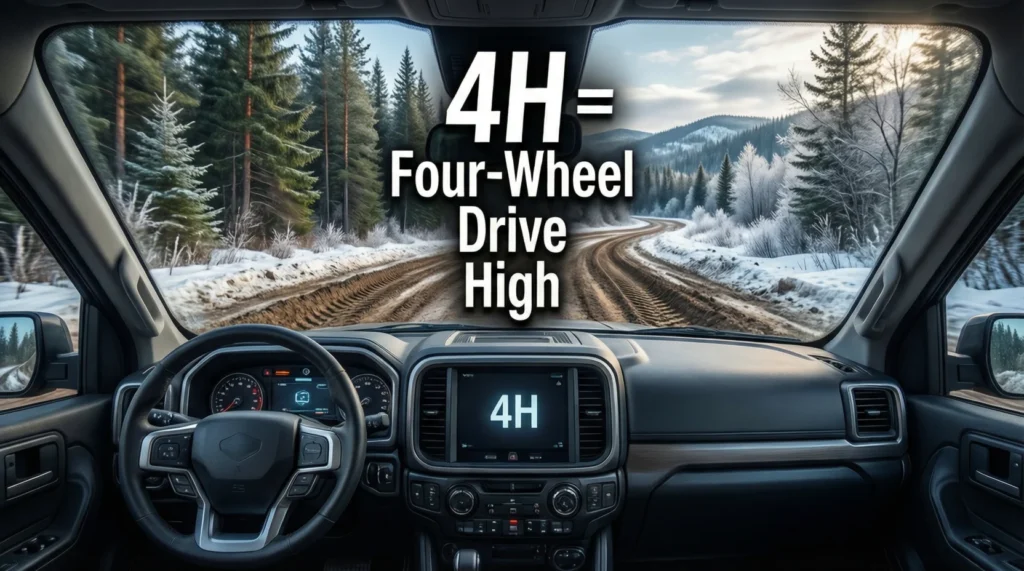
Ever spotted “4H” on your truck’s dashboard or gear selector and wondered what it actually means and when you’re supposed to use it? You’re not alone. This small label carries a big responsibility, and using it correctly can make the difference between smooth control and unnecessary wear on your vehicle.
Whether you’re a new truck owner, an off-road enthusiast, or just curious about drivetrain terms, this guide breaks everything down in simple, clear, real-world language no mechanical jargon overload.
🔍Definition:
4H in a truck means “Four-Wheel Drive High.”
It is a driving mode that sends power to all four wheels while allowing the vehicle to operate at normal driving speeds, typically used on slippery surfaces like snow, mud, gravel, sand, or wet roads to improve traction and control.
🚘 What Is 4H in a Truck?
At its core, 4H (Four-High) is a four-wheel-drive mode designed for situations where extra traction is needed, but you still want to maintain regular road speed.
When 4H is engaged:
- Power is distributed to both front and rear axles
- The transfer case remains in high gear
- The truck gains better grip without sacrificing speed
You’ll typically find 4H in:
- Pickup trucks (Ford F-150, Toyota Hilux, RAM, Chevy Silverado)
- SUVs with 4WD systems (Toyota Prado, Jeep Wrangler, etc.)
⚙️ How 4H Works
Think of 4H like giving your truck extra shoes with better grip.
In normal driving (2H):
- Only two wheels (usually rear) receive power
In 4H:
- All four wheels work together
- Torque is evenly or proportionally split
- The truck stays stable on low-traction surfaces
👉 Important: 4H is not for dry pavement at highway speeds unless specified by your vehicle manufacturer.
🕰️ Origin & Popularity of 4H
📜 Where Did 4H Come From?
The concept of four-wheel drive dates back to:
- Early military vehicles (WWI & WWII)
- Agricultural and utility trucks
- Later adopted by civilian trucks and SUVs
The terms 2H, 4H, and 4L became standardized as 4WD systems evolved.
🚀 Why Is 4H So Popular Today?
- Growing popularity of pickup trucks
- Increased use of vehicles in snow, rain, and off-road conditions
- Adventure travel, camping, and overlanding trends
- Safety awareness among drivers
🛣️ When Should You Use 4H?
4H is designed for moderate traction challenges, not extreme crawling.
✅ Best Situations to Use 4H
Use 4H when driving on:
- ❄️ Snow-covered roads
- 🌧️ Rain-slick highways
- 🏜️ Sand or loose dirt
- 🪨 Gravel roads
- 🌾 Muddy fields or rural paths
❌ When NOT to Use 4H
Avoid 4H on:
- Dry pavement
- High-speed highways (unless allowed by manufacturer)
- Sharp turns on solid surfaces
Using 4H on dry roads can cause:
- Drivetrain binding
- Premature tire wear
- Stress on axles and transfer case
🧭 How to Engage 4H in a Truck
Depending on your vehicle, 4H can be engaged via:
- 🔘 Rotary dial
- 🕹️ Manual transfer case lever
- 💻 Electronic button
General Steps (Always Check Your Manual)
- Reduce speed (usually under 60 km/h or 40 mph)
- Shift selector from 2H → 4H
- Wait for dashboard indicator to confirm engagement
- Drive smoothly avoid sudden acceleration
Some modern trucks allow shift-on-the-fly, meaning you don’t have to stop completely.
🧪 Real-World Examples of 4H Usage
Let’s see how 4H appears in real driving scenarios 👇
😊 Friendly / Practical Tone
“It started snowing heavily, so I switched to 4H for better grip.”
😐 Neutral / Informative Tone
“The driver engaged 4H while driving on the muddy construction road.”
⚠️ Negative / Warning Tone
“Driving in 4H on dry pavement can damage your drivetrain.”
📊 4H vs Other Truck Drive Modes
| Mode | Meaning | Speed Range | Best For |
|---|---|---|---|
| 2H | Two-Wheel Drive High | High speed | Normal dry roads |
| 4H | Four-Wheel Drive High | Moderate to high | Snow, rain, sand, gravel |
| 4L | Four-Wheel Drive Low | Very low speed | Rock crawling, steep hills |
| AWD | All-Wheel Drive | Automatic | Mixed conditions |
🔄 4H vs 4L: What’s the Difference?
This is one of the most common questions—and for good reason.
🔹 4H (Four High)
- Maintains normal speed
- For slippery roads
- Ideal for driving through conditions
🔹 4L (Four Low)
- Much slower
- Increased torque
- Ideal for climbing, towing, or crawling
👉 Rule of thumb:
If you need grip → 4H
If you need power at low speed → 4L
🔁 Alternate Meanings of “4H”
While rare in vehicle context, “4H” may also mean:
- ⏱️ 4 Hours (logistics or delivery)
- 🏥 Hospital ward code
- 📊 Four-Hour chart (finance/trading)
⚠️ In trucks, 4H almost always refers to Four-Wheel Drive High.
🧠 Pro Tips for Using 4H Safely
- ✔️ Engage before conditions worsen
- ✔️ Drive smoothly—no sudden turns
- ✔️ Match tire sizes (important!)
- ❌ Don’t use on dry pavement
- ❌ Don’t treat it as a racing mode
🗣️ Polite or Professional Alternatives
If you’re explaining 4H formally (manuals, blogs, reports), use:
- “Four-wheel drive high range”
- “High-range four-wheel drive”
- “Engaging 4WD high mode”
🧾 Conclusion
Understanding what 4H means in a truck isn’t just about terminology it’s about driving smarter and safer.
- 4H = Four-Wheel Drive High
- Use it on slippery or loose surfaces
- Avoid dry pavement
- Great for snow, rain, sand, and gravel
- Not a replacement for careful driving
When used properly, 4H gives you confidence, control, and capability—exactly what a truck is built for.
❓ Frequently Asked Questions (FAQs)
1. What does 4H stand for in a truck?
4H stands for Four-Wheel Drive High, a mode that powers all four wheels at normal driving speeds.
2. Can I drive fast in 4H?
Moderate speeds are okay, but avoid highway speeds unless your manufacturer allows it.
3. Is 4H bad for my truck?
Not if used correctly. Using it on dry pavement can cause damage.
4. Should I use 4H in rain?
Yes, especially during heavy rain or slippery conditions.
5. Can I switch to 4H while driving?
Many modern trucks allow shift-on-the-fly, but always check your owner’s manual.
6. What’s better: AWD or 4H?
AWD is automatic and always on; 4H is manual and better for off-road or tough conditions.
7. Does 4H use more fuel?
Yes, slightly because more components are engaged.
8. How do I know if 4H is engaged?
A dashboard indicator light usually confirms it.

John Miller is a professional meanings writer at Meanzy.com, specializing in word definitions, internet slang, acronyms, and text abbreviations. He focuses on delivering clear, accurate explanations with practical examples, helping readers easily understand modern digital terms and their real-life usage.

Pingback: Grade Horse Meaning: Buyers Need to Know Before Purchasing (2026)