
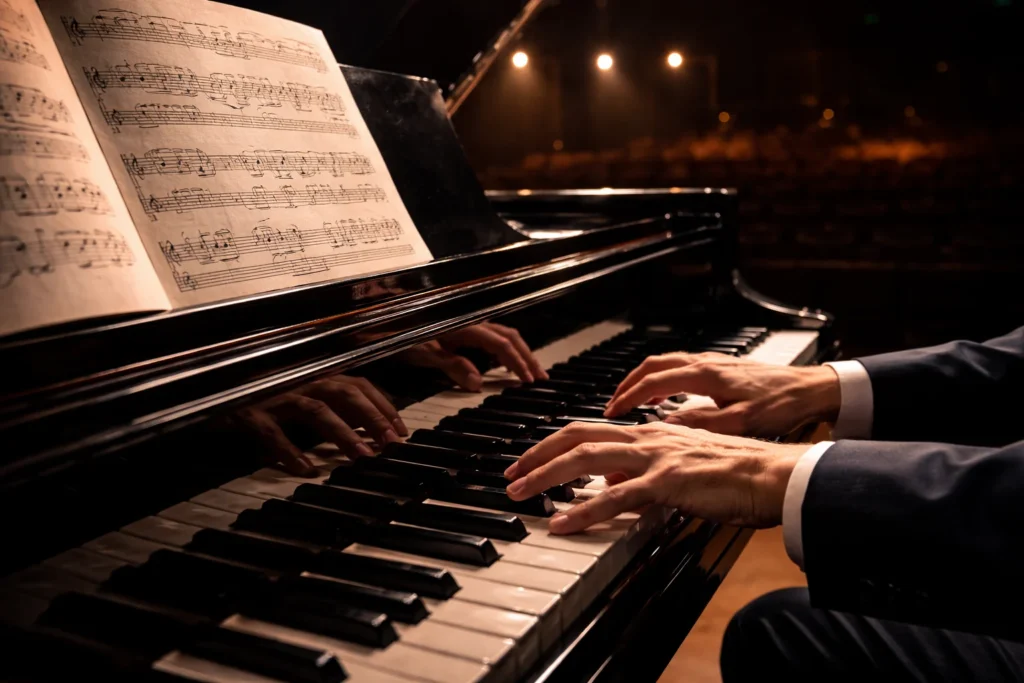
Rubato in music refers to a flexible tempo where the performer slightly speeds up or slows down the rhythm to convey emotion and personal expression.
The term literally means “stolen time” in Italian and is a hallmark of expressive, nuanced musical interpretation.
Music is not just about playing notes on time—it’s about conveying emotion, telling a story, and connecting with listeners. That’s where rubato comes in. Imagine a pianist subtly lingering on a heartfelt note or a violinist stretching a phrase just enough to make it sing—the music breathes, flows, and speaks directly to your emotions. Rubato transforms a mechanical performance into a living, expressive experience. But what does it really mean, and how is it used? In this guide, we’ll explore the origins, mechanics, examples, and practical tips for understanding and applying rubato in music.
Origin of Rubato
Rubato comes from the Italian word rubare, meaning “to steal.” Its literal translation, “stolen time,” perfectly captures its essence: a controlled, expressive bending of rhythm.
The technique gained popularity in the Romantic era (19th century), a time when composers emphasized emotion and individuality in music. Iconic pianists and composers like Frédéric Chopin and Franz Liszt often employed rubato, encouraging performers to bring their own interpretation to melodies.
Unlike rigid, mechanical timing, rubato allows performers to highlight emotion, phrasing, and nuance, making each performance unique.
Why Rubato Is Important in Music
Rubato is more than just a stylistic flourish—it serves several musical purposes:
- Adds emotional depth: Subtle tempo changes can convey sadness, joy, or longing.
- Enhances personal expression: Performers can interpret the music in a way that reflects their own musical voice.
- Creates natural flow: Music feels alive, breathing, and human rather than mechanical.
- Connects with audiences: Rubato makes listeners feel the emotion behind every note.
For instance, in Chopin’s nocturnes, the right-hand melody often stretches while the left-hand accompaniment remains steady. This contrast produces a gentle, floating sensation, captivating the listener.
How Rubato Works: The Mechanics
Rubato is not about randomly speeding up or slowing down; it’s controlled and deliberate. It typically involves the melody being flexible while the accompaniment maintains a steady pulse.
| Element | Description | Example |
|---|---|---|
| Melody | Slightly speeds up or slows down for expressive effect | A pianist holds a note a fraction longer to emphasize emotion |
| Accompaniment | Usually steady to maintain structure | Left-hand chords remain consistent while the right-hand flows freely |
| Overall Tempo | Maintains a sense of musical cohesion | A violinist may delay a phrase and then catch up in the next measure |
Rubato is a balancing act: performers “steal” time from one part of a phrase and return it in another, maintaining musical integrity.
Examples of Rubato in Music
Rubato is widely used across genres and instruments:
| Composer/Artist | Piece | How Rubato Is Applied |
|---|---|---|
| Frédéric Chopin | Nocturne in E-flat Major | Right-hand melody stretches, left-hand steady |
| Franz Liszt | Liebestraum No. 3 | Gradual slow-downs and accelerations for dramatic effect |
| Bill Evans (Jazz) | Jazz ballads | Subtle rhythmic shifts to enhance emotional depth |
| Opera singers | Puccini arias | Holding notes or delaying entrances for dramatic effect |
🎵 Tip: Rubato is often more impactful in live performance, where subtle variations feel spontaneous and emotionally resonant.
Tone and Interpretation of Rubato
Rubato can create different emotional tones depending on how it’s applied:
- Friendly/Expressive: Slightly delaying notes in a gentle melody to evoke warmth
- Neutral: Minor adjustments for musical flow without drawing attention
- Dramatic/Intense: Larger swings in tempo to emphasize tension, passion, or longing
It’s important to practice rubato carefully. Too much can make the music sound sloppy; too little can make it mechanical.
Rubato vs. Similar Musical Terms
Musicians sometimes confuse rubato with other tempo-related terms:
| Term | Definition | Difference from Rubato |
|---|---|---|
| Tempo rubato | Flexible tempo with expressive timing | Often used interchangeably with rubato |
| Accelerando | Gradual increase in tempo | Only speeds up; rubato can speed up or slow down |
| Ritardando | Gradual slowing down | Only slows down; rubato allows both directions |
| Fermata | Hold a note longer than written | Discrete pause, not continuous tempo flexibility |
Alternate Meanings of Rubato
While primarily a musical term, “rubato” can occasionally appear metaphorically in literature or conversation to suggest flexibility or taking liberties with timing. For example, someone might joke that a speaker “rubato-ed” a meeting schedule by extending it for dramatic effect.
Polite or Professional Alternatives
Composers or conductors may use alternatives to indicate expressive timing:
- Expressivo – Play expressively
- Con moto – With motion, allowing subtle tempo shifts
- Senza tempo – Without strict time, providing interpretive freedom
These terms clarify the emotional and structural intent behind flexible timing.
Tips for Applying Rubato
- Understand the piece – Identify melody vs. accompaniment.
- Practice slowly – Experiment with stretching or compressing phrases.
- Keep accompaniment steady – Ensure a stable rhythm under the flexible melody.
- Record yourself – Listen critically to gauge effectiveness.
- Study great performers – Observe recordings of Chopin, Liszt, or jazz pianists.
Rubato in Different Musical Contexts
| Context | Example | How Rubato Is Applied |
|---|---|---|
| Classical piano | Chopin Nocturnes | Right-hand melody flexible, left-hand steady |
| Opera | Puccini arias | Stretching vowel sounds or delaying entrances |
| Jazz | Bill Evans ballads | Flexible phrasing for mood and emotion |
| Orchestral | Romantic symphonies | Sectional rubato to enhance lyrical passages |
FAQs
1. What does rubato mean in simple terms?
Rubato is slightly changing the speed of music to make it sound more expressive, gently speeding up or slowing down while performing.
2. Is rubato used in all musical genres?
It is most common in classical and jazz music but can appear in any genre that values emotional expression, including pop, folk, and R&B.
3. How is rubato different from accelerando?
Accelerando only increases tempo gradually, while rubato can speed up or slow down irregularly to enhance emotion.
4. Can rubato be written in sheet music?
Yes, sometimes indicated explicitly as rubato or suggested through terms like expressivo or phrasing marks.
5. Does rubato make the rhythm “wrong”?
No, it’s a controlled expressive technique. Skilled performers balance stretching and returning time without disrupting the music.
6. Is rubato only for solo instruments?
No, it can be applied in ensembles but requires coordination to maintain cohesion.
7. How can beginners practice rubato?
Identify melody and accompaniment, then slowly stretch and compress phrases while keeping the accompaniment steady.
8. Can rubato be overused?
Yes, excessive rubato can sound inconsistent. The key is moderation and musical sensitivity.
Conclusion
Rubato is a powerful tool that transforms music from precise notes on a page into a living, emotional experience. By subtly “stealing” and returning time, performers can communicate passion, emotion, and personal interpretation. Whether in Chopin’s tender nocturnes, dramatic Liszt pieces, or jazz ballads, rubato brings music to life.
Practical Tip: Listen critically, practice slowly, and aim for expressive enhancement rather than mechanical alteration. With careful application, rubato can elevate any performance.
Read More Related Articles:
- Fade Mean in Betting: Turning Public Hype Into Personal Profit In 2026
- Retained Mean in School: Guide to School Retention Policies In 2026
- Rasterize Mean in Photoshop: Turning Vectors and Text Into Pixels In 2026

Megan Foster is a thoughtful and creative content creator at Meanzy.com with a strong curiosity for language and communication. Known for her clarity and attention to detail, she simplifies confusing slang, acronyms, and modern terms into easy, relatable meanings readers can trust.