
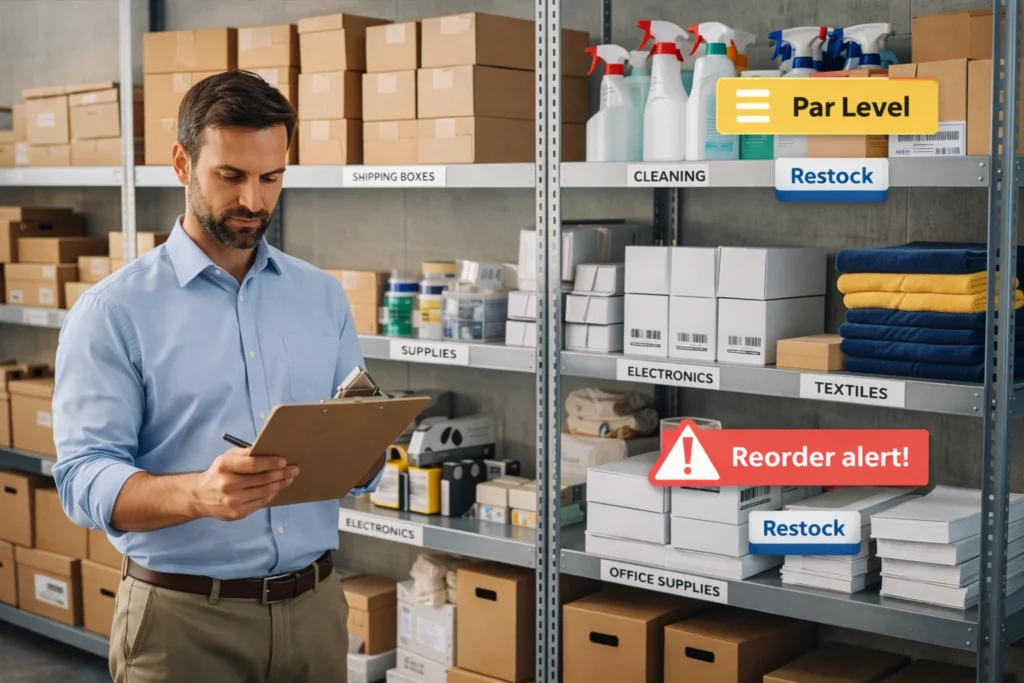
In inventory management, par refers to the standard or optimal quantity of a product that a business keeps on hand to meet customer demand without overstocking or understocking. Maintaining par levels ensures smooth operations, reduces waste, and helps in planning purchases efficiently.
Inventory is more than just counting boxes on shelves. Whether you manage a restaurant, retail store, or warehouse, knowing the right amount of stock is crucial. This is where the concept of par comes in—it helps businesses balance supply with demand effectively.
Origin of the Term “Par” in Inventory
The term par originally comes from the Latin word par, meaning “equal” or “standard.” Over time, it has been adopted in multiple industries, including finance, hospitality, and inventory management, to indicate a standard or baseline level.
In the context of inventory, par levels became popular in the hospitality and retail sectors as a simple way to track the minimum and optimal stock levels required to run daily operations smoothly. For restaurants, for example, a par system ensures they never run out of essential ingredients like milk, eggs, or bread during service.
How “Par” is Used in Inventory Management
Businesses use par levels to maintain efficiency and reduce waste. Here’s how it works:
- Setting a Par Level: Determine the minimum quantity of an item needed to meet typical demand.
- Monitoring Inventory: Check stock regularly to see if it meets or falls below par.
- Reordering: When inventory drops below the par level, it’s time to reorder.
- Adjusting Par Levels: Based on seasonal trends or sales data, par levels can be updated.
Maintaining par levels simplifies operations because managers know exactly how much to order and when. It also reduces the risk of overstocking, which can lead to spoilage or increased storage costs.
Example Table: Par Levels in a Restaurant
| Item | Par Level | Current Stock | Action Needed |
|---|---|---|---|
| Eggs (dozen) | 50 | 30 | Reorder 20 |
| Milk (liters) | 20 | 25 | No action |
| Flour (kg) | 100 | 80 | Reorder 20 |
| Cheese (kg) | 40 | 50 | No action |
In this example, eggs and flour are below par, so the manager needs to reorder to reach the optimal level. Milk and cheese are above par, so no action is required.
Benefits of Using Par in Inventory
Using par levels effectively brings several advantages:
- Prevents Stockouts: Ensures essential items are always available.
- Reduces Waste: Avoids over-ordering perishable goods.
- Simplifies Ordering: Makes procurement predictable and structured.
- Optimizes Storage: Maintains only the necessary inventory.
- Improves Cash Flow: Frees up money otherwise tied in excess stock.
Real-World Usage Examples
Here’s how par is applied across different contexts:
- Restaurants – Keeping a par of 50 burgers daily ensures they can meet typical customer demand.
- Retail Stores – A clothing store sets a par of 30 T-shirts per popular size to avoid losing sales during peak times.
- Hotels – Housekeeping may keep a par of 200 clean towels to accommodate guests efficiently.
Friendly tone example: “We’re running low on tomatoes—looks like we’re below par again! 🍅 Let’s reorder.”
Neutral tone example: “Inventory of paper towels is at 80% of par. Schedule a restock.”
Dismissive/negative tone example: “Stock for ketchup is way over par. We’ll have to slow down orders.”
Comparison with Related Terms
| Term | Definition | Difference from Par |
|---|---|---|
| Minimum Stock | The absolute lowest quantity of an item a business can have | Par is optimal, not the bare minimum |
| Reorder Point | Inventory level triggering a new order | Par can be higher than reorder point |
| Safety Stock | Extra inventory kept to avoid stockouts | Par is routine; safety stock is buffer |
| Max Stock | Maximum amount of inventory that should be held | Par is standard, not maximum |
While par levels indicate what you should keep, reorder points and safety stock are more about contingency and timing.
Alternate Meanings of Par
While in inventory management par is about standard stock, the term can also have other meanings:
- Finance: Par value refers to the face value of a bond or stock.
- Golf: Par is the number of strokes expected to complete a hole.
- Everyday Use: Par can mean equality or fairness in general conversation.
In inventory contexts, these alternate meanings are rarely used but can appear in discussions involving finance or corporate reporting.
Professional Alternatives to “Par”
Sometimes businesses prefer different terminology depending on formality:
- Optimal Stock Level – Professional and clear.
- Target Inventory – Focused on planning and goals.
- Standard Stock – Simple, widely understood term.
- Inventory Benchmark – Suitable for corporate reports.
Using these alternatives can make documentation or reporting more understandable to staff unfamiliar with the term “par.”
Example Table: Setting Par Levels Across Industries
| Industry | Item Example | Par Level | Notes |
|---|---|---|---|
| Restaurant | Eggs (dozen) | 50 | Daily breakfast prep |
| Retail Clothing | T-shirts (medium) | 30 | Seasonal peak adjustment |
| Hotel | Towels (each) | 200 | Housekeeping stock |
| Pharmacy | Painkillers (bottles) | 100 | Ensures patient demand is met |
| Office Supplies | Printer Paper (reams) | 40 | Monthly usage estimation |
This table helps illustrate that par levels vary significantly by industry and item type but the underlying principle remains the same: maintain enough stock to operate efficiently.
Tips for Maintaining Par Levels Effectively
- Review sales trends: Seasonal or unexpected spikes require par adjustment.
- Communicate with suppliers: Avoid delays in reaching par.
- Use inventory software: Automates tracking and alerts for low stock.
- Include perishables in planning: Avoid spoilage by adjusting par levels carefully.
- Audit regularly: Confirm stock levels match system records.
FAQs
1. What does par mean in inventory management?
Par is the standard quantity of stock a business keeps to meet demand without overstocking or understocking.
2. How do you calculate par levels?
Par levels are typically calculated by estimating average daily usage and multiplying it by the lead time required to reorder.
3. Why is par important in restaurants?
It ensures key ingredients are always available for menu items, reducing waste and preventing stockouts.
4. Is par the same as reorder point?
No. Par is the optimal stock level, while the reorder point triggers the order to replenish inventory.
5. Can par levels change over time?
Yes. Seasonal demand, sales trends, and special events can all affect par levels.
6. What industries use par levels most often?
Restaurants, hotels, retail stores, and pharmacies commonly use par systems.
7. What happens if inventory is above par?
It can lead to wasted space, expired products, and tied-up capital.
8. Are there tools to manage par levels?
Yes. Inventory management software often tracks par levels, sends alerts, and generates reorder reports automatically.
Conclusion
Understanding what par means in inventory is essential for efficient business operations. Setting and maintaining par levels allows businesses to avoid stockouts, reduce waste, optimize storage, and maintain smooth daily operations. By reviewing sales trends, communicating with suppliers, and using technology, companies can ensure their inventory stays at the right level. Remember, par is about balance—not too little, not too much. With careful planning, it becomes a powerful tool for operational success.
Read More Related Articles:
- What Does Barred Mean in Law? Legal & Real-World Examples In 2026
- What Does OG Mean in Fortnite? Simple Explanation for New Players In 2026
- What Does YoY Mean in Business? Year-Over-Year Explained Simply In 2026

Rachel Monroe is a digital content writer at Meanzy.com who focuses on explaining modern words, phrases, and online expressions. Her writing style is simple, practical, and reader-focused, helping users quickly understand the meaning and usage of today’s evolving language.