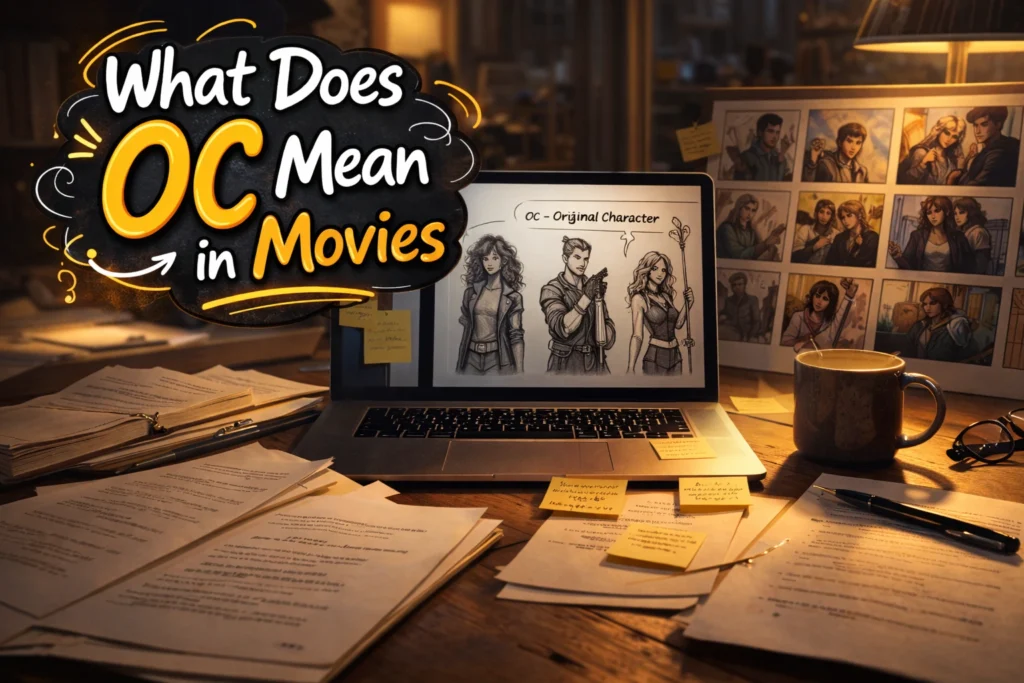
In movies and online discussions, OC stands for Original Character. It refers to a character created by a writer, filmmaker, or fan, rather than one adapted from an existing story, book, or franchise.
OCs are commonly used in fanfiction, creative writing, and movie discussions to describe characters that are entirely unique or self-invented.
Whether you’re a movie enthusiast, a fanfiction writer, or just browsing film forums, you may have come across the term OC multiple times. But what does it really mean in movies, and why is it so widely used? From fan-made characters in popular franchises to original creations in independent films, OCs play a huge role in storytelling, creative discussions, and fan communities.
In this article, we’ll explore everything you need to know about OC in movies—its meaning, origin, real-world usage, examples, and helpful tips for writers and fans alike.
Origin of OC in Movies
The term OC, meaning Original Character, has its roots in online fanfiction communities. Writers on platforms like Archive of Our Own (AO3) and FanFiction.net started using it to differentiate characters they created themselves from established, canonical characters in movies, books, or games.
Over time, the abbreviation OC spread beyond fanfiction to movie discussions, scriptwriting, and character analysis, especially in online forums and social media communities. Filmmakers and screenwriters also use it informally when differentiating between characters created for a new story and those adapted from existing works.
Key points about the origin:
- Emerged in online fanfiction communities in the early 2000s
- OC = Original Character (self-created, not part of the canon)
- Now widely used in both fan communities and professional movie writing
Popularity and Real-World Usage
The popularity of OC comes from its clarity and versatility. It provides a quick way to identify self-created characters while discussing movies, scripts, or fan content.
Where OC is commonly used in movies:
- Fanfiction and fan art: Artists and writers create OCs to explore alternative storylines.
- Scriptwriting and brainstorming: Writers introduce OCs when pitching new characters for original stories.
- Movie forums and social media: Communities discuss OCs to expand fan universes.
Example usage in discussion:
“I really love your OC in the Harry Potter universe! She feels like she belongs there but is completely original.”
Here, OC indicates creativity and originality within an established movie world.
Examples of OC in Movies
To better understand OC, let’s look at examples across popular movie universes:
| Movie Universe | OC Example | Context / Tone |
|---|---|---|
| Marvel Cinematic Universe | A young mutant attending Xavier’s school who is not in the comics | Friendly, imaginative |
| Star Wars | A Jedi padawan with a unique Force ability | Neutral, exploratory |
| Harry Potter | A new student with magical powers interacting with main characters | Positive, creative |
| Lord of the Rings | An elf warrior with a self-contained backstory | Imaginative, neutral |
OCs can be received in a friendly, neutral, or critical tone, depending on how well they fit the story. Overly perfect or unrealistic OCs may be criticized, while well-integrated characters are celebrated.
How OC Differs from Related Terms
Several terms are related to OC but have different meanings. Here’s a comparison:
| Term | Meaning | Difference from OC |
|---|---|---|
| Canon Character | An official character from the movie or book | Canon characters are part of the original story, OCs are invented |
| Mary Sue / Gary Stu | Overly perfect original character | Some OCs become Mary Sues if they are too idealized |
| Fan Character | Character created by fans in a movie universe | Often overlaps with OC but emphasizes fan-created backstory |
| Original Creation | Any character or story element created independently | Broader term, includes OCs but also objects, plots, or worlds |
Knowing these distinctions helps writers and fans discuss characters more accurately.
Alternate Meanings of OC
While OC is mainly used as “Original Character” in movie discussions, it can have other meanings depending on context:
- Overclocked (Tech / Gaming) – Not related to movies
- Orange County (Location / US) – Used in geographical discussions
- Officer in Charge (Professional) – Common in military or law enforcement contexts
In movie communities, OC almost always means Original Character.
Polite and Professional Alternatives
When discussing characters in a professional or academic context, consider using alternatives:
- Original character creation – Clear and formal
- Independent character – Emphasizes self-contained design
- Self-invented character – Friendly and descriptive
These alternatives make your writing more formal while keeping it understandable.
Tips for Using OC in Movies
- Label your OCs clearly: Avoid confusion in fan communities or collaborative writing.
- Provide context: Describe the character’s backstory, role, or abilities.
- Balance traits: Avoid making OCs overly perfect to prevent Mary Sue criticism.
- Interact with canon characters: Meaningful interactions enhance storytelling.
- Respect intellectual property: Ensure your OC doesn’t violate copyrights when placed in established universes.
Common Mistakes When Using OC
- Confusing OCs with canon characters
- Creating overly complex or unrealistic traits
- Making the OC too powerful (Mary Sue effect)
- Neglecting to explain the OC’s origin, motivations, or role
Avoiding these mistakes ensures your OC is engaging and believable.
OC Examples With Context
Here’s a table showing how OCs appear in different scenarios:
| Context | Example | Tone |
|---|---|---|
| Fanfiction | “My OC is a rogue wizard who secretly trained alongside Snape.” | Neutral / creative |
| Movie Pitch | “We could introduce an OC detective to interact with Sherlock Holmes.” | Professional / formal |
| Fan Art | “Here’s my OC painting in the Avatar universe.” | Friendly / positive |
| Forum Critique | “This OC feels unrealistic and overshadows the main cast.” | Critical / dismissive |
These examples illustrate the versatility of OCs and audience perception.
FAQs
1. What does OC stand for in movies?
OC stands for Original Character, a self-created character distinct from the source material.
2. Is an OC the same as a fan character?
Often yes, but not all fan characters are OCs; some may adapt minor traits from canon.
3. Can OCs be used in professional movie scripts?
Absolutely. Original characters are essential in creating fresh, engaging stories.
4. Are OCs always good characters?
Not always. Poorly developed OCs can feel unrealistic or overpowered.
5. Can OCs appear in franchises like Star Wars or Harry Potter?
Yes, fans frequently create OCs to explore alternate storylines.
6. What is a Mary Sue OC?
A Mary Sue OC is an overly perfect original character, often criticized in fan communities.
7. How can I create a strong OC for movies?
Develop a clear backstory, realistic traits, strengths and weaknesses, and meaningful interactions with canon characters.
8. Are there other meanings of OC outside movies?
Yes, including Overclocked (tech), Orange County (location), and Officer in Charge (professional roles).
Conclusion
Understanding OC in movies is essential for fans, writers, and creators. Original characters bring fresh perspectives, creative possibilities, and opportunities for storytelling both in fan communities and professional settings.
Key takeaways:
- OC = Original Character, unique and self-created
- Popular in fanfiction, movie forums, and scriptwriting
- Well-developed OCs are better received than overly perfect ones
- Labeling and providing context improves clarity
- Formal alternatives include “original character creation” or “self-invented character”
By thoughtfully crafting OCs, writers can enrich stories, expand universes, and connect more deeply with audiences. 🌟
Read More Related Articles:
- 5K Meaning in Running: Distance, Training & Tips In 2026
- LB Meaning in Football: From Definition to Real‑World Examples In 2026
- Spanish Meaning of Beautiful: When to Use Each Word in 2026

John Miller is a professional meanings writer at Meanzy.com, specializing in word definitions, internet slang, acronyms, and text abbreviations. He focuses on delivering clear, accurate explanations with practical examples, helping readers easily understand modern digital terms and their real-life usage.