
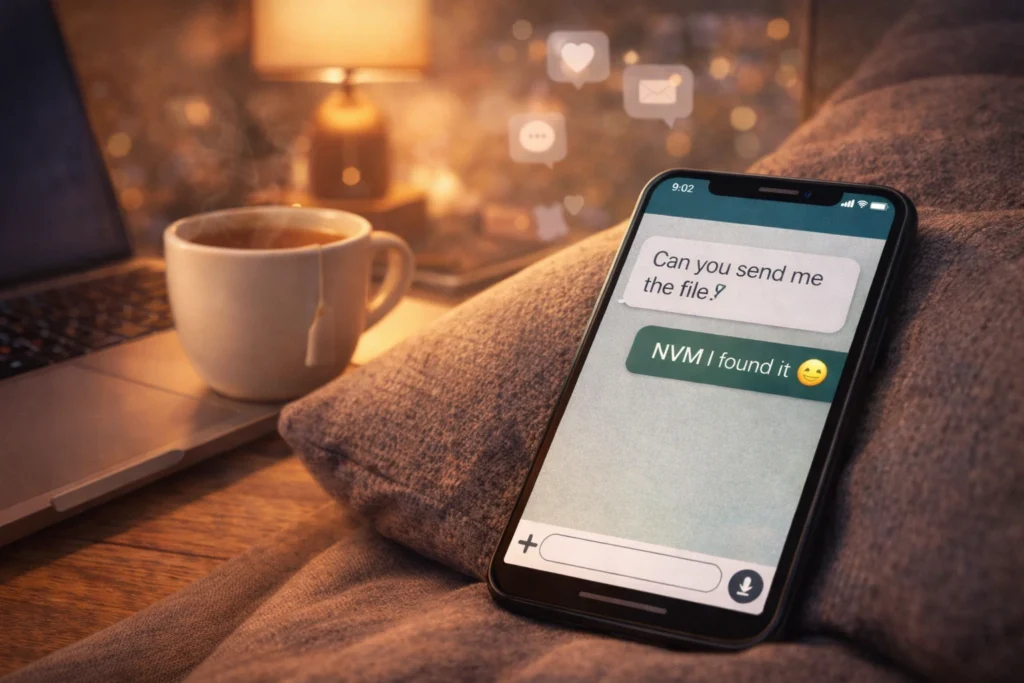
NVM is a texting abbreviation that stands for “Never Mind.”
It is used to cancel a question, dismiss a topic, or indicate that something is no longer important.
Friend: Did you find the file I sent?
You: NVM, I found it in my downloads
Have you ever sent someone a message, asked a question, and then immediately thought, “Actually, never mind”? Instead of typing out the full phrase, most people simply write NVM. If you spend time texting, using social media, or chatting online, you have likely seen this abbreviation many times.
It appears in casual conversations, group chats, gaming chats, and even work-related messages. Yet, despite how common it is, many people still wonder what it truly means, when it is appropriate to use, and whether it can sometimes come across as rude.
Understanding texting abbreviations like NVM is essential in today’s digital world. Not only does it help you communicate more clearly, but it also ensures you avoid misunderstandings. In this guide, we will explore the meaning of NVM, its origin, why it became so popular, how it is used in real-life texting, examples of different tones, comparisons with similar abbreviations, polite alternatives, and frequently asked questions. By the end of this article, you will have a complete understanding of NVM and how to use it confidently.
People typically use NVM when they have solved a problem themselves, when they no longer need help, when they want to drop a subject, or when they have changed their mind. For example, if you are chatting with a friend:
In simple terms, NVM is a way to tell someone that they do not need to respond or focus on the previous message. It is a convenient and quick way to move on in a conversation.
The Origin of NVM in Texting
The abbreviation NVM comes directly from the phrase “Never Mind,” which has been part of the English language for centuries. Traditionally, people would use the full phrase in spoken conversation to indicate that a previous statement or question should be ignored or forgotten.
With the rise of texting and instant messaging in the late 1990s and early 2000s, people began shortening common phrases to save time. This trend was especially common on platforms such as MSN Messenger, AOL Instant Messenger, Yahoo Messenger, and in early online gaming chats. Typing long sentences on small keyboards or early mobile devices was time-consuming, so abbreviations like NVM naturally became popular.
Over time, NVM became one of the most recognizable abbreviations in online chat culture. Today, it is widely used on platforms such as SMS messaging, WhatsApp, Instagram Direct Messages, Snapchat, Discord, and online forums. Its simplicity and versatility are key reasons it remains widely recognized and frequently used.
Why NVM Became So Popular
There are several reasons why NVM has remained popular for over two decades.
First, it saves time. Typing “NVM” is much faster than writing out the full phrase “never mind,” which is especially useful in fast-paced conversations.
Second, it fits naturally with the casual style of texting. Text messages often include abbreviations like LOL, BRB, BTW, and IDK. NVM complements this style perfectly because it is short and easily recognizable.
Third, NVM allows people to quickly end a topic or change the focus of a conversation. Sometimes, you realize that your question has been answered, that your concern is no longer relevant, or that the topic has become unnecessary. NVM communicates this instantly without requiring a long explanation.
Finally, NVM works in many situations. Whether you have solved a problem on your own, changed your plans, or simply decided a topic no longer matters, NVM provides a convenient and universal way to move on.
How NVM Is Used in Everyday Texting
The meaning of NVM is usually consistent, but the tone can change depending on the situation. It can be friendly, neutral, or slightly dismissive, so understanding the context is important.
For instance, if someone solves a problem themselves, they might text:
You: Do you know the WiFi password?
You (later): NVM, I found it on the router
In this case, the tone is neutral and practical.
When someone changes their mind or cancels a plan, NVM is equally useful:
You: Want to watch a movie tonight?
You: NVM, I just remembered I have homework
Here, the tone is casual and normal.
NVM can also be used when someone no longer needs help:
You: Can you send me the meeting link?
You: NVM, someone already sent it
This usage is informative and polite, letting the other person know that assistance is no longer required.
Finally, NVM can reflect slight frustration or embarrassment:
You: Wait, how do you open this file?
You: NVM… figured it out
This example shows that NVM is flexible and can adapt to different conversational moods.
Example Table: How NVM Is Used in Text Conversations
| Situation | Text Conversation | Tone |
|---|---|---|
| Found the answer | “NVM I figured it out.” | Neutral |
| Changed plans | “NVM I can’t come tonight.” | Casual |
| Question cancelled | “NVM don’t worry about it.” | Polite |
| Mild frustration | “NVM it’s not working anyway.” | Slightly negative |
| Mistaken message | “NVM wrong chat 😅” | Friendly |
This table demonstrates how versatile NVM can be in everyday communication.
Tone Differences of NVM
While NVM generally means the same thing, the tone can vary significantly depending on punctuation, additional words, or emojis.
A friendly tone can be achieved by adding emojis or playful wording:
NVM, I found it 😂
A neutral tone simply conveys the message without extra emotion:
NVM, I fixed it
A dismissive tone might come across as abrupt or rude:
NVM, forget it
Because texting lacks voice tone and facial expressions, these small differences in wording or punctuation can significantly affect how your message is interpreted.
Example Table: Friendly vs Rude Usage
| Message | How It Feels | Explanation |
|---|---|---|
| “NVM I found it thanks!” | Friendly | Shows appreciation |
| “NVM I solved it.” | Neutral | Provides an update |
| “NVM forget it.” | Slightly rude | Can feel dismissive |
| “NVM lol I was confused.” | Friendly | Adds humor |
| “NVM don’t worry.” | Polite | Reassures the recipient |
Adding context, emojis, or a friendly tone word can make NVM feel warmer and less abrupt.
NVM Compared with Similar Abbreviations
Many texting abbreviations have overlapping purposes, but they are not interchangeable. Understanding the differences can prevent miscommunication.
For example, IDC (I don’t care) expresses a lack of concern, while NVM (Never Mind) cancels a question or indicates that something is no longer relevant. IDK (I don’t know) expresses uncertainty, while JK (Just Kidding) clarifies a joke.
Here is a comparison table for clarity:
| Abbreviation | Meaning | When It Is Used |
|---|---|---|
| NVM | Never mind | Canceling a question or topic |
| IDC | I don’t care | Showing lack of concern |
| JK | Just kidding | Clarifying a joke |
| IDK | I don’t know | Expressing uncertainty |
| BRB | Be right back | Temporarily leaving chat |
For instance, IDK shows you are unsure, but NVM communicates that the topic is no longer important.
Example:
IDK where the file is.
NVM, I found it.
When You Should Avoid Using NVM
While NVM is widely accepted in casual conversations, it is not always appropriate.
In professional communication, using NVM may appear too informal. Instead of texting “NVM, I found the report,” a better option is to write “Never mind, I located the report. Thank you.”
NVM should also be avoided in serious discussions or emotional conversations. If someone wants to discuss a sensitive topic, replying with “NVM” might feel dismissive or hurtful.
In formal writing, such as emails or academic work, texting abbreviations like NVM are considered inappropriate and unprofessional.
Polite Alternatives to NVM
Sometimes a clearer or more polite message is more effective. Here are some alternatives:
| Alternative Phrase | When To Use |
|---|---|
| Never mind, I figured it out | Professional or polite situations |
| It’s okay, I solved it | Friendly conversation |
| Don’t worry about it | Reassuring someone |
| I found the answer already | Informational updates |
| Thanks, I managed to fix it | Appreciative tone |
These alternatives help you communicate the same idea while keeping the tone friendly and professional.
Other Possible Meanings of NVM
While NVM almost always means “Never Mind” in casual texting, it can have other meanings in different contexts.
In computing, NVM stands for Non-Volatile Memory, a type of storage that retains data even when the device is turned off. Solid-state drives, for example, use NVM technology.
In rare cases, NVM can also be used as a shorthand for Nevada, but this is uncommon. In texting, the meaning is overwhelmingly “Never Mind.”
Practical Tips for Using NVM Correctly
If you want your messages to feel natural, polite, and clear, keep these tips in mind.
Add context when possible. Instead of writing only NVM, include a short explanation. For example, “NVM, I found the answer online.”
Avoid sounding abrupt. Short messages without context can come across as cold. Instead, try adding words like “thanks” or “sorry.” For example, “NVM, thanks though.”
Use emojis in casual conversations to soften the tone. For example, “NVM, I fixed it 😅” feels friendly and light-hearted.
Avoid using NVM in professional emails or formal communication. Write the full phrase “never mind” or explain the situation clearly instead.
Consider the tone of the conversation. If someone is helping you or providing important information, showing appreciation or acknowledgment makes your use of NVM feel respectful.
FAQs
What does NVM mean in texting?
NVM means “Never Mind.” It is used when a question, request, or topic is no longer important or needed.
Is NVM rude in messages?
NVM is usually neutral, but it can sound slightly rude if used alone without context. Adding words like “thanks” or an emoji can make the message feel friendlier.
Is NVM the same as Never Mind?
Yes. NVM is simply the shortened version of the phrase “Never Mind” used in texting and online conversations.
Why do people use NVM instead of typing the full phrase?
People use NVM because it is faster and fits naturally with the informal style of texting.
When should you avoid using NVM?
You should avoid using NVM in professional emails, formal writing, or sensitive conversations where the abbreviation might seem dismissive.
What is the difference between NVM and IDC?
NVM means “Never Mind,” indicating a topic is no longer relevant. IDC means “I don’t care,” which expresses a lack of interest or concern.
Can NVM be used in professional communication?
It is better to avoid NVM in professional communication. Writing the full phrase “Never Mind” or explaining the situation clearly is more appropriate.
Does NVM have other meanings?
Yes. In technical fields, NVM can stand for Non-Volatile Memory, a type of computer storage. In casual texting, however, it almost always means “Never Mind.”
Conclusion
Abbreviations like NVM have become a natural part of modern digital communication. It is short, convenient, and instantly understood by most people online.
In simple terms, NVM means “Never Mind” and is used when someone cancels a question, solves a problem themselves, or decides a topic is no longer important. While it is perfectly acceptable in casual conversations, context and tone matter. Adding a few extra words or a friendly emoji can make your message feel warmer and more polite.
Understanding abbreviations like NVM helps you communicate more clearly in texting, social media, online gaming, and other digital platforms. Next time you see NVM in a conversation, you will know exactly what it means and how to respond appropriately.
Read More Related Articles:
- What Does KMA Mean in Text: Definition and Usage In 2026
- What Does ^ Mean in Texting: Here’s What It Means In 2026
- What Does Offsides Mean in Football? Football’s Most Misunderstood Rule In 2026

Megan Foster is a thoughtful and creative content creator at Meanzy.com with a strong curiosity for language and communication. Known for her clarity and attention to detail, she simplifies confusing slang, acronyms, and modern terms into easy, relatable meanings readers can trust.