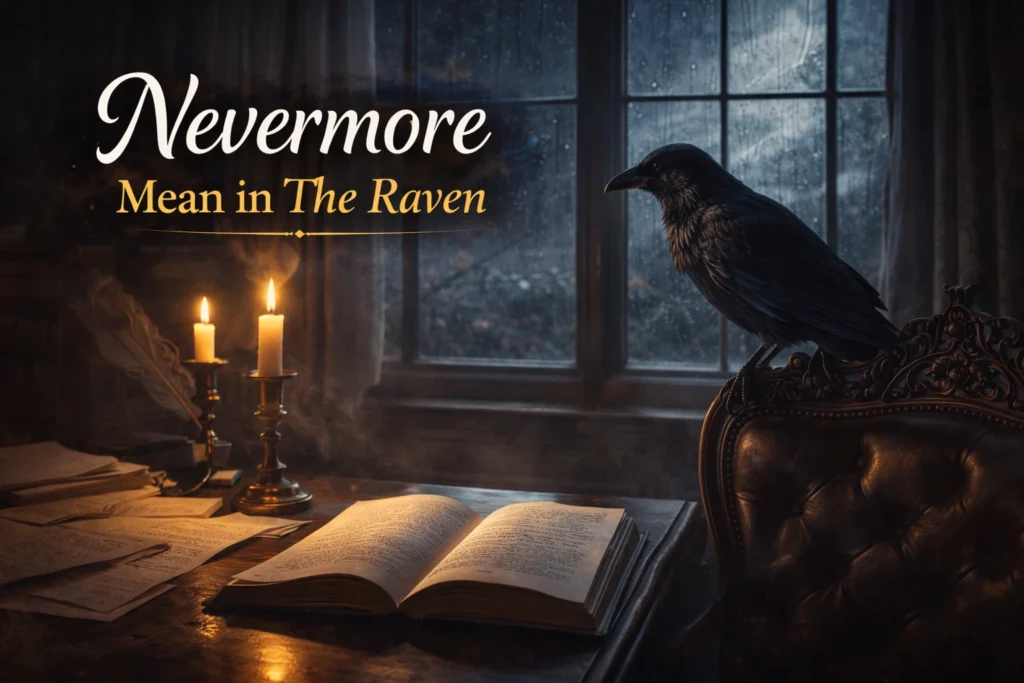
“Nevermore” is a haunting and melancholic word famously used in Edgar Allan Poe’s poem The Raven to signify finality, loss, and the impossibility of reclaiming what is gone.
In the poem, it is the only word spoken by the mysterious raven, echoing the narrator’s despair and grief.
Edgar Allan Poe’s The Raven has captivated readers for over a century, and the word nevermore remains one of the most recognizable expressions in English literature. But what does it truly mean in the context of the poem, and why has it resonated so deeply with readers worldwide? In this article, we’ll explore its origin, literary significance, examples, and real-world usage.
Origin of “Nevermore” in The Raven
The word nevermore has roots in archaic English, formed by combining “never” and “more” to emphasize permanence or irreversibility. While it existed before Poe, he elevated it to literary immortality.
- Historical Use: In older texts, nevermore was occasionally used in poetry and religious writings to indicate a sense of permanent ending or eternal denial.
- Poe’s Innovation: In The Raven (1845), Poe gave the word a rhythmic, almost musical quality, repeating it at key emotional moments to mirror the narrator’s despair.
Example from The Raven:
“Quoth the Raven, ‘Nevermore.’”
Here, the repetition transforms a simple word into a symbol of hopelessness and finality.
The word’s haunting resonance comes not only from its meaning but from its placement and repetition in the poem, creating a sense of inevitable doom.
Popularity and Real-World Usage
Nevermore gained instant popularity after The Raven’s publication and remains a cultural reference in literature, music, film, and even everyday speech.
- Literature: Many writers and poets reference nevermore when depicting irreversible loss or grief.
- Music: Artists across genres have used nevermore in song lyrics to convey heartbreak or permanent separation.
- Pop Culture: The word appears in movies, TV shows, and memes to evoke mystery, melancholy, or Gothic style.
Table: Examples of Nevermore in Modern Contexts
| Context | Example Use | Tone/Emotion |
|---|---|---|
| Literature | “The love I had for you is nevermore.” | Melancholy/Grief |
| Music | Song lyrics referencing ‘nevermore’ | Dramatic/Heartbroken |
| Social Media | Meme: “Me going outside? Nevermore.” | Humorous/Dismissive |
| Pop Culture | Movie quotes referencing Poe | Mysterious/Gothic |
Understanding the Meaning in Poe’s Poem
In The Raven, nevermore functions as a refrain that highlights:
- Finality: The narrator’s hopes of reuniting with his lost love, Lenore, are crushed.
- Hopelessness: Each repetition emphasizes despair and emotional stagnation.
- Psychological Impact: The word haunts the narrator, reflecting human struggle with grief and denial.
Unlike casual usage of “never” or “no more,” nevermore carries a poetic and eerie resonance. It is not just denial but a permanent, unchangeable refusal—forever and irreversibly.
Literary Tone Tip: Nevermore evokes a somber, Gothic tone, making it perfect for horror, mystery, and melancholic poetry.
Examples with Context
Here are some examples of how nevermore can be used with different tones:
| Example Sentence | Tone | Notes |
|---|---|---|
| “After losing his job, he felt his joy would return nevermore.” | Melancholy | Reflects permanent loss |
| “When asked about the forgotten project, she said nevermore with a smile.” | Neutral/Firm | Simple denial |
| “Me going back to that drama-filled party? Nevermore!” | Humorous/Playful | Casual, dismissive usage |
Adding context and tone ensures the word does not sound archaic or overly formal in modern usage.
Comparison With Related Terms
| Word | Meaning | Difference from Nevermore |
|---|---|---|
| Never | Not ever | Basic negation; lacks poetic or Gothic tone |
| No more | No longer | Less dramatic; common in everyday speech |
| Forevermore | For all time, eternally | Positive or neutral; lacks despair nuance |
| Evermore | Always, continuously | Often positive or reflective |
Nevermore is uniquely suited for expressing despair, hopelessness, or gothic melancholy, unlike the more neutral terms above.
Alternate Meanings
While its primary literary use in The Raven is melancholic, nevermore can also convey:
- Humor: Playfully refusing something forever (modern slang use).
- Formality: Archaic legal or literary writing to indicate permanence.
- Philosophical Reflection: Contemplating irreversible actions or life events.
Professional or Polite Alternatives:
If you want to replace nevermore in writing or speech for clarity:
- “No longer”
- “Not anymore”
- “For the foreseeable future, not possible”
Practical Usage Tips
- In Writing: Use nevermore in poetry, Gothic fiction, or dramatic narrative to emphasize permanence or despair.
- In Speech: Suitable for playful exaggeration or literary flair.
- Tone Awareness: Ensure your audience understands the word’s dramatic weight—using it casually can be humorous or ironic.
FAQs
1. What does nevermore symbolize in The Raven?
It symbolizes finality, hopelessness, and the impossibility of regaining what is lost.
2. Is nevermore a real word outside Poe’s poem?
Yes, it existed in archaic English, but Poe popularized its literary usage.
3. Can I use nevermore in everyday speech?
Yes, though it sounds poetic or dramatic. Modern use is often playful or ironic.
4. How is nevermore different from never?
“Nevermore” has a poetic and Gothic resonance, while “never” is plain and neutral.
5. What tone does nevermore create?
It typically creates a somber, melancholic, or haunting tone.
6. Are there modern pop culture references to nevermore?
Yes, it appears in films, songs, memes, and even video games as a Gothic or mysterious reference.
7. Can nevermore be used humorously?
Absolutely! Modern slang sometimes uses it to playfully refuse or exaggerate denial.
8. Is there a plural form of nevermore?
No, it is an adverb and cannot be pluralized.
Conclusion
Nevermore is far more than just a word in a poem. It embodies the haunting sorrow of loss, the eerie permanence of despair, and the literary brilliance of Edgar Allan Poe. Whether you use it to reference literature, express dramatic refusal, or add poetic flair to your writing, nevermore carries a weight that resonates deeply across generations.
By understanding its origin, literary significance, and modern applications, you can use nevermore effectively while appreciating its rich Gothic roots. Remember, the next time you echo nevermore, you are connecting with over 175 years of literary tradition and human emotion.
Read More Related Articles:
- What GG Means in Texts: Ultimate Beginner-Friendly Guide (2026)
- Matthew Meaning in the Bible: Rooted in Faith & Divine Gift (2026)
- BYT Meaning in Text Messages: How to Use It Correctly (2026)

John Miller is a professional meanings writer at Meanzy.com, specializing in word definitions, internet slang, acronyms, and text abbreviations. He focuses on delivering clear, accurate explanations with practical examples, helping readers easily understand modern digital terms and their real-life usage.