
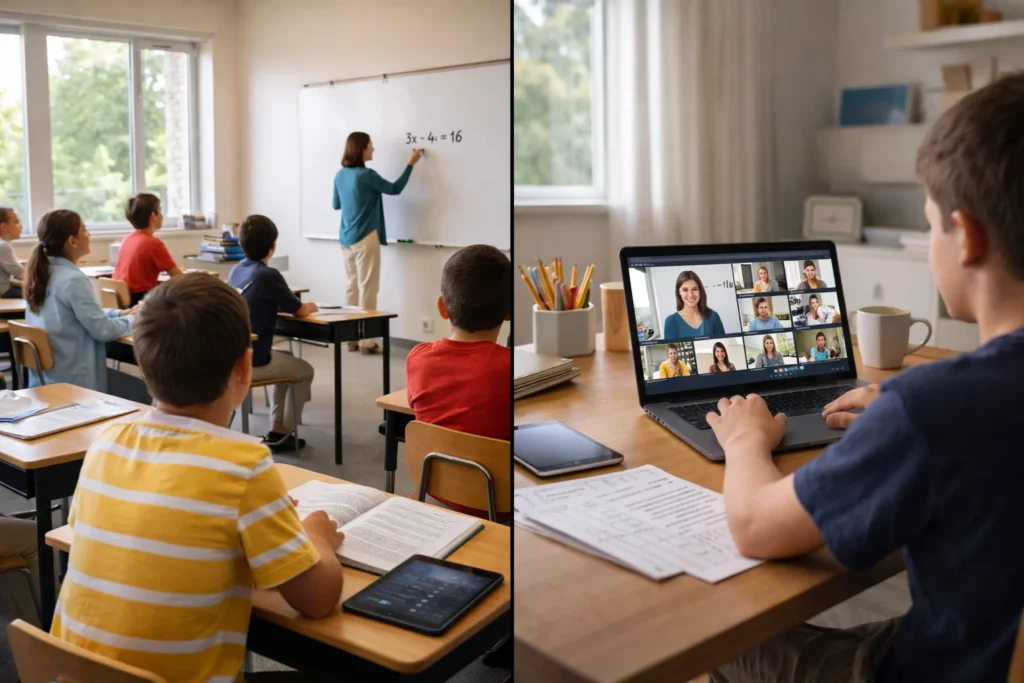
Hybrid in school refers to a learning model that combines in person classroom instruction with online or remote learning. Students attend school physically on certain days and complete the rest of their coursework through digital platforms from home. This flexible approach blends traditional teaching with modern technology.
If you have heard a school say, “We’re switching to a hybrid model,” you might wonder what that really means for students, parents, and teachers. Is it online school? Is it regular school? Or something in between?
The answer is simple but important.
Hybrid schooling is a mix of both.
In recent years, especially after the global impact of COVID 19, hybrid learning has become more common in education systems around the world. From elementary schools to universities, many institutions now use hybrid classrooms to offer flexibility, safety, and personalized learning options.
Let’s break it down clearly and practically.
What Does Hybrid Mean in School?
In simple words, hybrid school means students learn partly in a physical classroom and partly online.
A hybrid schedule usually looks like this:
- Students attend school in person on certain days of the week
- Students complete assignments or attend virtual classes on other days
For example:
- Monday and Wednesday in school
- Tuesday and Thursday online
- Friday independent work at home
This format combines face to face interaction with digital learning tools like:
- Zoom or Google Meet
- Learning management systems
- Online assignments
- Recorded lectures
Hybrid learning is sometimes also called:
- Blended learning
- Mixed mode learning
- Flexible learning
Although there are slight differences between these terms, they are often used interchangeably.
Origin of the Term Hybrid in Education
The word hybrid originally comes from biology. It describes something made by combining two different elements, such as hybrid plants or hybrid animals.
Later, the term expanded into other industries:
- Hybrid cars combine gasoline and electricity
- Hybrid work combines office and remote work
- Hybrid events combine physical and virtual attendance
In education, hybrid learning gained attention in the early 2000s when schools started integrating technology into classrooms. However, it became widely popular during the COVID 19 pandemic when schools had to quickly adapt to safety restrictions.
Today, hybrid education is not just a temporary solution. Many schools continue using it because it offers flexibility and innovation.
Why Hybrid Learning Became Popular
Hybrid schooling became popular for several reasons:
1. Health and Safety
During global health crises, schools needed ways to reduce large gatherings. Hybrid schedules helped limit the number of students in classrooms at one time.
2. Flexibility
Students who:
- Travel frequently
- Participate in sports
- Have medical needs
- Prefer self paced learning
benefit from a flexible schedule.
3. Technology Growth
With tools like Google Classroom and Microsoft Teams, online education became more practical and accessible.
4. Personalized Learning
Hybrid models allow teachers to:
- Record lessons
- Provide extra digital resources
- Offer one on one support
How Hybrid School Works in Real Life
There is no single format for hybrid schooling. Schools design models that fit their needs.
Here are common types:
Table 1: Common Hybrid School Models
| Hybrid Model | How It Works | Example Schedule |
|---|---|---|
| Rotational Model | Students rotate between in person and online days | Group A attends Mon Wed, Group B attends Tue Thu |
| Flex Model | Most instruction online with optional in person support | Online classes daily, in person tutoring available |
| Split Week Model | Fixed days in school and fixed days at home | Mon Tue in school, Wed Thu online |
| Alternate Week Model | One week in person, one week remote | Week 1 classroom, Week 2 online |
Each model serves different needs based on:
- School size
- Student age
- Available technology
- Teacher resources
Hybrid vs Traditional vs Online School
Many people confuse these terms. Let’s clarify.
Table 2: Hybrid vs Traditional vs Online School
| Feature | Traditional School | Hybrid School | Online School |
|---|---|---|---|
| In person classes | Yes | Yes partially | No |
| Online classes | Rare | Yes | Fully |
| Face to face interaction | High | Moderate | Low |
| Flexibility | Limited | Moderate | High |
| Technology use | Basic | Integrated | Essential |
Key Differences
Traditional school means students attend in person every day.
Online school means students learn entirely through digital platforms without attending a physical classroom.
Hybrid school sits in the middle.
Examples of Hybrid in School Conversations
Understanding tone helps you use the term correctly.
Friendly Tone
“We’re doing hybrid school this semester, so I only go in twice a week 😊”
This sounds positive and flexible.
Neutral Tone
“Our district adopted a hybrid learning model for the academic year.”
This is informational and professional.
Slightly Frustrated Tone
“Hybrid school is confusing sometimes because the schedule keeps changing.”
This shows mild dissatisfaction.
Tone depends on context and personal experience.
Benefits of Hybrid School
Hybrid learning offers several advantages.
Students
- Flexible schedule
- Reduced commute time
- Opportunity to replay recorded lessons
- Better time management skills
Parents
- More involvement in learning
- Reduced daily transportation needs
Teachers
- Use of creative digital tools
- More structured content delivery
Challenges of Hybrid School
It is not perfect.
Common Concerns
- Technology issues
- Internet access problems
- Reduced social interaction
- Self discipline requirements
Some students thrive in hybrid environments. Others prefer full classroom structure.
Example Weekly Hybrid Schedule
Table 3: Sample Middle School Hybrid Schedule
| Day | Mode | Activities |
|---|---|---|
| Monday | In Person | Math, Science labs |
| Tuesday | Online | Recorded lessons, assignments |
| Wednesday | In Person | Group projects, discussion |
| Thursday | Online | Virtual class sessions |
| Friday | Online Independent | Homework, revision |
This combination allows:
- Hands on learning in school
- Independent study at home
Alternate Meanings of Hybrid in Education
Although hybrid usually refers to a mixed learning format, it can also mean:
- Hybrid degree programs at universities combining campus and remote study
- Hybrid classrooms where some students attend physically while others join live online simultaneously
In rare cases, hybrid can refer to interdisciplinary courses combining subjects like science and art.
Professional Alternatives to the Term Hybrid
If you want a more formal expression, you can say:
- Blended learning model
- Mixed delivery format
- Integrated learning system
- Combined instructional approach
These alternatives may sound more polished in academic writing or reports.
Is Hybrid Learning Effective?
Research suggests hybrid education can be effective when:
- Teachers are properly trained
- Students have reliable internet access
- Course materials are well organized
Success depends less on the format and more on execution.
Students who are self motivated often perform well in hybrid settings.
Hybrid Learning in Universities
Many universities now offer hybrid programs.
Students might:
- Attend lectures in person
- Submit assignments online
- Watch recorded content anytime
This is especially common in graduate programs and professional certifications.
Hybrid formats support working adults who need flexibility.
Practical Tips for Students in Hybrid School
If you are part of a hybrid system, here are helpful tips:
- Keep a clear weekly planner
- Maintain a consistent study routine
- Test your internet connection regularly
- Participate actively in online discussions
- Communicate with teachers if confused
Hybrid learning rewards organization and responsibility.
FAQs
What does hybrid mean in school schedule?
It means students attend school physically on some days and complete online learning on other days according to a set schedule.
Is hybrid school the same as online school?
No. Hybrid includes both in person and online learning, while online school is fully remote.
Why do schools choose hybrid learning?
Schools choose hybrid learning for flexibility, safety, and better integration of technology.
Do students learn better in hybrid school?
It depends on the student. Some perform better due to flexibility, while others prefer structured in person learning.
What are the disadvantages of hybrid learning?
Common disadvantages include internet issues, less social interaction, and the need for strong time management skills.
Is hybrid learning permanent?
Many schools continue using hybrid models even after emergencies because of their flexibility and efficiency.
Do colleges offer hybrid degrees?
Yes. Many universities offer hybrid degree programs that combine campus attendance with online coursework.
How many days do students attend in hybrid school?
It varies. Some attend two to three days per week in person, while others alternate weekly.
Conclusion
So, what does hybrid mean in school?
It means a blended educational approach that combines in person classroom instruction with online learning.
Hybrid schooling emerged from technological growth and global necessity, but it continues because of its flexibility and efficiency.
It offers:
- Balance between structure and independence
- Integration of digital tools
- Greater adaptability
However, success depends on good planning, reliable technology, and student engagement.
Whether you are a student, parent, or educator, understanding hybrid learning helps you make informed decisions about modern education.
Education is evolving. Hybrid school is one clear example of how tradition and technology can work together.
Read More Related Articles:
- Why God Is Called Lord in the Bible: It’s Significance (2026)
- What GG Means in Texts: Ultimate Beginner-Friendly Guide (2026)
- Code Pink Meaning in Healthcare: What You Need to Know In 2026

Rachel Monroe is a digital content writer at Meanzy.com who focuses on explaining modern words, phrases, and online expressions. Her writing style is simple, practical, and reader-focused, helping users quickly understand the meaning and usage of today’s evolving language.