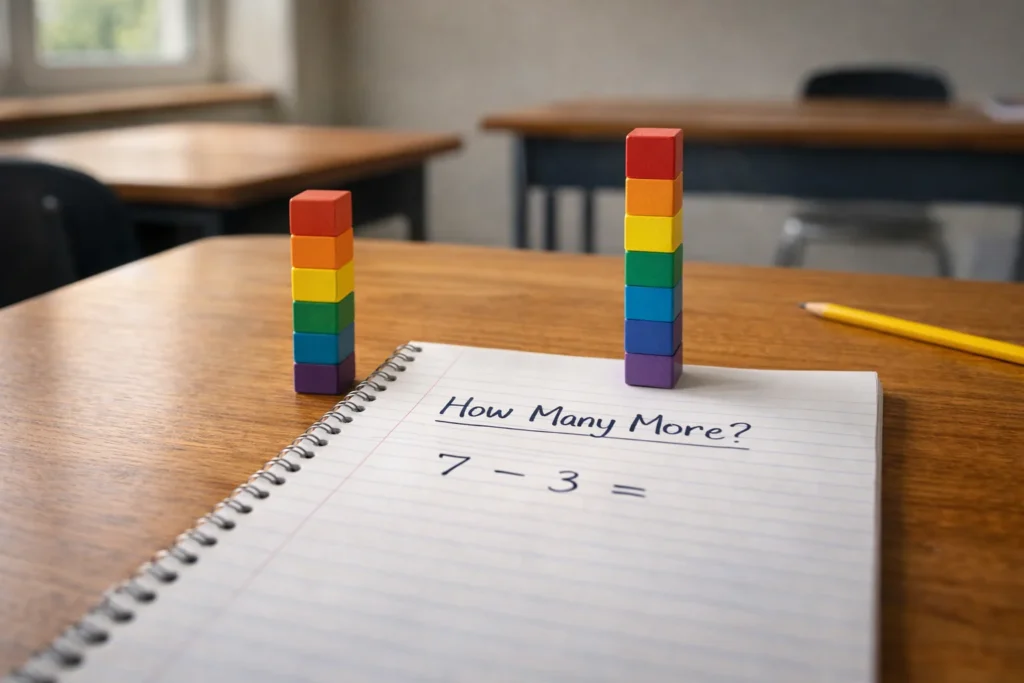
In math, “how many more” means finding the difference between two quantities.
It is a subtraction question that asks how much larger one number is compared to another.For example, if Sara has 12 apples and Ali has 8 apples, the question “How many more apples does Sara have?” means you subtract 8 from 12. The answer is 4.
If you’ve ever helped a child with homework or tried solving word problems yourself, you’ve probably seen the phrase “how many more” again and again.
At first glance, it seems simple. But many students get confused because they don’t immediately recognize it as a subtraction signal. Some think it means addition. Others hesitate because the numbers appear in reverse order.
Understanding what “how many more” means in math is a foundational skill. It helps with:
• Basic subtraction
• Word problem comprehension
• Comparing quantities
• Real life math situations
• Data interpretation and graphs
In this complete guide, we’ll break everything down clearly and practically so you can confidently understand and teach this concept.
What Does “How Many More” Mean in Math?
In math, “how many more” is a comparison phrase that indicates subtraction.
It asks:
What is the difference between two amounts?
It is commonly used in elementary math problems when students are learning how to:
• Compare numbers
• Subtract larger and smaller values
• Understand quantity differences
• Interpret word problems
When you see “how many more,” your brain should immediately think:
Bigger number minus smaller number.
The Origin and Popularity of the Phrase
The phrase “how many more” is not a mathematical invention. It comes from everyday English.
Children use it naturally in conversation:
• “I have 5 candies. You have 2. I have 3 more!”
• “She scored 10 points. He scored 6. She scored 4 more.”
Educators adopted this natural language into math teaching because it helps children connect real life comparisons with mathematical operations.
It became especially popular in early childhood education when math curriculum shifted toward:
• Word problem comprehension
• Real life application
• Conceptual understanding instead of memorization
Today, it is a standard phrase in elementary school textbooks worldwide.
How “How Many More” Works in Word Problems
When solving a “how many more” question, follow these steps:
- Identify the two numbers being compared
- Determine which number is larger
- Subtract the smaller number from the larger number
- State the difference clearly
Basic Formula
Difference = Larger Number − Smaller Number
Example Table 1: Basic “How Many More” Problems
| Situation | Larger Number | Smaller Number | Operation | Answer |
|---|---|---|---|---|
| 12 apples vs 8 apples | 12 | 8 | 12 − 8 | 4 |
| 20 students vs 15 students | 20 | 15 | 20 − 15 | 5 |
| 9 balloons vs 3 balloons | 9 | 3 | 9 − 3 | 6 |
| 50 books vs 35 books | 50 | 35 | 50 − 35 | 15 |
Each of these examples answers the question: How many more?
Real World Usage of “How Many More”
This phrase appears everywhere outside the classroom too.
In Shopping
• “This jacket costs 40 dollars. That one costs 55. How many more dollars is it?”
In Sports
• “Team A scored 85 points. Team B scored 78. How many more points did Team A score?”
In Business
• “This year we made 12,000 in sales. Last year we made 9,500. How many more did we make?”
In Data and Charts
When comparing bar graphs or survey results, “how many more” helps interpret differences.
It is especially useful in:
• Market research
• Inventory management
• Population studies
• Financial comparisons
Tone and Context Examples
Although “how many more” is neutral in math, tone changes depending on context.
Friendly Tone 😊
“I have 10 stickers and you have 7. I have 3 more!”
Neutral Tone
“This company earned 2 million more than last year.”
Slightly Competitive Tone
“Our team scored 12 more points than yours.”
Even though the phrase is mathematically neutral, context can change emotional meaning.
Common Mistakes Students Make
Understanding what “how many more” means in math becomes easier when you know the common errors.
1. Adding Instead of Subtracting
Some students mistakenly add the numbers because they see two values.
Incorrect: 12 + 8
Correct: 12 − 8
2. Subtracting in the Wrong Order
You must subtract the smaller number from the larger one.
If you do 8 − 12, you get a negative number, which usually does not make sense in basic word problems.
3. Ignoring Context
Always identify what is being compared. Numbers must relate to the same category.
Example Table 2: Correct vs Incorrect Interpretation
| Word Problem | Incorrect Method | Correct Method | Correct Answer |
|---|---|---|---|
| Sara has 14 pens. Ali has 9. How many more does Sara have? | 14 + 9 | 14 − 9 | 5 |
| A store sold 30 shirts on Monday and 22 on Tuesday. How many more on Monday? | 22 − 30 | 30 − 22 | 8 |
| One jar has 18 candies and another has 11. How many more in the first jar? | 18 + 11 | 18 − 11 | 7 |
Comparison With Similar Math Phrases
Understanding related terms helps avoid confusion.
1. How Many More vs How Many Fewer
Both indicate subtraction.
• How many more asks how much larger one number is.
• How many fewer asks how much smaller one number is.
The math operation is the same. The perspective changes.
Example:
Sara has 12 apples. Ali has 8 apples.
How many more apples does Sara have?
12 − 8 = 4
How many fewer apples does Ali have?
12 − 8 = 4
Same answer. Different wording.
2. How Many More vs How Many Altogether
This is where confusion often happens.
• How many more = subtraction
• How many altogether = addition
Example Table 3: Comparison
| Phrase | Operation | Example | Answer |
|---|---|---|---|
| How many more | Subtraction | 15 vs 9 | 6 |
| How many fewer | Subtraction | 15 vs 9 | 6 |
| How many altogether | Addition | 15 + 9 | 24 |
| What is the total | Addition | 15 + 9 | 24 |
Alternate Meanings Outside Math
Outside mathematics, “how many more” can simply mean asking about quantity increase.
For example:
• “How many more guests are coming?”
• “How many more episodes are left?”
In these cases, it is not strictly mathematical, but it still refers to counting additional amounts.
Teaching Tips for Parents and Teachers
If you are teaching this concept, here are practical strategies:
• Use physical objects like coins or blocks
• Draw visual models or number lines
• Circle the larger number first
• Underline the phrase “how many more”
• Practice word problem identification
A helpful classroom reminder:
“When you see how many more, subtract to find the score.”
Polite or Professional Alternatives
In formal writing, you might replace “how many more” with:
• What is the difference between
• By how much did X exceed Y
• What is the increase from
• What is the numerical difference
Example:
Instead of:
“How many more units were sold this year?”
You can write:
“What is the difference in units sold compared to last year?”
Visual Strategy: Using a Number Line
Number lines are excellent tools.
If comparing 7 and 12:
Start at 7
Count up to 12
Count the jumps
7 → 8 → 9 → 10 → 11 → 12
That is 5 jumps. So 12 is 5 more than 7.
Why This Concept Is Important for Higher Math
Understanding “how many more” prepares students for:
• Algebraic thinking
• Data comparison
• Ratios and percentages
• Statistical analysis
• Financial literacy
In algebra, for example:
If x is 5 more than y, then
x = y + 5
The simple childhood phrase becomes the foundation for equations.
FAQs
What operation does “how many more” indicate in math?
It indicates subtraction. You subtract the smaller number from the larger number to find the difference.
Is “how many more” always subtraction?
In elementary math word problems, yes. It signals comparison and requires subtraction.
What is the difference between “how many more” and “how many fewer”?
Both use subtraction. The difference is perspective. One focuses on the larger quantity and the other on the smaller.
Why do students confuse “how many more” with addition?
Because they see two numbers in the problem and assume they need to combine them instead of compare them.
Can “how many more” result in a negative number?
In basic word problems, no. You typically subtract the smaller from the larger number to keep the answer positive.
How do you teach “how many more” to first graders?
Use visual aids like blocks, apples, or drawings. Physically show the difference between groups.
Is “how many more” used in algebra?
Yes. It translates into equations like x is 3 more than y, written as x = y + 3.
What is another way to say “how many more”?
You can say “what is the difference,” “by how much,” or “how much greater.”
Conclusion:
Understanding what “how many more” means in math is simple once you recognize one core idea:
It is a comparison question that requires subtraction.
• It asks for the difference between two numbers
• Subtract smaller from larger
• Do not add
• Watch for similar phrases like “how many altogether”
• It is widely used in real life and higher math
Mastering this phrase builds strong foundational math skills and improves word problem confidence.
When you see “how many more,” think difference.
And once you think difference, you already know what to do.
Read More Related Articles:
- What Does Holdings Mean in a Business Name? Complete Guide In 2026
- What Does D/T Mean in Medical Terms: Patient-Friendly Guide In 2026
- What Does Non Reactive Mean in Test Results: Should You Be Concerned?

Megan Foster is a thoughtful and creative content creator at Meanzy.com with a strong curiosity for language and communication. Known for her clarity and attention to detail, she simplifies confusing slang, acronyms, and modern terms into easy, relatable meanings readers can trust.