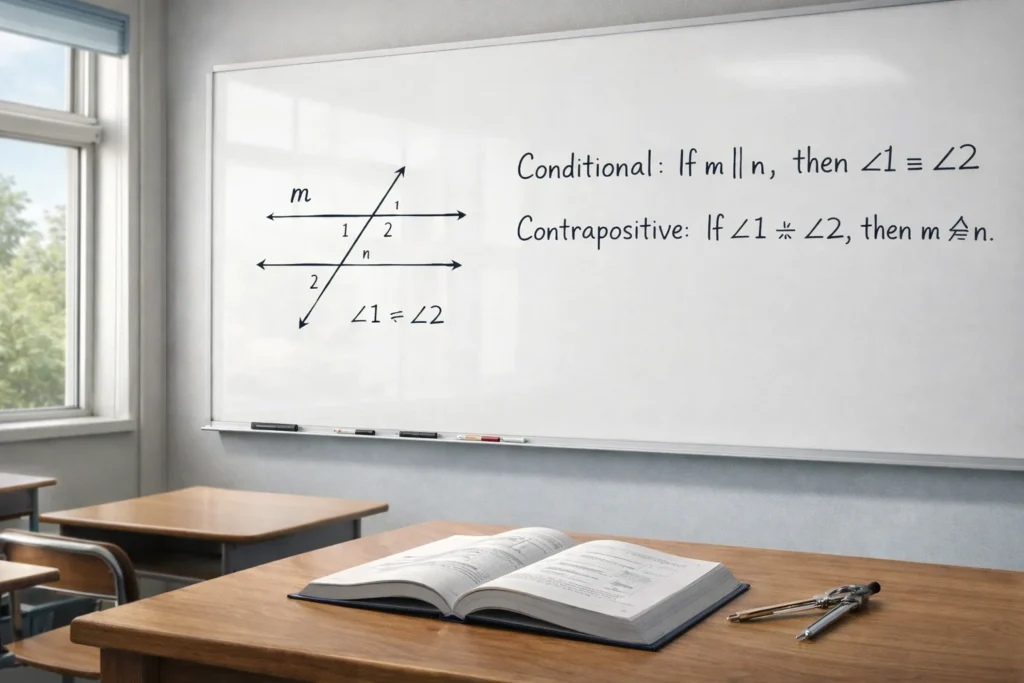
In geometry, the contrapositive of a statement is formed by reversing and negating both the hypothesis and the conclusion of a conditional statement.
A statement and its contrapositive are logically equivalent, meaning they are always either both true or both false.
If the original statement is:
If P, then Q
The contrapositive is:
If not Q, then not P
Understanding the contrapositive in geometry helps students prove theorems more effectively and avoid logical mistakes in reasoning.
Have you ever struggled to prove a geometry statement directly? Sometimes, trying to prove something head on feels confusing or complicated. That is where the contrapositive becomes incredibly useful.
In geometry, logic is everything. Every theorem, postulate, and proof depends on clear reasoning. When you understand what the contrapositive means in geometry, you gain a powerful tool that simplifies proofs and strengthens your logical thinking.
Whether you are a high school student learning formal proofs or preparing for competitive exams, mastering the contrapositive will make geometry far easier and more enjoyable.
Let’s explore it step by step in a simple and friendly way.
What Does Contrapositive Mean in Geometry?
In geometry, most statements are written in conditional form:
If a condition is true, then a result follows.
This is called a conditional statement and has two parts:
- Hypothesis, also called the if part
- Conclusion, also called the then part
The contrapositive flips the structure and negates both parts.
Original statement
If P, then Q
Contrapositive
If not Q, then not P
The key fact you must remember is this:
A statement and its contrapositive are logically equivalent.
That means proving one automatically proves the other.
Breaking It Down With a Simple Geometry Example
Consider this geometry statement:
If two angles are vertical angles, then they are congruent.
Let’s identify the parts:
Hypothesis
Two angles are vertical angles
Conclusion
They are congruent
Now form the contrapositive:
If two angles are not congruent, then they are not vertical angles.
Both statements mean the same thing logically. If one is true, the other must also be true.
Structure of Conditional Statements in Geometry
Here is a clear comparison table to help you visualize the logic:
Table 1: Conditional Statement Forms
| Type of Statement | Structure | Example in Geometry |
|---|---|---|
| Conditional | If P, then Q | If two lines are parallel, then they never intersect |
| Converse | If Q, then P | If two lines never intersect, then they are parallel |
| Inverse | If not P, then not Q | If two lines are not parallel, then they intersect |
| Contrapositive | If not Q, then not P | If two lines intersect, then they are not parallel |
Important note:
Only the original statement and the contrapositive are logically equivalent. The converse and inverse may or may not be true.
Origin of the Contrapositive Concept
The idea of contraposition comes from formal logic developed in ancient Greece. Philosophers like Aristotle studied logical structures long before modern geometry textbooks existed.
Later, mathematicians formalized logical reasoning as part of mathematical proof systems. In classical geometry, especially in the tradition of Euclid’s Elements, indirect reasoning and logical equivalence became essential.
Today, contrapositive reasoning is a standard method in:
- High school geometry proofs
- SAT and ACT math sections
- University level mathematics
- Competitive exams
It remains popular because it simplifies complex arguments.
Why the Contrapositive Is So Useful in Geometry
Sometimes proving If P then Q directly is hard. But proving If not Q then not P may be much easier.
This technique is called proof by contrapositive.
Instead of proving the original statement, you prove its contrapositive.
For example:
Original statement
If a number is divisible by 4, then it is even.
Proving this directly is simple. But in geometry, statements can be more complicated.
Consider:
If a quadrilateral is a square, then it has four right angles.
The contrapositive would be:
If a quadrilateral does not have four right angles, then it is not a square.
Sometimes showing something is not a square is easier than proving it is.
Step by Step: How to Write the Contrapositive
Follow these steps:
- Identify the hypothesis P
- Identify the conclusion Q
- Negate both P and Q
- Reverse their order
Let’s see another example.
Original statement
If a triangle is equilateral, then it is isosceles.
1st Step
P = triangle is equilateral
2nd Step
Q = triangle is isosceles
3rd Step
Negate both
Not P = triangle is not equilateral
Not Q = triangle is not isosceles
4th Step
Reverse and rewrite
Contrapositive
If a triangle is not isosceles, then it is not equilateral.
Common Geometry Examples of Contrapositive
Example 1
Original
If two lines are perpendicular, then they form right angles.
Contrapositive
If two lines do not form right angles, then they are not perpendicular.
Example 2
Original
If a figure is a rectangle, then it has four right angles.
Contrapositive
If a figure does not have four right angles, then it is not a rectangle.
Labeled Example Table With Logical Analysis
Table 2: Geometry Contrapositive Examples
| Original Statement | Hypothesis | Conclusion | Contrapositive |
|---|---|---|---|
| If a triangle is equilateral, then all sides are equal | Triangle is equilateral | All sides equal | If not all sides are equal, then triangle is not equilateral |
| If lines are parallel, then corresponding angles are equal | Lines are parallel | Corresponding angles equal | If corresponding angles are not equal, then lines are not parallel |
| If a quadrilateral is a square, then diagonals are equal | Quadrilateral is square | Diagonals equal | If diagonals are not equal, then quadrilateral is not square |
Comparison With Related Terms
Students often confuse contrapositive with converse and inverse. Let’s clarify.
Table 3: Contrapositive vs Converse vs Inverse
| Term | How It Is Formed | Logically Equivalent to Original? |
|---|---|---|
| Converse | Reverse parts | Not always |
| Inverse | Negate both parts | Not always |
| Contrapositive | Reverse and negate both | Always |
Key takeaway:
Contrapositive keeps the truth value of the original statement.
Converse and inverse do not guarantee that.
Tone and Context of Usage
In geometry, the word contrapositive is neutral and academic. It is not emotional or expressive. However, how you use it in explanation can change tone.
Friendly explanation
Let’s prove this using the contrapositive. It will make things much easier.
Neutral academic tone
The theorem is established by proving its contrapositive.
Slightly dismissive tone in conversation
You cannot assume the converse is true. Use the contrapositive instead.
In professional mathematical writing, always keep tone formal and precise.
Real World Applications of Contrapositive Thinking
Contrapositive logic is not limited to geometry. It appears in:
- Computer programming
- Legal reasoning
- Scientific research
- Logical puzzles
For example in law:
If a contract is valid, then it meets legal requirements.
Contrapositive
If it does not meet legal requirements, then it is not valid.
This type of reasoning prevents logical errors.
Alternate Meanings of Contrapositive
Outside mathematics, contrapositive is rarely used in everyday English. It is mainly a formal logic term.
In logic courses, it applies to all conditional statements, not just geometry.
There are no common slang or casual meanings.
Polite or Professional Alternatives in Writing
Instead of repeating contrapositive too often in academic writing, you can say:
- We prove this by contraposition
- Consider the logically equivalent statement
- We argue indirectly
- We establish the equivalent reversed statement
These alternatives keep your writing polished and professional.
Common Mistakes Students Make
Many learners:
- Forget to negate both parts
- Reverse without negating
- Confuse contrapositive with converse
- Assume converse is always true
Remember this formula:
Reverse and negate both.
Not just reverse. Not just negate.
Both.
FAQs
What does contrapositive mean in geometry in simple words?
It means rewriting an if then statement by reversing it and changing both parts to their opposites. The new statement has the same truth value as the original.
Is the contrapositive always true if the original statement is true?
Yes. A statement and its contrapositive are logically equivalent. If one is true, the other must also be true.
How is contrapositive different from converse?
The converse only reverses the statement. The contrapositive reverses and negates both parts. Only the contrapositive guarantees logical equivalence.
Why do teachers use contrapositive in geometry proofs?
Because sometimes proving the original statement directly is difficult. Proving the contrapositive can be simpler and clearer.
What is an example of a contrapositive in geometry?
Original: If two lines are parallel, then alternate interior angles are equal.
Contrapositive: If alternate interior angles are not equal, then the lines are not parallel.
Is contrapositive the same as inverse?
No. The inverse negates both parts but does not reverse them. It is not logically equivalent to the original statement.
Do I need to memorize contrapositive rules?
It is helpful to remember the structure. Reverse and negate both parts. Practice makes it natural.
Can contrapositive be used outside geometry?
Yes. It applies to any logical conditional statement in mathematics, science, law, and reasoning.
Conclusion:
Understanding what contrapositive means in geometry gives you a powerful logical advantage.
- It applies to conditional statements
- You reverse and negate both parts
- It is logically equivalent to the original
- It is extremely useful in proofs
- It prevents logical mistakes
If you ever feel stuck proving a theorem directly, pause and ask yourself:
Can I prove the contrapositive instead?
That simple shift in perspective can transform your entire approach to geometry.
Master this concept, and you will not just memorize geometry. You will truly understand it.
Read More Related Articles:
- What Does OSS Mean in BJJ? More Than Just a Shout In 2026
- What Does PR Mean in Fitness? The Term Everyone Celebrates In 2026
- What Does Waive Mean in NFL? This Guide Explains Everything In 2026

Rachel Monroe is a digital content writer at Meanzy.com who focuses on explaining modern words, phrases, and online expressions. Her writing style is simple, practical, and reader-focused, helping users quickly understand the meaning and usage of today’s evolving language.