
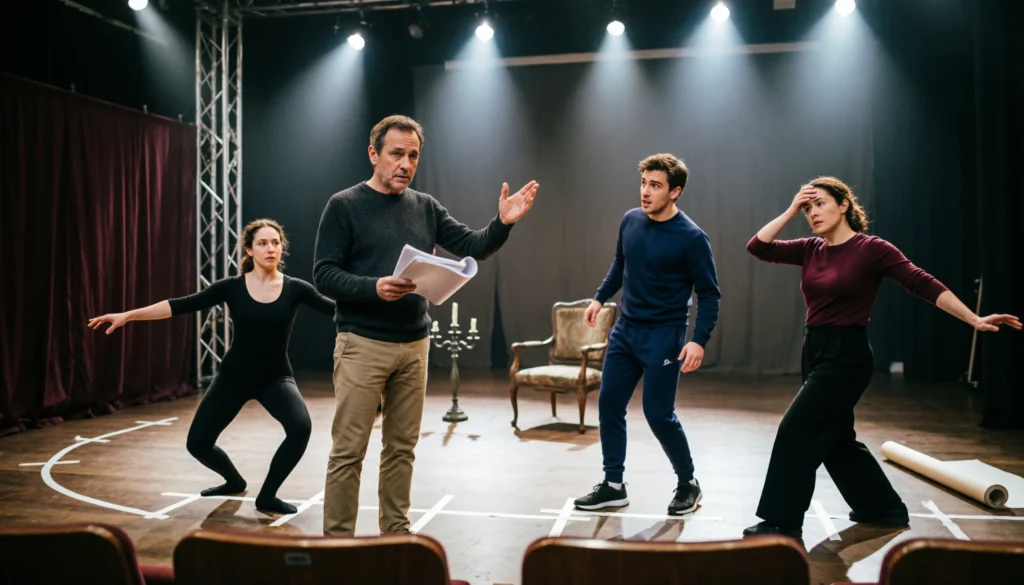
In theatre, blocking refers to the precise staging and movement of actors on a stage during a performance.
It involves deciding where actors stand, when they move, how they interact with each other, and their timing, all to ensure clarity, storytelling, and visual appeal for the audience.
In theatre, every movement on stage is deliberate, every step and gesture tells a story, and every actor’s position matters. This carefully choreographed arrangement is known as blocking, a cornerstone of stagecraft that ensures a performance flows smoothly and visually captivates the audience.
Blocking isn’t just about telling actors where to stand, it’s about guiding the narrative, creating tension, highlighting emotions, and shaping the overall visual composition of a scene.
Whether you’re an aspiring actor, a director, or simply a theatre enthusiast, understanding blocking can transform the way you perceive and create performances. From stage directions to spatial relationships between characters, blocking gives life to scripts and turns written words into compelling, dynamic action.
In this complete guide, we’ll explore the definition of blocking, its key purposes, practical examples from theatre productions, and tips to master this essential element of stagecraft. By the end, you’ll see why blocking is not just a technical requirement—it’s a powerful storytelling tool that can make every scene memorable.
Imagine a theatre stage where actors are frozen, moving randomly, or blocking each other from the audience’s view. Even the most talented performers can appear awkward without guidance. This is where blocking comes in a fundamental tool in theatre that shapes performances, creates visual storytelling, and guides audience attention.
From comedies to dramas, musical theatre to school plays, mastering blocking ensures a performance flows naturally, looks professional, and captivates audiences from start to finish. 🎭
The Origin of Blocking in Theatre
The term blocking originates from early theatrical practices when directors used wooden blocks or markers on the stage floor to indicate where actors should stand. These “blocks” were simple visual guides, helping performers maintain consistency in positioning during rehearsals and live shows.
- Early Usage: In the 19th and early 20th centuries, blocking often appeared as stage directions written in scripts.
- Evolution: Modern blocking is meticulously planned by directors, adapting to stage size, lighting, actor dynamics, and scene requirements.
- Popularity: Blocking gained importance in professional theatre, television, and film, where audience sightlines and camera angles demand precision.
How Blocking is Used in Theatre
Blocking is not just about placing actors on stage—it’s about creating a visual story that engages the audience.
Key Purposes of Blocking
- Enhancing Storytelling: Proper positioning emphasizes relationships, emotions, and key plot moments.
- Improving Visibility: Ensures that actors are always clearly seen by the audience.
- Creating Stage Dynamics: Prevents stagnant performances and adds energy to scenes.
- Timing & Flow: Coordinates movements with dialogue and scene changes for smooth pacing.
Who Plans Blocking?
- Director: Primarily responsible for the creative decisions behind actor movements.
- Stage Manager: Records blocking in the prompt book for consistency during performances.
- Actors: Practice blocking until movements feel natural and fluid.
Examples of Blocking in Theatre
Blocking varies depending on the scene’s tone, genre, and intended effect.
| Scene Type | Example of Blocking | Tone/Effect |
|---|---|---|
| Dramatic scene | Two characters face each other at center stage, stepping apart during a heated argument | Highlights tension and conflict |
| Comedic scene | Characters cross paths repeatedly while delivering lines | Adds humor through timing and positioning |
| Romantic scene | Characters move closer during dialogue, holding hands or exchanging gentle glances | Emphasizes intimacy and emotion |
| Action scene | Actors run across stage, duck behind props, or fight in coordinated patterns | Creates excitement and urgency |
Contextual Examples:
- Friendly tone: In a rehearsal for a comedy, the director blocked the actors to bump into each other repeatedly, creating natural laughter. 😄
- Neutral tone: In a drama, blocking ensured an actor’s back was never to the audience during important dialogue.
- Negative/dismissive tone: Poor blocking can confuse audiences, obscure key actions, or make a scene feel awkward.
Blocking vs Related Terms in Theatre
Several theatre terms are sometimes confused with blocking. Understanding the differences can clarify its purpose:
| Term | Meaning | How It Differs From Blocking |
|---|---|---|
| Stage Directions | Written instructions for movement or position in the script | Blocking is the practical execution of these directions |
| Choreography | Planned dance or movement sequences | Focuses on dance or stylized movement, not dialogue-driven scenes |
| Cue | A signal to perform an action or deliver a line | Cues are moments within blocking, not the full movement plan |
| Sightlines | Audience’s view of the stage | Blocking ensures actors remain visible along sightlines |
Alternate Meanings of Blocking
While in theatre blocking refers to actor movement, the word can have other meanings:
- Sports: Preventing an opponent from advancing (e.g., football or basketball).
- Hair & Fashion: Shaping hair or fabric during styling.
- Technology: Preventing access, such as blocking a user or website.
However, in theatre, blocking always pertains to movement, positioning, and timing on stage.
Polite or Professional Alternatives to “Blocking”
Theatre professionals sometimes use alternatives depending on context:
- Stage Movement: Emphasizes the motion aspect rather than positions.
- Stage Directions Implementation: Refers to executing written script instructions.
- Actor Positioning: Simple and clear for beginners learning stage basics.
Tips for Effective Blocking
- Plan with Purpose: Every movement should enhance storytelling or visual balance.
- Consider Sightlines: Make sure the audience can see faces and actions clearly.
- Use Levels: Incorporate sitting, standing, and dynamic movement for visual interest.
- Integrate Props & Set: Blocking must work around furniture, doors, and scenery.
- Rehearse Repeatedly: Practice ensures movement looks natural.
- Collaborate: Actors, directors, and crew input creates practical and fluid blocking.
Common Blocking Patterns in Theatre
| Pattern Type | Description | Example |
|---|---|---|
| Linear | Actors move along a straight line | Soldiers marching, line of dancers |
| Diagonal | Actors cross stage diagonally | Romantic entrances, dramatic exits |
| Circular | Actors form a circle or semicircle | Group discussions, ritualistic scenes |
| Staggered | Actors at different levels or distances | Adds depth and visual interest |
FAQs
1. What is the main purpose of blocking in theatre?
Blocking guides actor movement and positioning to enhance storytelling, clarity, and scene flow.
2. Who is responsible for blocking a play?
The director typically plans it, the stage manager documents it, and actors rehearse it.
3. Is blocking only for professional theatre?
No, blocking is essential in all performances, from school plays to Broadway productions.
4. Can blocking change during rehearsals?
Yes, directors often adjust blocking based on actor chemistry, stage space, and visual impact.
5. How is blocking recorded for consistency?
Stage managers create a prompt book, detailing each actor’s positions, movements, and cues.
6. What happens if blocking is done poorly?
Poor blocking can confuse the audience, obscure actors, and make the scene awkward.
7. How does blocking differ from choreography?
Choreography is dance or coordinated movement. Blocking covers all stage movement, including acting scenes.
8. Are there tools to help with blocking?
Directors may use floor markers, sketches, software, or rehearsal diagrams to plan blocking.
Conclusion:
Blocking is a cornerstone of theatre, transforming static lines into dynamic, engaging performances. It guides actors, highlights emotions, ensures visibility, and adds depth to storytelling.
Practical Tips:
- Memorize and rehearse blocking until movements are natural.
- Keep audience sightlines in mind at all times.
- Be flexible, adapting movements as scenes evolve.
- Collaborate with actors and stage crew for smooth implementation.
With effective blocking, a performance can captivate audiences, convey emotion, and look polished and professional.
Read More Related Articles:
- Meaning of Phở in Vietnamese: Language, History and Culture In 2026
- Dys Mean in Medical Terms: Definition and Complete Guide In 2026
- Meaning of Nim in Korean: How It’s Used and Why It Matters In 2026

Rachel Monroe is a digital content writer at Meanzy.com who focuses on explaining modern words, phrases, and online expressions. Her writing style is simple, practical, and reader-focused, helping users quickly understand the meaning and usage of today’s evolving language.